Just a few years ago, companies built warehouses and production halls with a decade-long horizon in mind. Today, speed and flexibility are winning – more and more Polish businesses are choosing modular solutions that allow them to increase space without locking up capital for years.
The Polish industrial market is booming. In the first three quarters of 2025, gross demand for modern industrial space exceeded 4.54 million square metres, a 19 percent increase year-on-year. Total warehouse and industrial resources surpassed 36 million square metres. E-commerce is the main driver: the online retail market is projected to reach PLN 192 billion by 2028, growing at an average rate of 8 percent annually.
Yet behind these impressive figures lies a fundamental change in corporate strategy. Companies no longer plan huge investments far in advance. Instead, they prefer to expand gradually, reacting to current needs and market signals.
The race against time and capital
– A few years ago, firms were ready to plan large investments with a very long lead time. Today, entrepreneurs are much more cautious about freezing capital for many years. Speed of action, the possibility of phased development and risk limitation are what counts – says Piotr Barżykowski, President of the Management Board of Łukasiuk.
Decisions are rarely made at the ideal moment. Typically, expansion happens when the warehouse is overflowing, production is lagging, and logistics is becoming congested. Then there is no time for calm planning – and that is the easiest path to overpaying for an investment or building a facility that will again prove too small after two years.
Modular solutions gain ground
Increasingly, investors choose staged implementation. First, the space needed here and now is built; subsequent modules can be added as production or orders grow. This approach changes the design philosophy: facilities are planned not only for current needs but for specific future scenarios.
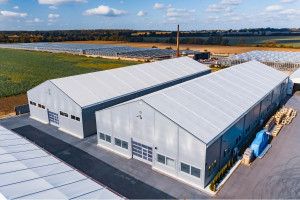
This is where tent halls – used as industrial and logistics facilities – come into play. Many still associate them only with seasonal or temporary storage, but that division has practically disappeared. Such halls are now used year-round in logistics, e-commerce, automotive, agriculture, food processing, recycling, sports and recreation, and even the defence industry.
– In many cases, companies need extra space not 'in three years’, but in three months. That is why modular solutions that can be expanded as the business grows are becoming so important – adds Barżykowski.
Łukasiuk: Polish capital, European reach
Łukasiuk, a Polish-owned company based in Siedlce, has been designing and producing tent halls for over 12 years. Its track record: over 1,000 halls erected, more than 460,000 square metres of built space, and over 850 clients served. In 2025, it was recognised as a Gazela Biznesu and a Diament Forbes laureate, joining the ranks of the most dynamically developing Polish SMEs.
The company competes with international players by offering high-quality construction, customisation, full support from design to after-sales service, and assembly by its own teams. The steel structure comes with a 10-year warranty, and assembly work with a 5-year warranty.
In practice, it is speed and flexibility that increasingly decide which company can seize a market growth moment. Financing is not frozen; space is expanded only when needed. This new investment logic is reshaping Poland’s industrial landscape.
Źródło: WNP.PL, Fot. Materiały prasowe / Łukasiuk