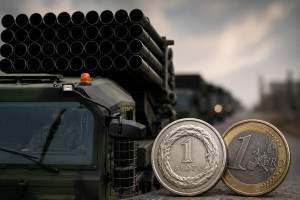
Poland’s public debt has exceeded 2.3 trillion PLN, and the country is embarking on its largest military modernization since the Cold War, financed in part through the EU’s SAFE program denominated in euros. This marks a turning point in the debate about adopting the common currency: the question is no longer ideological but fiscal.
The SAFE program allows the European Commission to raise funds on capital markets backed by the EU’s creditworthiness, then lend to member states for defense spending. For Poland, this means access to cheaper capital than domestic bond markets offer, and with it comes a direct comparison of borrowing costs between national and EU-guaranteed debt.
Former deputy finance minister Piotr Soroczyński, now chief economist at the Polish Chamber of Commerce, notes that Poland is entering a phase of significantly increased exposure to foreign-currency debt. – We are moving into a period of much larger foreign-currency exposure, denominated in euros. There are two natural concerns – he said. The first is the interest rate level on bonds issued by the Commission, which may rise if the ECB hikes rates. The second is exchange rate risk. – If the zloty weakens, servicing this debt becomes more expensive – he added.
The cost of staying outside the eurozone
Former prime minister and central bank chief Marek Belka argues that remaining outside the eurozone carries growing economic and geopolitical costs. – My thesis is simple: Poland derives no significant benefits from staying outside the eurozone. It bears measurable costs and risks – he said during a March conference at Kozminski University.
Belka pointed out that while Poland’s debt-to-GDP ratio is lower than in many Western European countries, it is rising fast. Servicing costs are about 2.5 times higher than in France, creating a snowball effect that accelerates debt accumulation. – The mechanism of debt accumulation works much stronger in Poland than in eurozone countries – he warned.
Marcin Mrowiec, chief economist at Grant Thornton, is more cautious. – Our debt servicing cost depends on the state of public finances. Adopting the euro is not a magic solution – he said. He recalled that Greece’s presence in the eurozone did not prevent a debt crisis.
Own currency as a buffer or a burden?
Piotr Arak, chief economist at VeloBank and former director of the Polish Economic Institute, warns against linking SAFE directly to euro adoption. – The SAFE loan is denominated in euros, but it is a debt instrument, not a political declaration or a procedural step toward ERM II – he stated.
Arak acknowledged that joining the euro could bring savings – about 30-40 billion PLN annually in lower interest costs on 2 trillion PLN of debt. But he stressed that the zloty acts as an automatic stabilizer. – The depreciation of the zloty in 2020 and 2022 cushioned external shocks. Entering the euro without real convergence and without a currency buffer is a recipe for problems known from Southern Europe – he warned.
Despite their differences, all three economists agree on one point: SAFE itself does not determine Poland’s path to the euro. The debate will be shaped by the growing debt, rising financing costs, and the scale of future defense spending. The question is no longer whether Poland should join the euro, but how much staying outside will cost.
Source: WNP.PL, Fot. Shutterstock