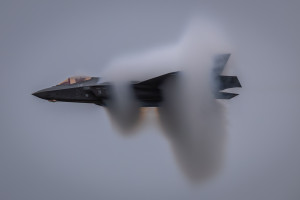
The F-35 program is confronting a severe readiness crisis. According to data from the U.S. Government Accountability Office (GAO), only slightly more than a quarter of America’s F-35A fighters were fully mission capable in 2025. The figure stands at 28.5 percent, and other variants performed even worse.
The report, which covers the entire U.S. fleet of fifth-generation fighters, shows that readiness rates have been declining for years. For the F-35C used by the Marine Corps, full combat capability reached just 22 percent. The F-35B fared even worse with 16.2 percent, while the Navy’s carrier-based F-35C recorded a mere 15.3 percent.
– The readiness levels are alarmingly low, especially for the F-35C and F-35B variants – stated the GAO report published on Monday.
Readiness rates plummet across all variants
An analysis of data from the past five years reveals a steady downward trend. In 2020, the overall full mission capability for all F-35 variants stood at 54 percent. By 2023, the figure for Marine Corps F-35C aircraft had dropped to just 4.6 percent. – The trend over the last five years shows a steady decline in full mission capability – noted analysts at Defense Express, which first reported the findings.
The GAO report indicates that the problem is not limited to one branch of the military. All three U.S. services operating the F-35 – the Air Force, Navy, and Marine Corps – are struggling to keep their jets combat-ready.
Causes: spare parts shortage, corrosion, and cannibalization
The reasons behind the low readiness are multiple. Chronic shortages of spare parts force maintenance crews to resort to so-called cannibalization – stripping parts from one aircraft to keep another flying. Intellectual property restrictions imposed by manufacturers further complicate repairs and the supply chain. – Pilots are spending more time in simulators than in the air because there simply aren’t enough flyable jets – added the Defense Express analysis.
Other factors include corrosion problems that affect airframe durability, delays in software and hardware upgrades, and difficulties in maintaining the complex logistics system. The report also highlights that the F-35’s Autonomic Logistics Information System (ALIS) – later replaced by the Operational Data Integrated Network (ODIN) – has often failed to provide accurate parts forecasting.
Poland’s F-35 program continues despite challenges
Poland, which ordered 32 F-35A fighters under a $4.6 billion contract signed in 2020, is already receiving its first aircraft. Three jets arrived at the 32nd Tactical Air Base in Łask earlier this year. The Polish variant, named “Husarz,” is expected to reach full operational capability by 2029. Despite the U.S. readiness problems, Polish defense officials have expressed confidence that the new jets will significantly boost the country’s air power.
Source: WNP.PL, Fot. Shutterstock/Wirestock Creators