
Poland’s military modernization is not just about buying new equipment; the real challenge and expense lie in maintaining it. The cost of ownership can be three to four times the purchase price, and building domestic repair capabilities has become a strategic priority for Warsaw.
The bill for 32 F-35 fighters came to around 18 billion zlotys (over 500 million per jet), including training, logistics, simulators, and spare engines. Yet each flight hour costs up to 150,000 zlotys, and all major overhauls depend on US facilities. Without a homegrown maintenance ecosystem, Poland risks crippling dependency and skyrocketing long-term costs.
The true cost of defense modernization
Lessons from the war in Ukraine have driven home a brutal reality: advanced weaponry is useless without the ability to repair and sustain it under fire. Analyses by RAND, CSIS, IISS, and the European Defence Agency all stress that in high-intensity conflict, sustainability determines combat effectiveness. Polish purchases from the US and South Korea often neglected to secure domestic industrial participation – a mistake now being urgently corrected.
Building a domestic maintenance ecosystem
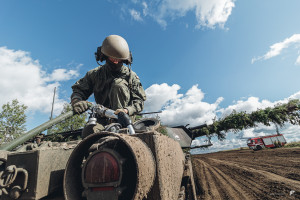
Wojskowe Zakłady Motoryzacyjne (WZM) in Poznań, together with General Dynamics Land Systems (GDLS), are creating a Regional Competence Center for M1 Abrams tanks. A framework agreement signed in May 2025 covers repairs, spare parts, tooling, and technical support. – We are building capabilities that go beyond current operational needs. Our goal is a permanent system for sustaining armored equipment, based on knowledge, technology, and domestic industrial base – said Grzegorz Szkaradek, president of WZM.
Poland as a regional logistics hub
WZM has already completed de-conservation of 116 M1A1 FEP tanks and is processing 100 M1A2 SEPv3 units. A buffer spare parts warehouse is planned to cut repair times. The plant has been audited by US Army and will eventually service not only Polish but also allied Stryker vehicles. These moves position Poland as a key NATO logistics hub in Central and Eastern Europe, transforming the country from a pure buyer of weapons into a sustainment and industrial backbone for the region.
Źródło: WNP.PL, Fot. MON / plut. Anna Wolska


