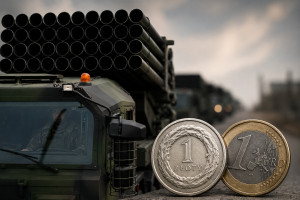
Poland’s public debt has exceeded PLN 2.3 trillion, servicing costs are among the highest in the EU, and the country is launching its largest arms procurement program in decades – financed in euros under the SAFE scheme. This changes the nature of the debate on adopting the common currency: it is no longer a question of ideology but of hard economic calculus.
The SAFE program, designed to support European defence, is becoming a financial test for Poland. The European Commission borrows on markets using the creditworthiness of the entire Union and then lends to member states for military spending. Warsaw can now access capital raised cheaper than some of its domestic bond issues.
According to Piotr Soroczyński, former deputy finance minister and now chief economist at the Polish Chamber of Commerce, Poland is entering a phase of significantly increased exposure to foreign-currency debt denominated in euros. He warns of two main risks: fluctuating interest rates on EU bonds and exchange rate volatility. – If the zloty weakens, both interest payments and eventual principal repayment become more expensive – he said.
The fiscal turning point
Marcin Mrowiec, chief economist at Grant Thornton, stresses that joining the euro zone remains a strategic decision, not a mechanical consequence of borrowing in euros. – Our debt service cost depends on the state of public finances, and adopting the euro is not a magic fix – he argued. He recalled that after the Greek crisis, being inside the euro area did not guarantee cheap financing.
Former prime minister and central bank governor Marek Belka takes a different view. Speaking at a conference in March 2026, he stated that Poland’s security rests on three pillars: a strong army, a robust economy, and reliable alliances. – The common currency has ceased to be merely an economic project, it has become an element of alliance credibility – he said. Belka pointed out that Poland’s debt servicing costs are roughly 2.5 times higher than in France, creating a stronger “snowball effect” on debt accumulation. – My thesis is simple: Poland gains no significant benefits from staying outside the euro zone, while it bears tangible costs and risks – he added.
The price of staying outside
Piotr Arak, chief economist at VeloBank and former head of the Polish Economic Institute, dismisses the idea that SAFE automatically points toward the euro. – Poland has been borrowing in euros for years – through foreign bonds, the SURE program, REPowerEU – and none of that was seen as a commitment to join the euro – he noted. However, he calculates that if Poland’s average bond yield dropped by 1.5–2 percentage points after full portfolio rollover, the annual saving would amount to PLN 30–40 billion.
Yet Arak warns against pushing for the euro solely for fiscal reasons. – The zloty acts as an automatic stabiliser; its depreciation in 2020 and 2022 cushioned external shocks. Entering the euro without real convergence and without the exchange rate buffer is a recipe for the kind of problems seen in southern Europe – he said. He insists that reducing the deficit and improving competitiveness matter more than the currency debate.
Surprisingly, all three economists agree on one point: SAFE alone does not decide Poland’s path to the euro. The disagreement concerns the conclusions to be drawn from rising debt, high funding costs, and future defence spending. Belka sees mounting economic and geopolitical costs of staying out; Arak believes lower financing costs cannot substitute for structural reforms. The question of the euro may return to Polish politics sooner than most politicians assume – not because of Maastricht or Brussels, but because with debt in trillions and defence spending at record levels, ignoring the price of capital becomes increasingly difficult.
Źródło: wnp.pl, Fot. Shutterstock