
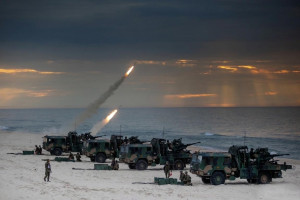
Poland has signed 62 contracts worth around 120 billion zlotys under the first phase of the SAFE program, a record injection of funds for the domestic defense industry. However, despite the celebration, the most difficult challenges for the Polish army and arms manufacturers are just beginning.
The Security Action for Europe (SAFE) program, a European Union response to the equipment gaps exposed by the war in Ukraine, allocates 186.3 billion zlotys in low-interest loans to Poland, with 89 percent destined for over 11,900 Polish companies. The contracts signed recently cover air and missile defense, artillery systems, and ground combat support. Yet the speed of the signing has raised concerns.
– This is the end of that part of the SAFE program. Nothing ends today, much begins. We do not celebrate. We get down to hard work – said Adam Leszkiewicz, president of Polska Grupa Zbrojeniowa (PGZ), the state-owned defense holding.
Industry capacity under scrutiny
The real test lies in execution. Many PGZ subsidiaries are already operating at full capacity, and the new orders force them to expand production lines, hire staff, and maintain quality under immense time pressure. All contracts under SAFE must be completed by 2030.
– This is the first step, maybe even the last before the first. Factories, especially PGZ plants, have reasons to be happy, but risks stem primarily from the industry’s competence – whether it has enough skills to deliver all orders on time and with quality – said Gen. Mieczysław Cieniuch, former chief of the Polish General Staff.
Labor shortages are acute. The defense sector lacks engineers, CNC operators, and specialists in electronics and artificial intelligence. Many experienced workers are leaving for private companies, and new hires often lack qualifications. Automation remains low, with many production steps still manual. Supply chains are fragile, as much of the advanced electronics, composites, and optoelectronics come from outside the EU. A single bottleneck could stall the entire program.
A marathon run at sprint pace
Beyond production, financial and political risks loom. The interest rate on SAFE loans depends on the European Central Bank rate, currently around 3.17 percent. With an initial disbursement of 6.6 billion euros, annual interest could reach 209 million euros, nearly 900 million zlotys. Any further ECB rate hikes would increase the burden. Poland’s defense budget is already strained by previous large-scale purchases, such as K2 tanks and F-35 fighters, and the Ministry of National Defense is renegotiating payment schedules to avoid a debt spike.
– Political disputes can destroy the efficiency of SAFE – warned Gen. Komornicki, a former deputy chief of the General Staff. The pressure to accelerate certification and testing also carries the risk of design flaws and integration problems. Without proper infrastructure, ammunition stockpiles, and trained soldiers, the most advanced equipment may remain unusable. The Polish army is trying to rebuild in four years, but the lack of long-term planning could turn the sprint into a stumble. SAFE is a test of Poland’s industrial capacity, management, and political stability – and the hardest part is only beginning.
Źródło: WNP.PL, Fot. Zoom WP mil pl/Bartosz Bera


