
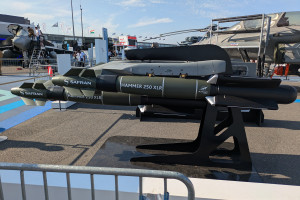
French defence conglomerate Safran is investing over 120 million euros to ramp up production of its AASM Hammer laser-guided bombs. Deliveries to the armed forces are expected to reach 2,000 units by 2027, marking a tenfold increase from 2022 levels.
The AASM Hammer (Armement Air-Sol Modulaire) is a highly precise modular air-to-ground weapon developed over a decade ago for French Air and Space Force fighter jets. The system combines a guidance kit with an integrated propulsion unit attached to a standard bomb, allowing for all-weather operation and extreme accuracy.
Initially exported to India, the weapon gained new strategic importance after Russia’s full-scale invasion of Ukraine. Ukrainian aircraft have been equipped with these munitions, and demand has surged dramatically as Kyiv seeks to strike deep behind enemy lines with minimal collateral damage.
Technology behind the AASM Hammer
The bomb is available in three variants: 250 kg, 500 kg, and 1,000 kg. It features an independent target verification system that does not rely on satellite or GPS signals. When released from high altitude, its range exceeds 70 km with a circular error probability of just 10 meters. At lower altitudes, the range shortens but accuracy improves to within one meter, making it suitable for pinpoint strikes against fortified positions.
– This weapon gives pilots the ability to engage targets with surgical precision, even in contested electronic warfare environments – said a Safran spokesperson.
War in Ukraine drives demand
In 2022, Safran delivered only 200 AASM Hammer bombs. Last year, that number jumped to over 1,400 units. The latest investment will push annual production capacity to 2,000 bombs by 2027. The lightest variant costs approximately $80,000 per unit, which officials describe as a cost-effective solution for high-value targets.
– The scale of the conflict has fundamentally changed our production planning. We are moving from peacetime rates to wartime output – a French defence ministry official commented.
Analysts note that the boost in production reflects broader European efforts to rebuild military stockpiles depleted by transfers to Ukraine and to reduce dependence on non-European suppliers. France has also been increasing domestic production of other munitions, including artillery shells and cruise missiles.
Strategic implications for NATO and Poland
The expansion of AASM Hammer output aligns with NATO’s push for interoperable precision munitions that can be deployed from multiple aircraft types, including Mirage 2000 and Rafale fighters. Poland, which operates F-16s and is acquiring F-35s, has not yet purchased these bombs but could consider them as part of its rapid modernisation programme.
With European defence budgets rising and the war in Ukraine showing no signs of abating, the demand for precisely guided, low-cost air-to-ground weapons is expected to remain high for the foreseeable future. Safran’s increased capacity may also open new export opportunities beyond current clients like India and Ukraine.
Źródło: WNP.PL, Fot. Artville 3.0 / Wikimedia Commons / CC 4.0 BY-SA


