
Just a few years ago, companies built warehouses with a decade in mind. Today, the advantage goes to those who can increase storage space faster without freezing capital for years.
The market has accelerated, and investments have had to change. Until recently, many facilities were designed with a 10–15 year perspective. Now, markets react more dynamically, demand rises or falls quickly, logistics is less predictable, and companies reorganize production or storage much more often. Added to this are rising costs of materials, energy, and construction. The longer the implementation, the greater the risk that the original budget will lose touch with reality.
The numbers confirm this. In the first three quarters of 2025, gross demand for modern industrial space in Poland exceeded 4.54 million m², up 19 percent year-on-year. Total market resources after Q3 surpassed 36 million m². The growth is driven in part by e-commerce. According to available forecasts, the Polish online retail market is expected to reach PLN 192 billion in 2028, growing at an average of 8 percent annually.
– A few years ago, companies were ready to plan large investments far in advance. Today, business owners are much more cautious about freezing capital for many years. Speed of action, the ability to develop in stages, and risk mitigation are what count – said Piotr Barżykowski, President of the Management Board of Łukasiuk.
New approach to industrial construction
Companies rarely start expansion at the ideal moment. Most often, it happens when the warehouse begins to fill up, production can no longer keep pace, and logistics starts to clog. Then there is usually no time for calm planning. Decisions have to be made quickly, which is the simplest path to overpaying for an investment or building a facility that after two years will again prove too small.
Increasingly, investors are opting for phased implementation. First, the space needed here and now is built. Additional modules can be added as production or order volumes grow. The approach to design is also changing. Companies plan a facility not only for current needs but for specific development scenarios. A hall for a seasonal buffer warehouse looks different from one for a plant planning to launch a new production line in two years.
Tent halls gain importance in industry and logistics
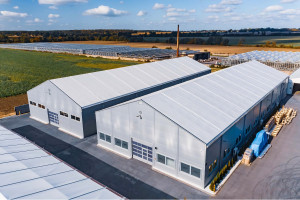
This is why tent halls used as industrial and logistics facilities are playing an increasingly important role. Many people associated them mainly with seasonal storage or temporary structures. Today, this division has practically disappeared. Such halls are used year-round in logistics, e-commerce, automotive, agriculture, food processing, recycling, sports and recreation, and the defense and military sectors. The technology and ability to tailor facilities to a specific industry have changed significantly.
A tent hall can be designed as a high-bay warehouse or a space requiring specific thermal conditions. Depending on the purpose, the facilities are equipped with thermal insulation, heating, ventilation, lighting, industrial gates, and systems to limit condensation. Modularity remains a major advantage. The structure can be expanded without reorganizing the entire plant, and if necessary, moved to another location or repurposed. Where traditional construction can take several months or more, a tent hall can be operational within a few weeks of completing formalities and preparatory work.
– Very often, our clients no longer want to build everything at once at the final scale. They prefer to develop space in stages, alongside business growth. This allows them to maintain greater financial liquidity and the ability to respond to market changes – emphasized Piotr Barżykowski. In logistics and production, the ability to quickly increase space without a multi-year investment process is becoming increasingly important. In many cases, companies need additional space not 'in three years’ but in three months. That is why modular solutions that can be expanded as the company grows are playing such a large role.
Łukasiuk has been designing and producing tent halls for industry, logistics, agriculture, and many other sectors for over 12 years. The company, based on Polish capital with headquarters in Siedlce, carries out investments for both domestic enterprises and clients across Europe. The scale speaks for itself: over 1,000 halls built, more than 460,000 m² of constructed space, and over 850 clients served. In 2025, the company was among the winners of Gazela Biznesu and Diamenty Forbes, joining the fastest-growing Polish SMEs. In a competitive market with a strong presence of foreign companies, Łukasiuk builds an advantage through quality of execution, the ability to adapt facilities to specific applications, and service and support at every stage of the investment, from design to after-sales care. Assembly carried out by its own teams guarantees repeatable standards and quality. Clients receive a 10-year warranty on the steel structure and 5 years on assembly work. In practice, it is speed of action and flexibility that increasingly decide which company will be able to seize a moment of market growth.
Źródło: wnp.pl, Fot. Łukasiuk


