
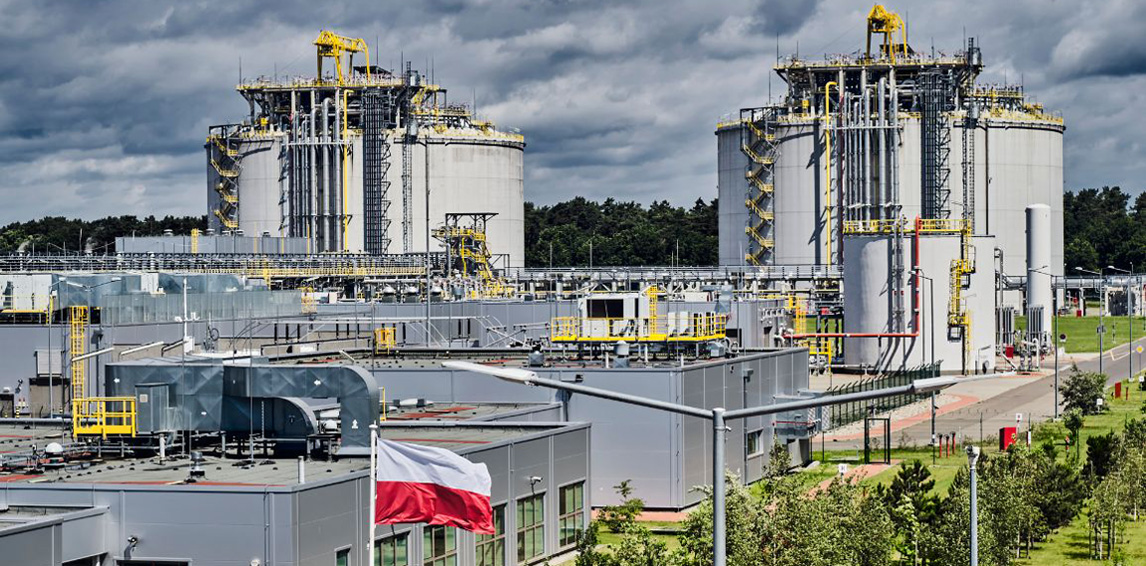
On December 11, 2025, exactly a decade had passed since the first LNG carrier arrived at the terminal in Świnoujście. Over those ten years, 31 million tons of LNG had been delivered to Poland, which after regasification yielded more than 40 billion cubic meters of natural gas, and the number of deliveries handled exceeded 400 calls. Today the terminal covers about 40 percent of domestic gas demand, and in 2025 alone, gas carriers called at the port 81 times, 20 times more than the year before. What started as a strategic decision made in 2006 by the government of Kazimierz Marcinkiewicz became the foundation of Poland’s energy independence and one of the most important infrastructure projects in the country’s modern history.
Before the terminal became a reality, however, Poland had for decades been dependent on natural gas supplies from a single direction, from the east. The Yamal pipeline, through which Russian gas flowed, was practically the only significant source of supply for the country. Every political crisis or trade dispute with Russia meant a real risk to the energy security of Poles. The lack of alternative supply routes made Poland a hostage to Kremlin policy. The need to diversify gas sources became obvious as early as the first decade of the 21st century, but it was only concrete political and investment decisions that would transform this need into tangible infrastructure.
It all began in 2006, when the government of Kazimierz Marcinkiewicz decided to build a gas port in Świnoujście. The investment was recognized by the Council of Ministers as strategic for Poland. In April 2007, the company Polskie LNG was established to carry out this ambitious project. Two years later, in 2009, the formal and legal process began. On February 12, the company received an environmental decision for the marine part of the terminal, and on March 4 for the land part. On July 15, 2009, the Governor of West Pomerania issued a building permit, which became final on August 4. These were crucial steps that opened the way for construction to actually begin.
On July 15, 2010, the contract for the construction of the liquefied natural gas terminal in Świnoujście was signed between the investor, Polskie LNG, and a consortium of contractors. The consortium included Italian companies Saipem and Techint, French Saipem SA, Canadian Snamprogetti, and Polish PBG SA and PBG Export. It was one of the largest engineering undertakings in Poland’s history, requiring coordination of work on land and at sea. On March 23, 2011, the ceremonial laying of the cornerstone for the terminal took place. Construction work started in full swing, and their implementation was supported by funds from the Operational Programme Infrastructure and Environment, which allocated 456 million zlotys for this purpose.
The construction of the terminal did not go without delays and problems. Originally, it was assumed that the gas port would be put into operation in October 2015, but work started with a delay. The Supreme Audit Office in its 2015 report pointed to the risk of delays in the commissioning of the terminal, which could delay the start of LNG supplies from Qatar. Despite these difficulties, the investment was completed. On December 11, 2015, the first gas carrier arrived at the terminal, which was the symbolic culmination of many years of effort. The opening of the terminal was a turning point, from which the diversification of directions and sources of natural gas supplies to Poland became a fact.
The technology that changed the rules of the game. How the LNG terminal works
The LNG terminal in Świnoujście is not just an ordinary port. It is a technologically advanced complex that enables the reception of liquefied natural gas by sea from virtually any direction in the world. Natural gas in liquefied form, at a temperature of about minus 162 degrees Celsius, is brought in on special ships, gas carriers. After mooring at the quay, the LNG is pumped into three cryogenic tanks with a total capacity of 500 thousand cubic meters. There it is stored, awaiting regasification.
The regasification process consists of heating the liquefied gas to a temperature at which it becomes gas again. The gas is then introduced into the National Transmission System, from where it goes to recipients throughout Poland. The terminal also handles a number of other operations, such as loading LNG into road tankers and ISO containers, loading into small and large scale tankers, and bunkering, or refueling ships with LNG fuel. This makes the Świnoujście facility stand out not only for its high utilization rate but also for its growing operational flexibility.
The current regasification capacity of the terminal is 8.3 billion cubic meters per year. The nominal send-out capacity reaches 984 thousand cubic meters of gas per hour, which allows for very efficient introduction of fuel into the system and response to changing recipient demand. In 2025, the entire installation operated at about 98 percent of its technical capacity, placing it among the most utilized installations of this type in Europe. This shows that the terminal not only exists but is intensively used and constitutes a key element of the country’s critical infrastructure.
Expansion and new possibilities. The terminal continues to grow
The LNG terminal in Świnoujście is not a static facility. Between 2019 and 2024, it was expanded, which significantly increased its capabilities. As part of the expansion, a third tank and a second quay were built, which increased the regasification capacity from 6.2 to 8.3 billion cubic meters per year. The expansion also made it possible to handle more gas carriers and manage supplies more flexibly. In 2025, gas carriers called at the terminal 81 times, one-third more than the year before, which is the most visible effect of the increased capacity.
The year 2025 brought the first commercial operation of loading a small-scale tanker at the LNG Terminal in Świnoujście. The LNG was used to fuel a passenger ferry with gas propulsion. This opens up new possibilities for the development of the LNG market in Poland, particularly in the maritime transport segment. The terminal is fully operationally prepared to carry out this type of operation, and the infrastructure is ready.
At the same time, GAZ-SYSTEM is already building a second LNG terminal, a floating FSRU terminal in the Gulf of Gdańsk, which will be commissioned in the first half of 2028. This is another step towards strengthening energy security and building a regional gas hub. Poland, which a decade ago was completely dependent on supplies from a single direction, today is becoming one of the key players on the gas map of Central and Eastern Europe. Minister of Energy Miłosz Motyka emphasizes that these investments will strengthen the economy and cement Poland’s position as a regional leader for decades to come.
Why the terminal changed everything?
The construction of the LNG terminal in Świnoujście radically changed the Polish gas market. First, it made it possible to receive natural gas from anywhere in the world, allowing for the diversification of supply directions and sources. Poland ceased to be a hostage to a single supplier and gained a real choice. Second, the terminal became a key element of energy security, ensuring supply stability even in crisis situations. In 2025, the terminal covered about 40 percent of domestic gas demand. This is a huge change compared to the situation a decade ago.
Third, the terminal affected gas prices. Thanks to the ability to import the raw material from various sources, Poland gained a tool to negotiate better pricing terms. Competition among suppliers translated into greater predictability and price stability. Fourth, the terminal opened the way to building a regional gas hub. Poland, thanks to having its own terminal and an extensive network of connections with neighboring countries, can become a gas distribution center in Central and Eastern Europe. This not only strengthens Poland’s security but also that of the entire region.
Today, ten years after the first delivery, the LNG terminal in Świnoujście is a symbol of energy independence and proof that Poland is capable of implementing ambitious, strategic projects. It is not only a key element of the national transmission system but also motivation for further action, namely increasing regasification capacity through the construction of a floating FSRU terminal in the Gulf of Gdańsk.
As Deputy President of Gaz-System Adam Bryszewski emphasizes, such projects increase independence, ensure stability of energy and heat supply, and build the competitiveness of the economy. The LNG terminal in Świnoujście changed the Polish gas market forever, and its importance will grow with further investments and the development of the LNG market in Europe.
Photo: Gaz-System




