
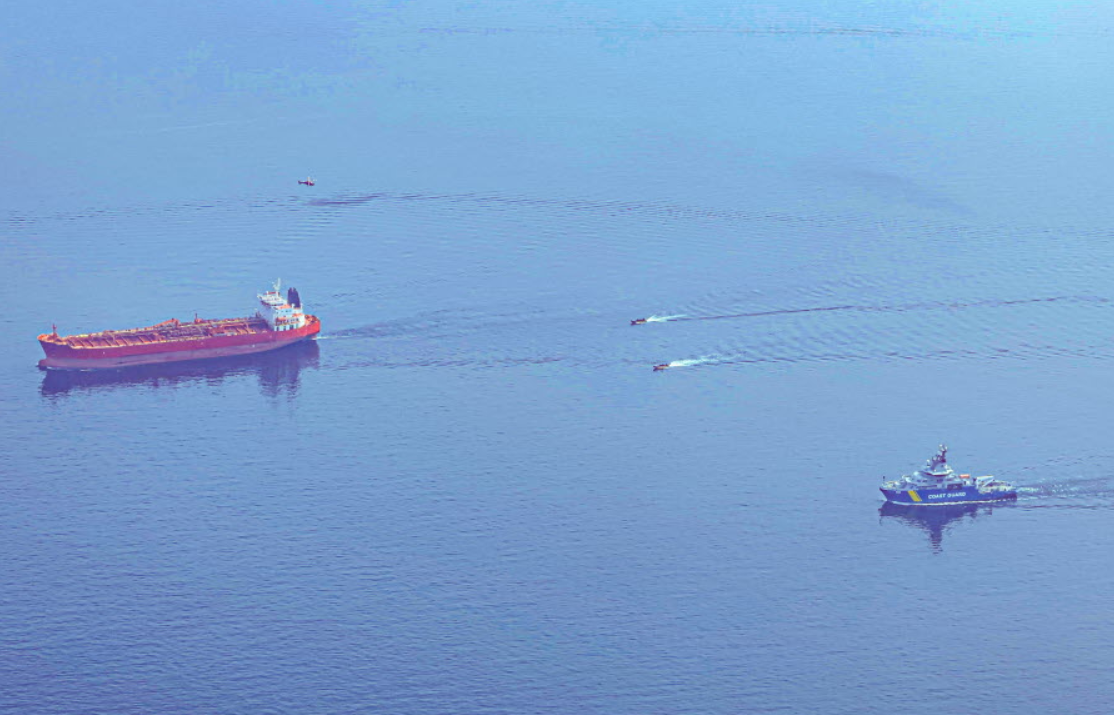
On May 3, 2026, the Swedish Coast Guard seized the tanker Jin Hui flying a Syrian flag. It was the fifth suspicious vessel detained in recent weeks. The ship was empty but had switched off its transponder and is subject to EU, UK and Swiss sanctions. Sweden takes action while the rest of the region watches. In 2025 alone, Russia’s shadow fleet transported oil worth $85 billion – 72 percent of it on sanction‑evading vessels.
The Russian shadow fleet is an informal name for hundreds of ageing tankers and freighters that after 2022 began transporting Russian crude oil, petroleum products and liquefied natural gas following the imposition of the EU and G7 embargo and price cap ($60 per barrel, set in December 2022). These ships change flags (often to Syria, Liberia, Panama, Gabon, Marshall Islands), register in dubious jurisdictions, turn off AIS transponders (Automatic Identification System) or give false location data. The goal is to hide the origin of the cargo and circumvent sanctions.
According to data from the Finnish Centre for Research on Energy and Clean Air (CREA) from March 2026, the shadow fleet carried about 1.9 million barrels of Russian oil per day in 2025, accounting for 72 per cent of all Russian seaborne exports. The value of this trade was about $85 billion.
Five detentions in the region
Jin Hui is the fifth vessel inspected by Swedish services in recent weeks. Previous stops took place: on 15 March 2026 – tanker Tierra (Panama flag, stopped in the Sound off Copenhagen with a cargo of 35,000 tonnes of diesel originating from the Russian refinery in Primorsk); on 2 April 2026 – freighter Baltic Carrier (Liberia flag, suspected of damaging a telecommunications cable between Sweden and Estonia); on 12 April 2026 – tanker Sea Falcon (Gabon flag, without valid P&I insurance – Protection and Indemnity); on 27 April 2026 – bulk carrier Storm Rider (Marshall Islands flag, with irregularities in cargo documentation).
The Swedish Coast Guard did not provide details on the legal basis for stopping Jin Hui. In a press release of 3 May 2026 (published at 19:22) it only informed that the vessel would be subject to further investigation and that the crew had not been arrested at this time. The standard procedure in such cases is to direct the vessel to the nearest port – Trelleborg or Ystad – where inspectors from Sweden (Transportstyrelsen) and Europol officers check documents, insurance, technical condition and the identification of the real owner.
Ownership and structure
According to open source data analysed by the War and Sanctions portal, Jin Hui is linked to Jinhui Shipping Ltd – a company registered in the Marshall Islands. The Marshall Islands are a Pacific island state that is one of the most popular registries for the shadow fleet – in 2025 over 2,200 vessels suspected of carrying Russian commodities were registered there. The Marshall Islands register does not require disclosure of the beneficial owner, which allows links to Russian companies such as Sovcomflot (the Russian state-owned carrier) or oligarchic structures to be hidden.
Jinhui Shipping Ltd was founded in 2018. Its sole registered director is a citizen of Kazakhstan (name not disclosed in the statement). The company has no website, and its correspondence address is a PO Box in Majuro, the capital of the Marshall Islands. According to the Lloyd’s List Intelligence database (accessed May 2026), Jin Hui was built in 2007 at a shipyard in Nantong (China) as a tanker for carrying chemicals and oil. Its deadweight tonnage is 47,800 tonnes.
Jin Hui was empty at the time of the stop. This means it was not carrying any cargo. Swedish services can stop a vessel not only for carrying sanctioned goods but also for lack of proper insurance, violation of navigation safety regulations (e.g., switching off AIS in the Danish straits), suspicion of espionage or sabotage (damage to submarine cables, pipelines).
Over the past 18 months, a series of incidents in the Baltic Sea have involved vessels linked to Russia: damage to the EstLink 2 power cable between Finland and Estonia in December 2025 (anchor of the tanker Eagle S), severing of the C-Lion1 telecommunications cable between Germany and Finland in November 2025, damage to the Balticconnector gas pipeline between Finland and Estonia in October 2025. In each of these cases, the suspect vessel was flying the flag of one of the shadow fleet registries.
An empty tanker in the Baltic is not unusual – ships often sail in ballast (with seawater in ballast tanks for stability) between loadings. However, in the case of Jin Hui, suspicions were raised by the switching off of the AIS transponder on the stretch from the Sound (between Sweden and Denmark) to the place of the stop – for about 6 hours, from 07:52 to 13:58 according to MarineTraffic data. Disabling AIS in narrow international straits is a violation of the SOLAS Convention (Safety of Life at Sea) and grounds for inspection.
Swedish resolve
Sweden has pursued a policy of increasingly stringent controls on the shadow fleet since 2025. On 1 January 2026, a Swedish law entered into force allowing the Coast Guard to stop and search vessels in territorial waters and in the exclusive economic zone (up to 200 nautical miles from the coast) without a court warrant if there is reasonable suspicion of sanctions violations. The law was passed by the Riksdag with 84 per cent of the vote in December 2025.
In addition, Sweden allocated an extra SEK 450 million (about PLN 170 million) in its 2026 budget to strengthen the Coast Guard. The funds are intended for the purchase of two new KBV 300 class patrol vessels (80 metres long, adapted for boarding in harsh ice conditions) and for the lease of Gulfstream G550 reconnaissance aircraft to monitor vessel traffic from the air.
The Swedish Royal Navy participates in patrols as part of NATO’s Standing Mine Countermeasures Group 1 (SNMCMG1) and the alliance’s enhanced presence in the Baltic following the Balticconnector incident. However, it is the Coast Guard that has police powers – boarding, stopping, taking fuel and cargo samples, arresting crews.
Reactions in the region
Poland, Finland, Estonia and Lithuania have for months been calling for a joint NATO strategy on the shadow fleet. At the NATO summit in The Hague in February 2026, a framework document “Baltic Sentry 2026” was adopted, providing for increased air and sea patrols, real-time data sharing on suspicious vessels and joint boarding exercises. However, the document does not provide for stopping vessels on international waters – only member states may do so in their own territorial waters and economic zones.
A Finnish government spokesman (statement of 4 May 2026) said that Finland is watching Swedish actions with interest and is considering similar powers for its Border Guard. Estonia already stopped two shadow fleet tankers (Sunrise and Ahtamar) in its territorial waters in the Gulf of Finland in March 2026.
Poland, with its short Baltic coast (from Świnoujście to Gdańsk), has not yet stopped any shadow fleet vessel. According to information provided by the Ministry of Infrastructure in March 2026, Polish law does not give the Maritime Patrol Service of the Border Guard a clear basis to stop vessels in the exclusive economic zone (outside the territorial sea up to 12 nautical miles) on suspicion of sanctions violations – a court order is required, which takes an average of 72 hours to obtain. By that time, the vessel may have sailed away.
Sanctions and insurance
Jin Hui was subject to sanctions by Ukraine (from March 2024), the European Union (from July 2025, after the expansion of the 15th sanctions package), Switzerland (from August 2025) and the United Kingdom (from September 2025). Sanctions entail a ban on entering ports, a ban on providing services (e.g., bunkering, pilotage, mooring) and freezing of assets. However, a vessel sailing on international waters does not need to enter a port – it can transfer cargo to other vessels on the high seas (ship-to-ship). In 2025, satellites recorded 340 such transfers in the Gulf of Finland and south of Bornholm, 210 of them involving vessels linked to the Russian shadow fleet.
Lack of P&I insurance (civil liability) means that in the event of an oil spill or collision, no one will cover the damage. Standard insurance required by the International Maritime Organization (IMO) is at least $1 billion per incident. Shadow fleet vessels often have insurance from companies in Kazakhstan, the United Arab Emirates or China that are not recognised by the International Group of P&I Clubs. In the case of Jin Hui, inspectors in Trelleborg will check the validity of an insurance certificate issued by a Dubai-based company. If the certificate is forged or the insurer is not on the IMO-approved list, the vessel may be arrested.
Role of satellites and intelligence
The stopping of Jin Hui was preceded by satellite observations. According to unofficial information (Swedish daily Svenska Dagbladet of 4 May 2026), the vessel was tracked by radar satellites from ICEYE (Finland) from the moment it left the Gulf of Finland on 1 May 2026. The satellites showed that the tanker changed course near the island of Bornholm – instead of heading towards the Danish straits (the natural exit from the Baltic), it turned northwest towards the Swedish coast. Such manoeuvres are unusual for an empty tanker, which normally heads to a loading port in Primorsk or Ust-Luga.
The Swedish Security Service (Säpo) and the Military Intelligence Service (MUST) assigned liaison officers on board the Coast Guard patrol vessels. The boarding also included police officers from Trelleborg trained in securing electronic documentation (laptops, mobile phones, navigation systems). Materials seized from Jin Hui will be sent for analysis at a forensic laboratory in Stockholm.
Russia’s position
The Russian Foreign Ministry has not yet issued an official comment on the stopping of Jin Hui. In previous cases of detention (Tierra in March 2026, Sea Falcon in April 2026), Russia filed protest notes, accusing Sweden of “pirate actions” and violating freedom of navigation on international waters. None of these protests led to the release of the vessels – all four previous vessels remain under arrest in Swedish ports (Trelleborg, Ystad, Gothenburg), and criminal proceedings against their owners for sanctions violations are ongoing.
In response to Swedish controls, Russia in April 2026 announced changes in procedures for shadow fleet vessels – operators were advised to register vessels under flags of countries recognised by the EU as “fully cooperating” (e.g., Turkey, United Arab Emirates, India) instead of Syria or the Marshall Islands. According to an analysis by the Centre for Energy Security Research in Helsinki, 12 flag changes from Syrian to Turkish were recorded in one week in April 2026.


