
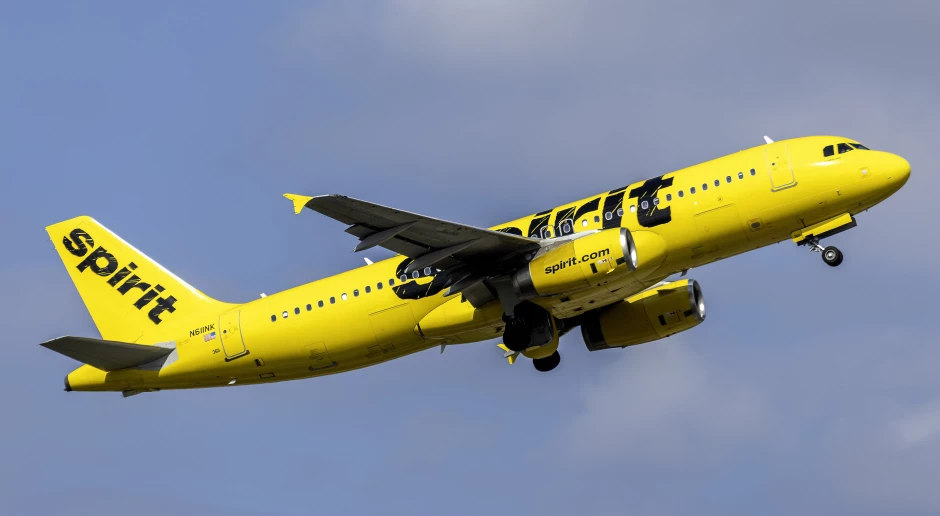
On May 2, 2026, Spirit Airlines officially collapsed and suspended all operations with immediate effect. Passenger aircraft and all available assets were seized by court bailiffs to cover debts owed to creditors.
Spirit Airlines was founded in 1980 in Miramar, Florida. For decades, the carrier built its brand around the ultra-low-cost carrier (ULCC) model. Passengers paid for the seat alone – everything else was extra: checked baggage, carry-on luggage, seat selection, drinks, even water. Between February 2025 and the end of January 2026, Spirit carried 28 million people. It operated a fleet of around 130 aircraft, mainly Airbus A319, A320 and A321.
The company had long struggled with financial problems. Debt had been accumulating for several years, and attempts to rescue the airline failed. From March 2026 onwards, Spirit held talks with creditors and representatives of the US Department of Transportation. Several options were considered: a federal budget loan, the issuance of 500 million dollars in convertible bonds with a multi-year grace period, or the sale of the entire company.
Two competing airlines – Frontier Airlines and JetBlue Airways – expressed interest in a takeover. Negotiations continued, but the situation worsened day by day. In the end, the talks failed, and on May 2 a court declared bankruptcy with immediate liquidation.
War in the Middle East
The key moment was February 28, 2026, when war broke out in the Middle East. The price of jet fuel (Jet A1) rose by 300 percent within the first two weeks of the conflict. According to data from the US Energy Information Administration, on February 27, 2026, the price of jet fuel was 2.85 dollars per gallon. By March 15, 2026, it had exceeded 8.50 dollars per gallon, and in April it stabilised at 7.20–7.80 dollars per gallon. Spirit Airlines had not hedged against such a price increase. Unlike larger carriers, which use fuel hedging (futures contracts on oil and fuel), Spirit bought at spot prices. In 2025, when prices were stable, this strategy allowed savings. In the first months of 2026, it proved catastrophic. For a single A320, which burns about 2,500 litres of fuel per flight hour, a price increase of 5 dollars per gallon over eight hours of daily utilisation increased daily fuel costs by about 26 thousand dollars. For a fleet of 130 aircraft, that meant an extra 3.4 million dollars in daily costs.
No insurance
As it later turned out, Spirit also did not have the money to insure against such a situation. Standard insurance policies for airlines cover, among other things, the risk of fuel price increases, but require the premium to be paid upfront – often tens of millions of dollars per quarter. In 2025, Spirit abandoned this type of protection to reduce operating costs. According to the company’s fourth-quarter 2025 report filed with the US Securities and Exchange Commission (SEC) in February 2026, net liquidity reserves stood at just 87 million dollars – less than two weeks’ fuel costs after the price surge.
– The collapse of Spirit Airlines is a direct consequence of the sharp rise in fuel prices caused by the Middle East conflict and the airline’s lack of adequate financial hedging – said US Secretary of Transportation Sean Duffy at a press conference on May 2, 2026. – The Department of Transportation will take action to ensure that ticket holders receive a refund.
After the bankruptcy declaration, court bailiffs immediately began securing assets. Spirit Airlines aircraft remained at various airports – not only in the US but also in Canada, Mexico, the Dominican Republic and Colombia (Spirit flew to 18 countries in North, Central and South America). Most of the aircraft were leased. Under the lease agreements, upon bankruptcy the aircraft return to lessors or are seized to cover liabilities to creditors.
Spirit Airlines’ creditors include banks (Bank of America, JPMorgan Chase, Wells Fargo), aircraft lessors (AerCap, Air Lease Corporation, BBAM) and fuel suppliers. The company’s total debt as of April 30, 2026, was about 3.2 billion dollars, of which 1.8 billion was owed to lessors, 900 million to banks and 500 million to suppliers and other creditors.
Tickets became invalid
At the moment of the bankruptcy declaration, all Spirit Airlines tickets became invalid. Passengers who had flights scheduled for May 2 and the following days were left at airports with no possibility of departure. It is estimated that the collapse affected about 120 thousand passengers who were due to fly within the first 72 hours of the bankruptcy announcement (data from the Department of Transportation report of May 3, 2026).
US aviation law protects passengers from losing money only when an airline files for bankruptcy with the possibility of reorganisation (Chapter 11). In the case of liquidation (Chapter 7), tickets become invalid and passengers become creditors in the bankruptcy estate – but they are paid only after banks and lessors. In practice, this means they will recover an average of 5–10 cents for every dollar spent on a ticket.
– Ticket holders will receive a refund through the federal budget compensation system – said Sean Duffy. – The detailed mechanism will be announced within 14 days.
Competitors in the market extended a helping hand. American Airlines, Southwest, United Airlines and the smaller carrier Avelo offered discounted tickets for Spirit passengers. According to individual airline statements from May 3, 2026:
– American Airlines offered tickets at 99 dollars for any domestic route (no limit on the number of seats per flight, subject to availability).
– Southwest Airlines introduced a „Spirit Relief” programme – 50 percent off flights in May and June 2026 for holders of valid Spirit tickets (proof of booking required).
– United Airlines offered flights at 129 dollars for domestic routes with no additional fee for carry-on baggage (United typically charges 35 dollars for carry-on baggage in its cheapest fare).
– Avelo (an ultra-low-cost carrier similar to Spirit but smaller – 20 aircraft) offered a 150-dollar voucher for future flights to every Spirit passenger who buys a ticket with Avelo in May.
Crew members of Spirit Airlines – pilots, flight attendants, cabin crew – found themselves in a difficult situation. Many were away from their home bases, where they normally start and end work. Competing airlines helped them return. American and United offered free return flights for Spirit crews upon presentation of an employee ID. According to data from the Air Line Pilots Association, about 2,100 pilots and 3,400 cabin crew members took advantage of the assistance.
The era of cheap tickets in question
The collapse of Spirit changes the entire geography of the US airline market. For years, Spirit was the most extreme example of the ULCC model – its average ticket price in 2025 was 68 dollars for a one-way flight, while the average ticket price in the US was 298 dollars (data from the Department of Transportation, Q4 2025 report). Spirit offered low prices, forcing competitors to follow suit on routes where it appeared – for example, on the Chicago–Denver connection, Spirit flew for 49 dollars, forcing United and American to cut prices from 120 to 80–90 dollars.
Now that pressure is gone. Frontier Airlines and Allegiant Air remain in the market as low-cost carriers, but their model differs from Spirit. Frontier has 148 aircraft (more than Spirit) and is publicly traded, but its ticket prices are on average 15–20 percent higher than Spirit’s (data from a comparative analysis for 2025). Allegiant focuses on flights from small cities to holiday destinations (Las Vegas, Orlando, Florida), not on business routes.
– Spirit forced us to keep prices low on many routes. The competition was brutal, but passengers benefited. Now, without Spirit, there is no reason to keep those prices – said an unnamed representative of a major airline in a conversation with The Air Current on May 3, 2026.
The end of ultra-low prices?
Aviation market analysts agree: the collapse of Spirit marks the end of the era of the cheapest tickets in the US. Within 24 hours of the bankruptcy announcement, three major airlines – American, Delta and United – raised prices on 47 routes where Spirit had been the cheapest carrier (according to an analysis by the Hopper platform of May 3, 2026). The increases averaged 35–40 percent. For example, on the New York (LaGuardia)–Fort Lauderdale route, the minimum price rose from 69 to 99 dollars. On the Las Vegas–Denver route, from 45 to 79 dollars.
Will other ULCCs (Frontier, Allegiant, Avelo) take over Spirit’s fleet and enter its routes? It is possible, but not simple. Most of Spirit’s aircraft will return to lessors, who will then put them on the market. Frontier had previously been interested in taking over Spirit – in 2022 it attempted a merger, but the Department of Justice blocked it. After the collapse, Frontier may lease some of Spirit’s aircraft and take over airport slots (take-off and landing slots at congested airports, e.g. New York, Los Angeles, Chicago). However, the process of taking over slots requires approval from the Federal Aviation Administration (FAA) and takes an average of 6–12 months.
Bailiffs seized not only the aircraft, but also the flight simulators at the training base in Miramar, Florida, spare parts, onboard equipment and real estate – the company’s office building, covering 18 thousand square metres. According to a decision of the Bankruptcy Court for the Southern District of Florida (case number 26-1187-BKC), the sale of assets is to begin within 30 days of the bankruptcy declaration.
Secured creditors (lessors and banks) will have priority in satisfaction from the bankruptcy estate. They are expected to recover about 60–70 percent of their claims. Unsecured creditors (catering suppliers, airport cleaning companies, advertising agencies) will recover 5–10 percent. Passengers who bought tickets with a credit card will recover an average of 8–12 cents per dollar.
By May 4, 2026, 214 thousand people had already applied for assistance from the Department of Transportation compensation programme. Total claims amount to approximately 42 million dollars. The compensation fund has a budget of 75 million dollars, which should be enough to cover all claims.
Why assets were seized?
The immediate liquidation (Chapter 7) means that the court appoints a trustee who immediately takes control of all the company’s assets. In the case of Spirit Airlines, the trustee is John F. O’Donnell of White & Case in Miami. Within 48 hours of the bankruptcy declaration, the trustee ordered the physical securing of 78 aircraft that were at US airports. The remaining 52 aircraft were stationed abroad – in Toronto (Canada), Cancun (Mexico), Santo Domingo (Dominican Republic) and Bogota (Colombia). Cooperation with local authorities is ongoing – Colombia has agreed to return the aircraft to lessors, Mexico has suspended its decision, citing the protection of the interests of passengers stranded at Cancun airport (approximately 3,200 people).
– There is no precedent for a US bankruptcy court ordering the return of aircraft from the territory of a foreign country without the consent of that country’s government – said Angela Foster, professor of aviation law at Georgetown University, in an interview with Reuters on May 3, 2026. – Those 52 aircraft will become the subject of separate international proceedings.
Long-term ticket price changes
Over the next 12–18 months, according to a forecast by the International Air Transport Association (IATA) of April 2026, the average ticket price in the US will rise by 12–18 percent. Without Spirit, which acted as a price regulator on about 17 percent of domestic routes (where it was the cheapest), competition will weaken. Frontier and Allegiant will increase their market shares, but will not fill the entire gap – Spirit had a 5.2 percent share of the US passenger market (data for 2025). Frontier has 4.8 percent, Allegiant 3.2 percent, Avelo 0.7 percent. The ULCC segment will fall from 13.9 percent to about 8.7 percent of the market.
Passengers who had become accustomed to tickets priced at 49–69 dollars will have to pay 80–120 dollars on the same routes. For a family of four, a difference of 100–200 dollars on a round-trip ticket means 400–800 dollars more for a holiday.
In response to the Spirit collapse, the Federal Aviation Administration (FAA) announced on May 3, 2026, that it would accelerate work on regulations requiring all airlines to hold liquidity reserves sufficient for at least 90 days of operations, including hedging against sharp fuel price increases. The draft bill has been sent to Congress and is to be processed on an emergency basis – first reading on May 10, 2026.


