
The question of small modular reactor safety is returning to public debate as work on their deployment in Poland accelerates. The answer is not simple, because SMRs are not one technology but a whole category of reactors with different designs, levels of maturity and safety systems. The key feature of most projects is passive safety systems that operate without external power, but the problems of radioactive waste and economies of scale remain unresolved.
The debate over SMRs in Poland is taking place against the backdrop of the energy transition and the search for stable, emission‑free power sources. On one side, proponents point to decades of experience with marine reactors as well as the simplicity and passive safety features. On the other side, critics warn of larger volumes of radioactive waste and higher unit costs compared with conventional nuclear plants. To answer the question of safety, one must first understand what SMRs are – and what they are not.
The term SMR refers primarily to reactors with an electrical output of up to 300 MWe, manufactured in factories as modules and delivered to the site of operation. Historically, the first nuclear power plants of the 1950s and 1960s also had outputs below 300 MWe, and their construction time was three to five years. Over time, however, the nuclear industry moved toward ever larger and more complex installations, which led to higher costs, quality problems and delays.
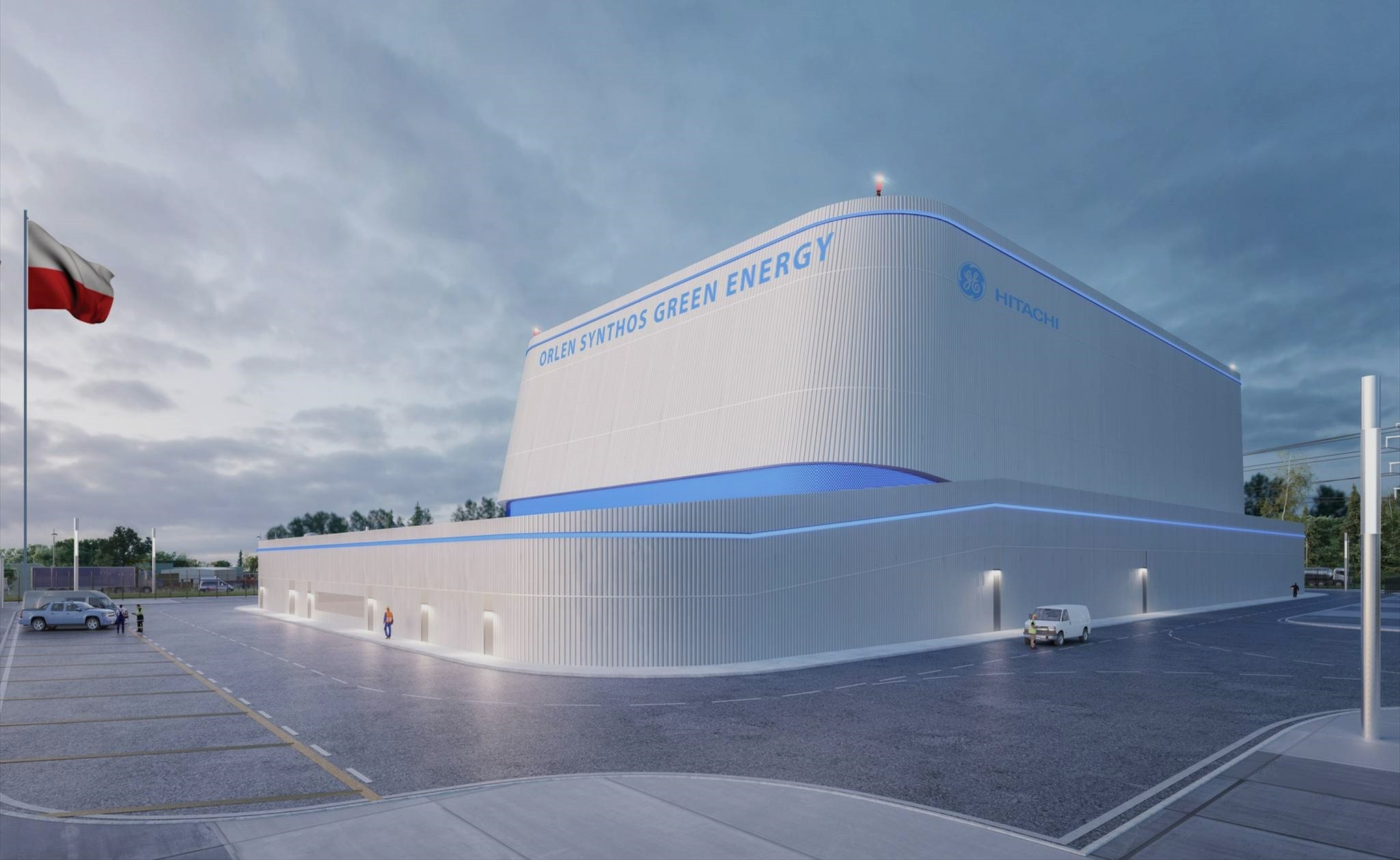
SMRs represent an attempt to return to the roots while using all the knowledge gained in recent decades, especially in the field of nuclear safety. The most advanced commercial SMR project in the world is the BWRX‑300 reactor developed by the American conglomerate GE Vernova. This is the technology chosen for implementation in Poland by ORLEN Synthos Green Energy (OSGE), a joint venture of Orlen and Synthos, and the BWRX‑300 belongs to the boiling water reactor family with an output of 300 MWe.
Passive systems as the foundation of SMR safety
The key safety feature of most SMR designs is passive safety systems, which operate without external power and without human intervention in emergency situations. Unlike conventional nuclear power plants, which require complex active cooling systems based on pumps and backup generators, SMRs rely on natural physical phenomena: natural circulation, convection and gravity.
This means that even in the event of a complete loss of power or operator failure to act, the reactor can safely shut down and remove decay heat without risk of core melt. The lower power of the reactor further facilitates fuel safety. SMR designs often build on solutions proven in marine nuclear reactors, which have been operated for decades without serious accidents.
According to the Polish Economic Institute, proposed SMR projects are generally simpler compared with existing reactors, and the safety concept relies more on passive systems and reactor features such as low power and operating pressure. Increased safety margins eliminate or significantly reduce the possibility of dangerous emissions of radioactive isotopes into the environment in the event of an accident.
Licensing and assessment
In Poland, the National Atomic Energy Agency (PAA) approaches SMRs with the same diligence as large‑scale nuclear power plants. Under current law, the same nuclear safety and radiological protection requirements apply to small modular reactors. This means that permits for construction, start‑up, operation and decommissioning of a nuclear facility are required.
An investor may ask the President of the PAA for a so‑general opinion, which shows whether the assumptions of a given technology are consistent with Polish safety standards. In May 2023, the President of the PAA issued the first general opinion on the BWRX‑300 technology at the request of Orlen Synthos Green Energy. The PAA is also currently reviewing an application from KGHM Polska Miedź for the NuScale technology.
The Polish nuclear regulator is cooperating in this field with regulators from other countries, including the Canadian Nuclear Safety Commission (CNSC), with which an agreement on cooperation on SMR technology has been signed. Advanced work is also under way on the legal and financial framework for deploying SMRs in Poland, and the document setting out that framework was expected by the end of September 2025.
The radioactive waste problem
Although passive systems significantly raise the level of operational safety, SMRs are not free from controversy. One of the most serious arguments of opponents is the issue of radioactive waste. According to critics, SMRs can produce 2 to 30 times more waste per unit of energy produced compared with conventional nuclear power plants. The problem stems from the simpler design and poorer fuel burn‑up efficiency in smaller reactors.
As the Confederation (political grouping) notes, SMRs do not solve the problem of stable baseload power, do not guarantee a competitive price for energy, increase risk and costs for the economy, and mean serious waste problems requiring management and disposal. Experts stress that there will be no closed fuel cycle, which undermines the argument that SMRs are a more ecological version of large nuclear power; in reality the waste problem will be more complex and costly.
Are SMRs economically viable?
Another area of criticism is the economics of SMRs. For decades, nuclear power has relied on economies of scale – the larger the reactor, the lower the unit cost of energy. SMRs reverse that logic. Lower output means higher cost per MW, and so far the promise of standardisation and serial production that was supposed to lower those costs has not materialised.
The construction costs of any of the SMRs being considered by Polish investors are not known. It can be expected that the price of an SMR per MW of installed capacity and the cost of the electricity it produces will be higher than for conventional coal‑ or gas‑fired power plants. According to some analyses, SMRs will never be a primary source of electricity in Poland.
Grid stability and the role of SMRs in the power system
As a controllable source, SMRs can provide stable baseload power to the electricity system. Their advantage is the ability to be located close to consumers, which reduces grid and transmission costs. They can complement renewable energy sources during periods of low wind and sun, providing an emission‑free alternative to existing power assets.
At the same time, opponents point out that SMRs do not solve the problem of stable baseload power because their unit capacity is too small to replace large coal‑fired units. Their role will therefore be rather supplementary – as local sources of heat for industry, district heating networks or seawater desalination, rather than as the foundation of the national power system.
Polish SMR projects
Despite the controversy, work on deploying SMRs in Poland is progressing. OSGE plans to build a fleet of GE‑Hitachi BWRX‑300 reactors in Poland. Six principal decisions have already been issued for potential locations, and for one of them – Stawy Monowskie – the General Director for Environmental Protection has issued a decision on how to prepare the environmental report. Orlen, in its strategy “Energy of Tomorrow Begins Today”, assumes that by 2035 it will have at least two SMRs with a total capacity of 0.6 GW, with the first reactor to be built in Włocławek. The estimated cost of producing 1 MWh of energy from an SMR is expected to be about 30 percent lower than that of energy from gas. A single 300 MWe modular reactor can prevent the emission of 0.3 to 2 million tonnes of carbon dioxide per year.
So are SMRs safe?
From a purely technical point of view, SMRs have been designed with the highest level of safety in mind. Passive safety systems, lower power and operating pressure, and the use of proven solutions from marine reactors mean that the risk of a serious accident is significantly lower than with older reactor types. The fact that the same rigorous licensing procedures apply to SMRs as to large nuclear power plants further raises the level of safety.
Safety, however, is not only about technology but also about economics, waste management and social acceptance. In these areas, SMRs raise serious doubts. The problem of increased amounts of radioactive waste, uncertainty about actual construction and operating costs, and the question of economic rationality compared with other energy sources remain unresolved.
SMRs will not replace large‑scale nuclear power, but they can be a valuable complement in specific niches – where a local, stable and emission‑free source of heat or electricity is needed. The decision to deploy SMRs in Poland will require balancing technical, economic and environmental considerations. The technology is promising, but before it can be deployed commercially on a wider scale, the waste problem must be solved, unit costs reduced and operating experience gained. Passive safety systems alone do not yet determine the full safety of the entire enterprise.


