
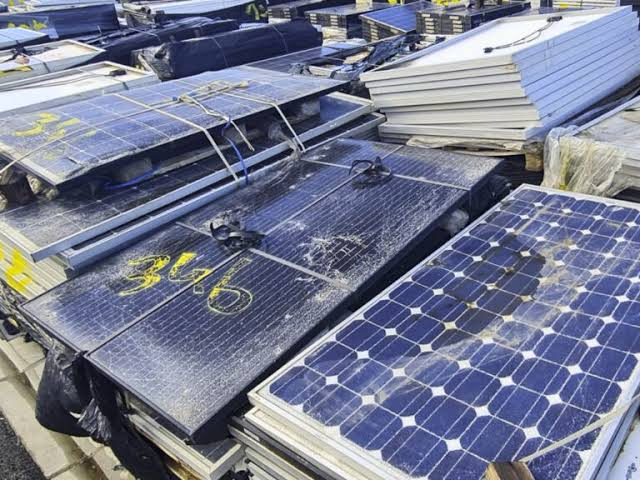
Poland not only should develop its own capabilities for recycling photovoltaic panels, but it is now a strategic necessity driven by the scale of the growing waste problem, EU regulations and the opportunity to capture economic value. According to forecasts by the International Renewable Energy Agency (IRENA), over the next 25 years Poland will generate 2.8 million tonnes of waste from PV panels – a mass comparable to five national stadiums filled to the brim. In 2026 alone, approximately 18,000 tonnes will go to disposal, and by 2030 this figure will rise to 65,000 tonnes per year, meaning that in just five years the scale of the problem will increase more than 3.5 times.
At the same time, since 1 January 2026, tightened targets have applied across the European Union: a minimum collection rate of 85% for end-of-life panels and a minimum recycling rate of 80% by mass. Poland, which is the European leader in installed PV capacity per capita (about 47 million panels for a population of 38 million), must take immediate decisions to avoid drowning in a wave of waste and to avoid financial penalties and the loss of critical raw materials such as silicon, silver, copper and aluminium, which can be recovered and reused in domestic industry.
The Polish photovoltaic market developed in two main waves. The first wave comprised commercial installations from 2005‑2010, which are now reaching the end of their useful life and are already generating significant waste volumes in 2026. The second, much larger wave is the result of the net‑metering boom from 2015‑2018 and the subsequent development of individual prosumers and commercial farms. At the end of 2025, Poland had an installed capacity of about 24.5 GW, which corresponds to about 47 million panels with an average power of 480 W. For comparison, Poland’s population is about 38 million, meaning that there is more than one PV panel per person. This makes Poland the absolute leader in Europe in terms of PV saturation per capita, but at the same time it poses a huge challenge for waste management when these installations reach the end of their life.
Forecasts prepared by IRENA and Polish analytical centres indicate a steady, then rapid, increase in the mass of PV waste over the coming decades. According to these forecasts, in 2026 about 18,000 tonnes of used panels will go to disposal, mainly from early installations (2005‑2010) and modules damaged mechanically (e.g. by hailstorms or gales). In 2027 the waste mass will rise to about 24,000 tonnes, in 2028 to 32,000 tonnes, in 2029 to 45,000 tonnes, and in 2030 to about 65,000 tonnes. The total mass of PV waste generated in Poland in the years 2026‑2030 will be about 184,000 tonnes. By 2040, about 850,000 tonnes of used PV panels will be generated in Poland, and by 2050 – after 25‑30 years from the installation peak of 2018‑2025 – the waste mass will reach about 2.8 million tonnes. For comparison, in 2023 PV panels already accounted for nearly 220,000 tonnes of the more than 970,000 tonnes of total electrical and electronic equipment placed on the market in Poland. This means that photovoltaics, which only a few years ago was ignored in waste analyses, has become one of the key waste streams, and its importance will grow exponentially as installations from the period of greatest growth are decommissioned.
Regulatory requirements
Since 1 January 2026, new, stricter targets for the management of photovoltaic panel waste have applied across the European Union under the WEEE Directive. Under the new rules, Member States are required to achieve at least 85% collection of end‑of‑life PV panels and at least 80% recycling by mass of those collected wastes. This is a significant increase compared to previous requirements, which were much less ambitious. The WEEE Directive covers all PV panels sold in Europe, and producers and importers are obliged to register at national level, finance collection and recycling, and achieve the required targets.
In Poland, these provisions have been implemented through the Act on Waste Electrical and Electronic Equipment, which obliges producers and importers of PV panels to provide a system for the collection and treatment of end‑of‑life equipment. At the same time, the Act introduces the principle of extended producer responsibility (EPR), under which producers and importers are responsible for organising and covering the costs of collecting and processing used panels, but only for panels placed on the market after 1 January 2016. For installations installed before that date, disposal costs are borne by the owner, which mainly concerns early commercial installations from 2005‑2010 that are now reaching the end of their life.
Failure to meet the requirements of the WEEE Directive exposes Member States to infringement proceedings before the Court of Justice of the European Union and financial penalties. For Poland, which is the largest photovoltaic market in Central and Eastern Europe, the regulatory pressure is particularly strong. The European Commission monitors collection and recycling rates in individual Member States, and Poland must demonstrate that it has the appropriate infrastructure and systems to meet the targets. Otherwise, in addition to financial penalties, Poland could lose credibility as a partner in the EU’s climate policy and circular economy.
State of recycling infrastructure in Poland
Until 2025, Poland did not have dedicated, full‑scale photovoltaic panel recycling lines. Panels were mainly processed in plants that process mixed waste electrical and electronic equipment, where the process was limited to dismantling frames and glass, while the rest of the laminate with cells went to landfill or further processing outside the country. The situation changed radically in 2026, when the first dedicated recycling lines were launched.
The largest project is the ROSE Polska plant in Bełchatów, with a capacity of 30,000 tonnes per year. The plant is located in the vicinity of a lignite mine and power plant, which is a symbolic sign of the region’s transformation – coal mining infrastructure is being replaced by infrastructure serving a circular economy for renewable energy sources.
The second largest installation is the Reciclus plant in Sosnowiec, with a capacity of 5,000 tonnes per year, serving as a pilot facility for a recycling technology developed by Polish engineers. The third significant line belongs to Solpol from Wrocław, which expanded its existing installation from 2,000 to 8,000 tonnes per year. Poland’s total recycling capacity in 2026 is approximately 43,000 tonnes per year, which corresponds to processing about 2.3 million used PV modules.
This is a good start, but analysts agree that this capacity will be sufficient only until the end of 2027. After that date, the demand for recycling will increase 5‑7 times compared to 2026 levels. ROSE Polska has already announced the construction of a second plant in Świerklaniec in Silesia, which is to start in 2028 with a capacity of 50,000 tonnes per year, and Reciclus plans to expand by another 15,000 tonnes. At the same time, an innovative technology developed by the Warsaw‑based company 2loop Tech in cooperation with the AGH University of Science and Technology in Kraków is being developed. According to its developers, this technology allows for almost 100% recovery of raw materials from used PV panels and other RES equipment, and the process is supposed to be completely waste‑free. The 2loop Tech plant is being built in Łódź and initially received an environmental decision to process up to 2,000 tonnes per year, with plans to expand to 8,000 tonnes within one year of launch.
Raw material recovery potential
A typical crystalline photovoltaic module, which dominates the Polish market, consists of several layers of materials, most of which can be recovered. The dominant component by mass is tempered glass, which accounts for about 66% of the panel’s mass. For a typical 580 W module with a mass of 28 kg, this means about 18.5 kg of glass. This glass is the easiest to recycle – with 95‑98% efficiency it returns to glass production as a feedstock for furnace production of building or bottle glass.
The aluminium frame accounts for another 12% of the panel’s mass, i.e. about 3.4 kg of pure EN AW‑6063 alloy, which is easy to remelt. Aluminium recovery efficiency is 98‑99%, and aluminium from panels has the same quality as primary aluminium, meaning it can be used directly in industry without loss of properties.
The remaining elements are silicon cells (about 3‑5% by mass), laminating films (EVA – ethylene‑vinyl acetate), copper and silver conductors, plastics from the junction box and a plastic backsheet. The recovery of silicon and precious metals is more technologically advanced and still a challenge, but its economic potential is significant.
Silver, present in very thin layers on the cells, is recovered by electrolytic or chemical processes – there is only about 6‑10 grams per panel, but with millions of panels going to recycling, the annual volumes of recovered silver become significant from an economic point of view. After purification, silicon can be used as a raw material for the production of new PV cells or for metallurgical applications.
Estimates suggest that the total value of recoverable raw materials from the 2.8 million tonnes of PV waste that will be generated in Poland by 2050 is in the billions of zlotys. This is therefore not only an environmental issue, but also an economic one – the development of domestic PV panel recycling is an opportunity to create a new industry, jobs and reduce dependence on imports of critical raw materials such as silicon, silver and copper.
The role of recycling in reducing dependence on critical raw materials
The European Union, including Poland, is heavily dependent on imports of critical raw materials from China and other third countries. In the case of lithium, cobalt, nickel, graphite and rare earth elements, Europe does not have its own significant deposits, and extraction and refining processes are concentrated in a few countries.
The EU is actively developing projects to improve recycling technologies in order to reintegrate PV waste back into production as high‑value materials. The aim is to turn discarded solar panels into a source of new raw materials for the PV industry, lowering material recovery costs and opening up new commercialisation opportunities.
These projects are expected to contribute to increasing circularity and minimising environmental impact by developing cost‑effective recycling technologies for various solar module components, including glass recycling to PV specifications, silicon purification to solar grade, silver and heavy metal recovery, and polymer valorisation with carbon capture. The ultimate goal is to close the loop, where recovered glass and silicon are reused in the production of modern solar modules.
For Poland, developing PV panel recycling is therefore part of a broader raw materials strategy. Recovered materials – glass, aluminium, silicon, silver, copper – can be used not only in the photovoltaic industry, but also in construction, automotive, electronics and other industries.
The more raw materials can be recovered from domestic waste, the less dependence on imports and the more competitive the Polish economy will become.
Economic aspects
The cost of recycling photovoltaic panels in Poland in 2026 is relatively uniform across the country. The base price for PV panel disposal is PLN 1.5‑2.5 net per kilogramme of panels and includes processing at the plant. For a typical 4‑6 kW home installation consisting of about 12‑15 modules with a total mass of about 240‑360 kg, the processing cost is between PLN 360 and 900 net.
There are transport costs (about PLN 2.5 per kilometre) and possible dismantling costs. For installations put into service after 1 January 2016, these costs are not borne directly by the owner – they are covered by the producer or importer under the EPR system. For installations put into service after 1 January 2026, the disposal cost is already included in the purchase price of the panels.
From a business perspective, PV panel recycling can be profitable even with relatively small amounts of waste. According to available analyses, the processes developed can be profitable even for small volumes, e.g. 1,000 tonnes per year. The Polish PV panel recycling market is not yet as developed as abroad, mainly because most installations are still relatively new. However, as the wave of waste grows, the value of the PV recycling market will increase systematically. According to a report by Research & Markets, last year the value of the European solar panel recycling market was $49.1 million, and forecasts suggest an average annual growth of 19% in the coming years.
For Polish entrepreneurs, this represents a real opportunity to enter a growing industry with high growth potential. Companies such as PVP Recycling already offer comprehensive recycling of used PV panels, including dismantling, compliant transport, recycling and full environmental documentation. Their offer is addressed to producers and introducers of PV panels, installation companies, PV farm operators and PSZOK operators.
Environmental and social burden
If Poland does not develop its own recycling capacities, the environmental and social consequences will be severe. Photovoltaic panels, although a source of clean energy during their operational life, become waste at the end of their life that cannot be landfilled on ordinary landfills.
They contain small amounts of heavy metals such as lead, tin and antimony, which can leach into soil and groundwater if not properly disposed. Moreover, PV panels have been officially classified as waste electrical and electronic equipment (WEEE), which means that they are subject to hazardous waste regulations and cannot be thrown into municipal waste containers.
The lack of sufficient recycling infrastructure can lead to three undesirable phenomena. First, illegal dumping of panels on wild dumps, which creates a risk to the environment and human health. Second, the accumulation of waste in warehouses and on private property, which is not only illegal but also creates a risk of fire and other accidents.
Third, the shipment of waste to third countries with lower environmental standards, which is contrary to the principles of the circular economy and can lead to the problem being shifted to other regions of the world.
Poland, which in 2026 will have a recycling capacity of 43,000 tonnes per year, must already plan to expand its infrastructure to avoid these risks. ROSE Polska has announced the construction of a second plant in Świerklaniec in Silesia, due to start in 2028 with a capacity of 50,000 tonnes per year, and Reciclus plans to expand by a further 15,000 tonnes.
These are steps in the right direction, but given the projected growth in waste to 65,000 tonnes per year by 2030 and to 850,000 tonnes by 2040, these capacities will have to be increased systematically.
Actions of other EU countries
In other European Union countries, PV panel recycling is already more advanced, which can serve as a model for Poland. Germany, which for two decades was the largest PV market in the world, will be one of the first and largest PV recycling markets in the coming years.
The EU WEEE Directive was transposed into German law in October 2015, and the institution responsible for PV waste management is Stiftung EAR, which registers waste producers on the market. In Germany, regulations on the collection, recovery and recycling of PV panels have been introduced, and the amount of PV waste sent for recycling has been increasing – from 11,953 tonnes in 2019 to 15,195 tonnes in 2022.
In France, the PV panel recycling system is managed by ADEME (Agence de l’environnement et de la maîtrise de l’énergie), and the main compliance body is PV Cycle France, which operates within the broader European PV Cycle network.
Italy also has an extensive system, with the institution CENTR responsible for producer registration and organisations EcoTre and PV Cycle Italy managing collection and recycling. Spain, in turn, bases its system on SEPA and the organisations Ambilamp and EcoRaee.
For Poland, this means that it does not have to reinvent the wheel. The experience of Germany, France, Italy and Spain shows that an effective PV panel recycling system requires three elements: clear regulatory framework (transposition of the WEEE Directive), an institution responsible for registration and supervision (in Poland this role would be played by the Chief Inspectorate for Environmental Protection or a newly established agency), and cooperation with industry organisations such as PV Cycle, which have the experience and infrastructure for collecting and processing waste. Poland can benefit from these models, adapting them to its specific conditions – above all, the huge number of dispersed individual prosumers who make up the majority of PV installations in the country.


