
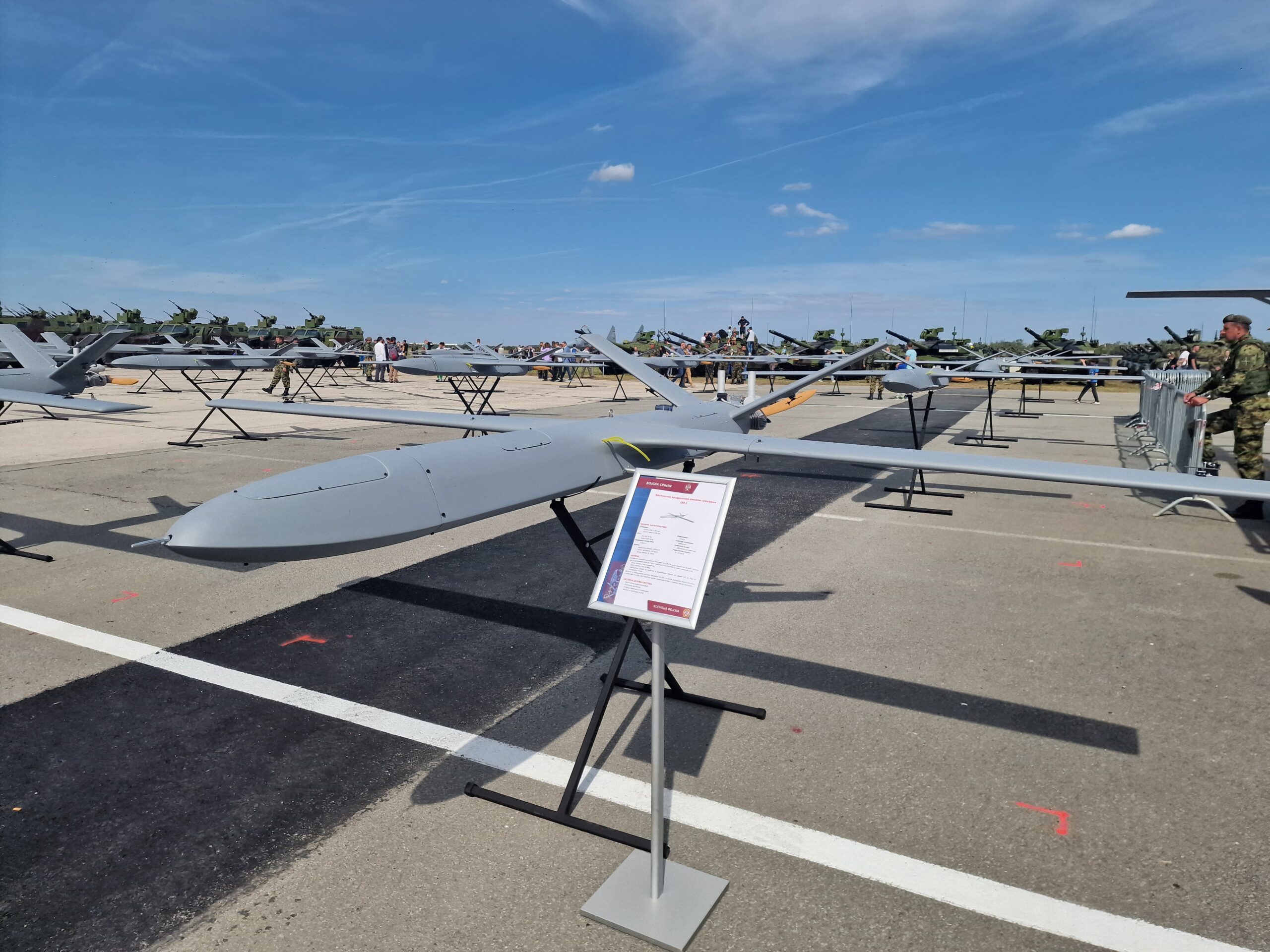
Poland’s defense industry is undergoing an unprecedented production surge in loitering munitions, culminating in 2026. Evidence includes a ten‑year framework agreement signed in May 2025 for the delivery of 10,000 Warmate drones, while production of a new generation of unmanned systems begins in the second quarter of 2026 at Hornet – Polskie Drony.
Poland’s defense industry is not starting from scratch in building production capacity. The Warmate loitering munition, manufactured by the WB Group, has been used for years by the Polish Armed Forces as well as the armed forces of Ukraine, Turkey, India and the United Arab Emirates. Its effectiveness has been proven in combat conditions – the Ukrainian army successfully uses Warmate to destroy Russian air defence systems such as Pantsir, and Polish Piorun missiles and Warmate loitering munitions are making a splash in the war in Ukraine. The experience of the war in Ukraine has made it clear that unmanned warfare has become a key element of modern military operations, and the ability to mass‑produce kamikaze drones is now as important as the production of artillery ammunition.
In May 2025, the Polish Armaments Agency signed a ten‑year framework agreement with the WB Group for the delivery of approximately 10,000 Warmate loitering munitions. The contract, worth PLN 4.37 billion, provides for deliveries in batches of 1,000 units over 10 years, with the first batch scheduled for delivery to the military in 2025. In December 2025, the first executive contract was signed for 36 Warmate 3 systems – the third generation of loitering munitions, which are to reach soldiers before the holidays. Warmate 3 is a mature strike system, capable of operating in swarms and formations, produced in thousands of units.
The Warmate drone itself weighs approximately 5.3–5.7 kilograms, has a range of up to 30 kilometres and a flight time of up to 70 minutes. It can be carried by a single soldier, increasing its mobility on the battlefield. In 2024, the WB Group also presented a new variant, the Warmate 50, capable of carrying a 50‑kilogram warhead over much longer distances. This shows that Poland’s industry not only produces proven designs but also systematically develops them, adapting to the changing needs of the battlefield. Warmate drones are already used by a dozen armies around the world, confirming their competitiveness on the international stage.
New investments and expanding production capacity in 2026
The year 2026 brings a breakthrough with the launch of new production lines. In the second quarter of 2026, drone production begins at Hornet – Polskie Drony, in which the majority stake (52 percent) has been taken by the Military Institute of Aviation Technology (ITWL), with the Boryszew Group as a project partner. The company is to engage in the production of unmanned airborne weapon systems, with Boryszew providing funding for research, development and trial production and leasing a site in Sochaczew, while ITWL contributes its know‑how.
At the same time, the WB Group is expanding its production lines near Warsaw to fulfil the largest contract in its history for Warmate. This means that Poland’s defence industry not only possesses a proven design but is also systematically increasing its manufacturing capacity to meet military demand. It is worth emphasising that these investments are being made within the framework of a broader technical modernisation programme for the Polish Armed Forces, which envisages a significant increase in defence spending to 4.8 percent of GDP.
Cooperation with Ukraine and technology transfer
In April 2026, Poland announced the launch of a drone armada project, carried out in cooperation with Ukraine. This project is not a single procurement programme but an attempt to create a comprehensive system for using drones in defence, encompassing technology development, production and integration with existing military structures. Ukraine, which has gained enormous experience in using drones on the battlefield since 2022, is relocating part of its combat drone and missile production to Poland.
As Foreign Minister Radosław Sikorski put it, in response, Ukraine is moving part of its drone and missile production to Poland. Poland brings industrial, financial and institutional resources to the project, while Ukraine contributes operational knowledge and combat experience. Such synergy is expected to enable faster development of systems that will be not only modern but also proven in real‑world conflict. Production is to be dispersed, involving various research and industrial centres in Poland.
Within the framework of cooperation with Ukraine, Warsaw is primarily interested in unmanned aerial vehicles for ammunition drops, FPV racing drones and interceptor drones. According to the Foreign Ministry, the negotiations involve not only government representatives but also potential participants in joint projects – both state‑owned defence companies and private firms. This openness to cooperation with the private sector is crucial for the dynamics of development of Poland’s drone industry.
Anti‑drone systems as a complement to offensive capabilities
Poland is not focusing exclusively on producing offensive kamikaze drones but also on systems to counter them. In March 2026, the Polish Armaments Group announced the launch of production of Mark 1 missiles designed to counter drones. A full‑scale production line is being built, capable of manufacturing up to 10,000 missiles per year. This is an important complement to defensive capabilities, because the development of combat drones requires parallel development of systems to counter them.
PGZ has also signed an agreement with Norway’s Kongsberg for the delivery of the San air defence system, designed primarily to counter drones. The system includes vehicles, the ZM Tarnów multi‑barrel machine gun, the SA‑35 cannon, as well as kamikaze drones and jammers. The system is to be delivered on 703 vehicles in 2026–2028, with the contract valued at PLN 15 billion. This shows that Poland’s defence industry is developing a whole spectrum of capabilities related to unmanned warfare – from offensive drones to defensive anti‑drone systems.
Challenges: speed, integration and supply chains
Despite enormous progress, Poland’s defence industry faces serious challenges that could affect the pace of contract delivery. As Arkadiusz Bąk, the first vice‑president of PGZ, acknowledged, the most difficult part is integrating such a mass of equipment in such a short time. All the products exist, but most of the elements have to be manufactured because no one keeps such quantities of equipment in warehouses. The San programme is very ambitious because it is very large and very fast.
A key challenge remains supply chains for components. Russia is expanding its network of intermediaries to import foreign components needed for kamikaze drone production, which shows how important access to sub‑assemblies is. Poland must also secure access to key components such as engines, navigation systems, sensors and communication systems, which largely come from outside Europe. This weak link could become a bottleneck in the event of a sharp increase in production.
Another challenge is the pace of deliveries. The contract for 10,000 Warmate units provides for delivery over 10 years, meaning about 1,000 units per year. Meanwhile, the needs of war, especially in the context of supporting Ukraine, may require a faster pace. Ukraine consumes in a single month as much ammunition as Poland produced annually before the invasion. This shows the scale of the disparity between peacetime production and wartime demand.
State of readiness
The answer to the question of whether Poland’s defence industry is ready to produce kamikaze drones on the scale demanded by war is therefore complex. Poland’s industry is technologically ready. It has proven designs (Warmate in several generations) that are used and tested in combat conditions in Ukraine. It has skilled engineering and production personnel, as well as experience in exporting advanced unmanned systems to a dozen countries worldwide.
Poland’s industry is increasing production capacity. The launch of production at Hornet – Polskie Drony in the second quarter of 2026, the expansion of the WB Group’s production lines and cooperation with Ukraine under the drone armada project are evidence that Poland is systematically building mass production capabilities. The main challenges remain speed and supply chains. Integrating thousands of systems in a short time, securing component supplies and adapting the pace of production to wartime needs are areas where Poland’s industry still has to catch up.
The experience of the war in Ukraine shows that a war of attrition requires the ability to scale production very quickly – and this is the hardest thing to achieve. Deputy Prime Minister and Minister of National Defence Władysław Kosiniak‑Kamysz, when signing the contract for 10,000 drones, stated that the Polish army had decided to acquire kamikaze drones in a formula that would ensure deliveries of the latest solutions. Executive contracts are signed on a cyclical basis, so that the newest version can be purchased as often as possible. This shows that the Ministry of Defence’s strategy envisages not only mass production but also continuous technological improvement, which is crucial in the dynamically changing environment of unmanned warfare.
Fot. Wikimedia Commons




