
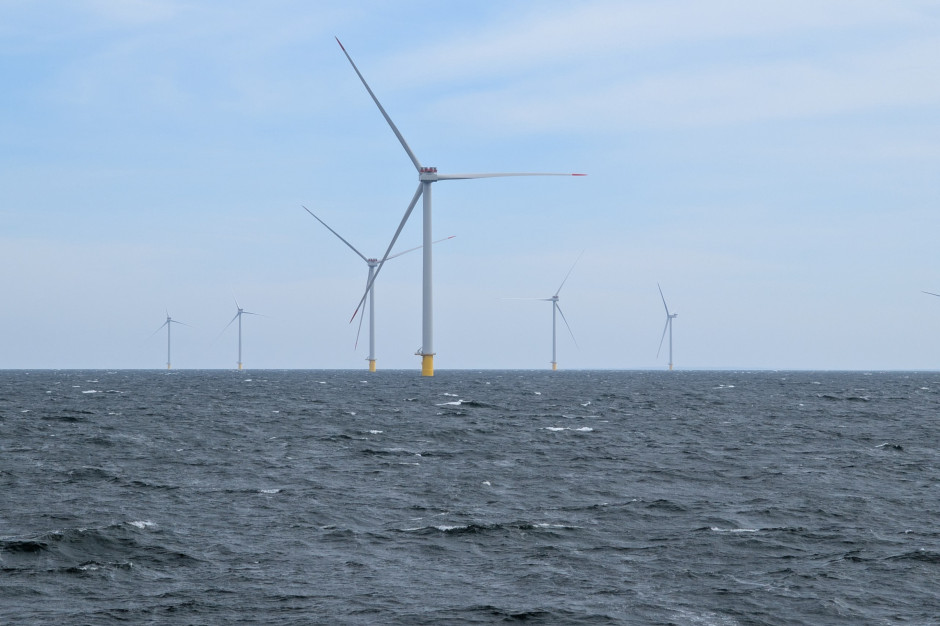
Poland’s offshore wind programme on the Baltic Sea has moved from years of planning into active delivery of multi-billion projects — and the industry says its biggest problems are no longer technological. At the Energy Days conference, panellists pointed to supply-chain bottlenecks, sluggish permitting, disinformation and, in one striking case, the absence of a helicopter able to reach modern turbines.
The shift in scale is dramatic. A decade ago the official state target was just 500 MW and investments were planned around turbines five times smaller than today’s machines. The offshore wind act triggered an avalanche of projects, and almost 6 GW of new capacity is now being built, with orders flowing to Polish industry.
– We are in a completely different place today, it is literally another galaxy – said Jakub Budzyński, president of the Polish Chamber of Maritime Wind Energy.
Contracting in this business is a long game, signed years in advance, and some suppliers are only now gaining their first experience on Polish projects. Kacper Kostrzewa, managing director of Ocean Winds in Poland, said every deal is preceded by months of analysis. He cited the Crist shipyard in Gdynia, which designs and builds offshore substations — Ocean Winds ordered one such unit for its BC Wind farm. For the shipyard, that means entering Tier 1, the group of top suppliers working directly with the investor.
– We talked with Crist of Gdynia for a good two years before we signed the contract. The purpose was for us to understand each other’s capabilities and expectations, and to know what this cooperation would ultimately involve – said Kostrzewa.
Maciej Stryjecki, head of offshore wind at Orlen SA and president of Baltic Power, warned that reaching a 45 per cent share for Polish industry in the second phase requires maturity on both sides, so that unprepared firms do not collapse under the weight of signed agreements. He also flagged schedule risk: starting several projects in parallel can create bottlenecks for contractors and suppliers alike and push overall costs, and ultimately the price of electricity, higher.
– Before the second phase there can be no over-enthusiasm of the kind where every company signs contracts, tries to become a consortium member and take on shared responsibility. They may think that the role of subcontractor is no longer for them, because we have strong local content. Everyone must consider what that involves. When something goes wrong on a contract worth tens of millions of euros, as a consortium member you take full shared responsibility for it – warned Stryjecki.
New instruments are meant to answer those financial and delivery risks. Beside state programmes — the Industrial Development Agency has just launched one — commercial solutions are coming.
– PIMEW will announce cooperation with an entity from the banking sector, aimed at developing the groundwork for introducing debt financing instruments and bank guarantees to the market for small and medium-sized companies interested in offshore wind – said Budzyński.
Predictability over spectacular growth
Bartosz Fedurek, president of PGE Baltica, argued that smart planning of works, auctions and orders counts for more than headline capacity figures.
– More important than spectacular, step-by-step additions of further gigawatts to the system is ensuring sustainable development. As a sector we prefer stability, repeatability and predictability. Put simply: quality is key, not speed – assessed Fedurek.
Administrative procedures remain a permanent headache. Kostrzewa pointed to extended permit acquisition times caused by staffing shortages in state offices. Ewa Makowska, head of the offshore wind energy division at the Ministry of Climate and Environment, said the ministry keeps in touch with the market and patches regulatory gaps as fast as multi-ministerial agreement allows.
– We are in constant contact with the market, we try to patch all regulatory gaps in the shortest possible time, as far as multi-ministerial consultations allow – said Makowska.
Offshore wind involves several ministries — climate and environment, energy, state assets and infrastructure — which makes a single unified voice difficult. Makowska confirmed work on an amendment to the offshore wind act introducing non-price criteria and plans for another support auction in the second half of 2027. The draft is ready and awaits entry into the Council of Ministers’ work list.
Fighting disinformation and counting the benefits
Janusz Gajowiecki, president of the Polish Wind Energy Association, described the information battle in stark terms and called for education campaigns, pointing to a broad government campaign for nuclear energy years ago that shifted public perception of that source.
– We deal every day with a situation bearing the hallmarks of hybrid warfare. The scale of disinformation and artificial distortion of costs related to offshore wind is enormous – said Gajowiecki.
He cited research showing that almost half of Poles wrongly believe the energy transition and renewables push up electricity bills, a result — in his view — of propaganda targeting Poland as a frontline country. The manipulation presents costs through the lens of a short period and high capital spending while ignoring that the technology lowers prices over the long term.
Fedurek offered the opposite side of the ledger. Adding 6 GW from the first phase should cut wholesale power prices by around 50 zł per megawatt-hour, producing savings of 8-10 billion zł a year for the economy, and avoiding the burning of roughly 4 billion cubic metres of natural gas.
– That is as much gas as communal and household consumers use in Poland, so offshore is a fuel-saving technology. Thanks to offshore we will not burn fuel, mainly gas. This is the effect of building the Polish economy’s resilience to global political shocks – said Fedurek.
One challenge is far more mundane, though it concerns aviation. After the investment phase comes operation, which has rules of its own. Stryjecki described a paradox: billions were spent on projects for which Poland has no suitable helicopter.
– The only helicopter available today for state rescue operations on the Baltic can hover at a maximum altitude of just 46 metres. Let me remind you that turbines reach 250 metres, which in extreme cases drastically extends the time needed to evacuate casualties – said Stryjecki.
Źródło: WNP.pl, Fot. PTWP




