
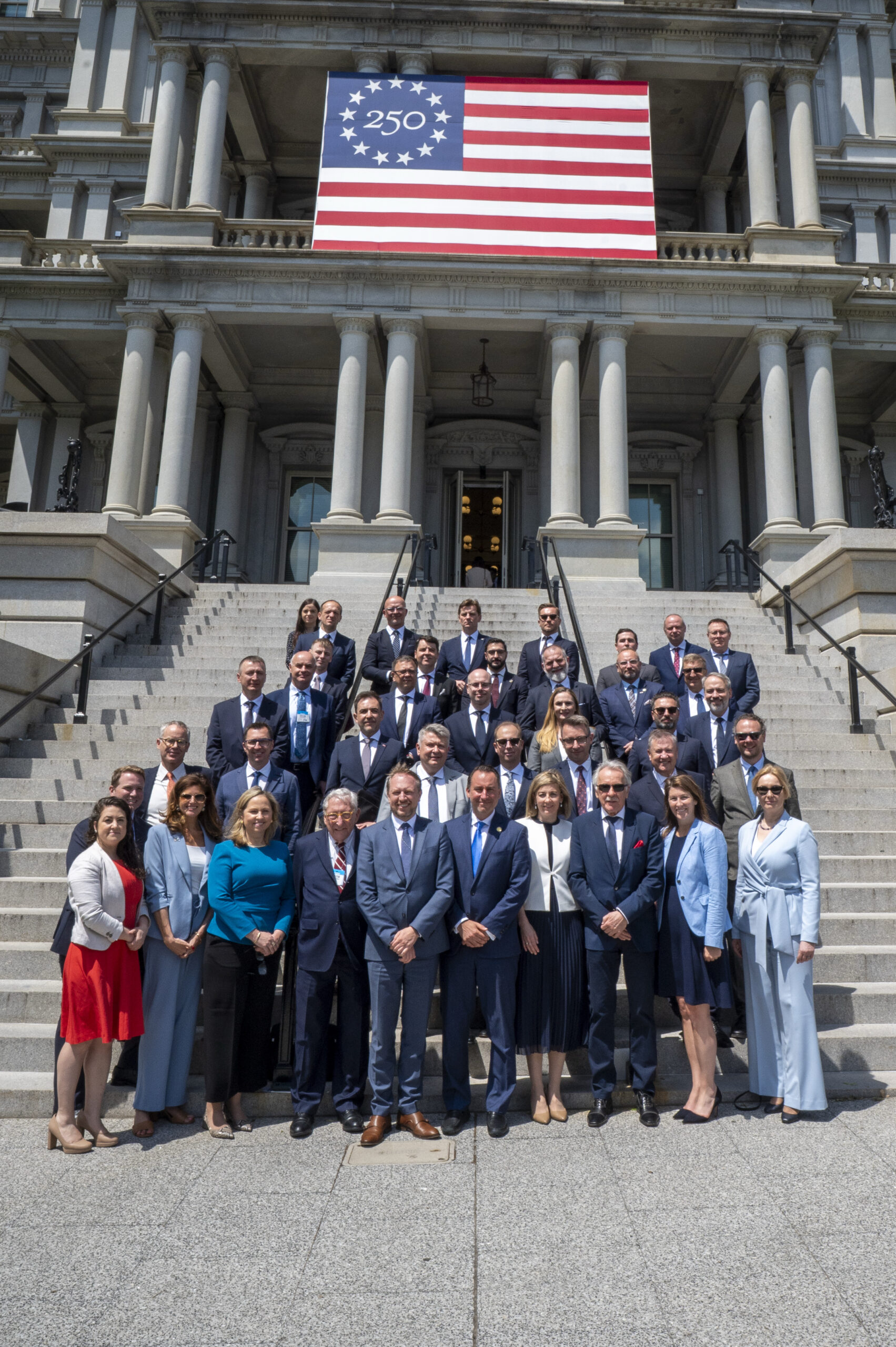
In May 2026, Westinghouse Electric Company and Bechtel hosted a Polish economic mission in the United States, with the participation of representatives from the management of Polish Nuclear Power Plants and leading Polish industrial companies. The several-day mission took place in Washington, D.C., and was organised by the Nuclear Energy Institute and the Polish Chamber of Energy and Environmental Protection. The talks focused on long‑term cooperation opportunities, the development of a local supply chain and the competencies needed to implement nuclear power plant projects in Poland based on AP1000 technology.
Washington, D.C., May 14, 2026 – This week, Westinghouse Electric Company and Bechtel hosted a Polish economic mission in the United States, with participation of representatives from Polish Nuclear Power Plants (PEJ) and leading Polish industrial companies. The visit aimed to deepen transatlantic cooperation in the nuclear energy sector.
The multi-day mission, organised by the Nuclear Energy Institute and the Polish Chamber of Commerce for Energy and Environmental Protection, was led by Deputy Minister of Energy Wojciech Wrochna and PEJ President Marek Woszczyk. It included a series of meetings with administration representatives, industry leaders and American nuclear sector suppliers. Discussions focused on opportunities for long‑term cooperation, development of a local supply chain and the competencies needed to build nuclear power plants in Poland using AP1000® technology.
140 years of experience and a third reactor
Westinghouse and Bechtel bring over 140 years of combined experience in nuclear energy to the project. Westinghouse Electric Company was founded in 1886 by George Westinghouse in Pittsburgh, Pennsylvania. Bechtel is an American engineering and construction firm founded in 1898 in San Francisco by Warren A. Bechtel. The two companies are cooperating on the construction of new nuclear units worldwide.
– This economic mission demonstrates how strong and dynamic the partnership between Poland and the United States is in the nuclear energy area – said Dan Lipman, President of Global Business Initiatives at Westinghouse.
– As work progresses on the project in Lubiatowo‑Kopalino in Pomerania, we are pleased to host representatives of PEJ and Polish entrepreneurs in the United States. Together we are developing a strong supply chain that will strengthen Poland’s energy security and bring economic benefits on both sides of the Atlantic.
American experience from Vogtle
During the mission, Westinghouse and Bechtel shared their experience in delivering complex, large‑scale projects, including nuclear power plants. Polish entrepreneurs also had the opportunity to talk with representatives of American companies that participated in the construction of AP1000 units at the Vogtle plant in Georgia. The Vogtle plant with units 3 and 4 was completed in 2023 and 2024, after years of delays and cost overruns. The two AP1000 reactors at Vogtle now supply a total of about 2.2 GW of power.
– We were honoured to host the Polish economic mission at our Washington, D.C. office – said Dena Volovar, President of the Nuclear, Security & Environmental business unit at Bechtel.
– This week of meetings has shown that the first nuclear power plant project in Poland has a committed investor, Polish suppliers ready to act, the support of the Polish and US governments, and a team capable of delivering this undertaking efficiently. It also underscores the role of American leadership in delivering safe, reliable and advanced energy infrastructure in partnership with trusted allies. We are delighted to host Polish industry leaders in the United States and to participate in discussions that help integrate Polish companies into the global nuclear energy supply chain.
AP1000 technology and global deployment
The advanced AP1000 reactor is the only operating Generation III+ reactor with fully passive safety systems, modular construction and the smallest footprint per MW of electrical capacity on the market. Passive safety systems mean the reactor can be cooled without power from external sources – a critical feature in emergency situations. Six AP1000 reactors are currently setting operational efficiency and availability records worldwide. Another 14 reactors are under construction, and five more are under contract.
AP1000 technology has been selected for nuclear energy programmes in Poland, Ukraine and Bulgaria. In Poland, the project envisages the construction of three units with a total capacity of about 4.5 GW. The first unit, under the 2025 schedule, was to start in 2033, but deadlines may slip. Westinghouse and Bechtel did not give new dates during the mission, nor did they comment on delays related to the licensing process at the National Atomic Energy Agency. Polish Nuclear Power Plants also did not announce which Polish companies have already joined the supply chain.
Economic benefits for Poland
The investment is expected to bring long‑term economic benefits to Poland by creating thousands of jobs for highly skilled workers and increasing opportunities for Polish companies to participate in the nuclear power supply chain. According to earlier Westinghouse estimates, the construction of the plant could create between 8,000 and 10,000 construction jobs and about 1,000 permanent jobs in operation. Polish companies can bid for contracts to supply prefabricated elements, reinforcing steel, ventilation systems and other non‑nuclear components.
During the mission, Polish entrepreneurs also had the opportunity to discuss other cooperation opportunities at the local, regional and global levels. Westinghouse and Bechtel did not disclose, however, which specific Polish companies took part in the meetings nor what preliminary agreements or letters of intent might have been signed. No schedule for further visits or specific investment decisions was announced.
Support from the Polish and US governments
The mission demonstrated that the first nuclear power plant project in Poland has a committed investor in Polish Nuclear Power Plants (a company 100 percent owned by the Polish State Treasury), Polish suppliers ready to act, and the support of the Polish and US governments. The US EXIM Bank approved $8 billion in financing for the project in January 2026. The total estimated cost of building the three units is about $20 billion.


