
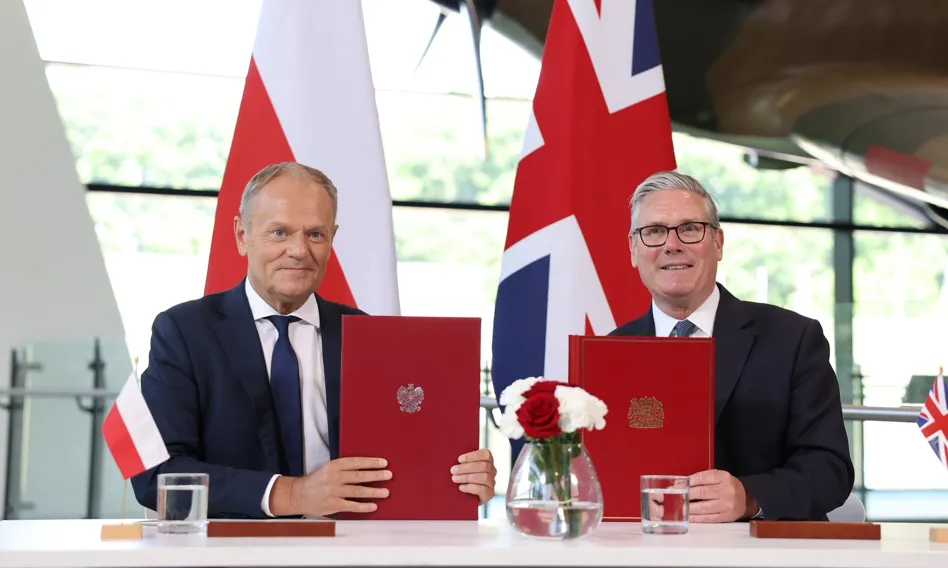
On 27 May 2026, the prime ministers of Poland and the United Kingdom, Donald Tusk and Keir Starmer, signed a treaty on security and defence partnership in west London. The document provides for joint production of new-generation medium-range air defence missiles, large-scale military exercises, and cooperation between the defence industries.
The treaty was signed in the afternoon at a residence in west London. Earlier announcements from the Polish prime minister’s office indicated that the list of projects implementing the agreement would include countering hybrid threats, disinformation and illegal migration. The treaty also covers the development of cybersecurity and the security of maritime, energy and health infrastructure.
Before leaving for the United Kingdom, Donald Tusk said that the treaty sets out a framework for military cooperation, the defence industry and cybersecurity. Poland will work with London on cutting-edge technologies for drones, air defence and cybersecurity.
– This treaty sets out a framework for military cooperation, the defence industry and cybersecurity – said Donald Tusk before his departure for the United Kingdom.
The Polish prime minister stressed that in one of the opening sentences of the Polish-British treaty, both sides emphasise that they are aware that Russia is a strategic threat, also a long-term one, for Poland, the United Kingdom and NATO. That wording is in the preamble and is declaratory, but it sets a common assessment of the geopolitical situation.
After the signing ceremony, Donald Tusk said that the United Kingdom and the Republic of Poland need this highest-level cooperation between their governments, states and nations in the field of security and defence.
– We want to defend a safe United Kingdom, Northern Ireland, we want to defend a safe Poland, our territories, our borders. Secondly, we want to protect cyberspace; modern technologies mean that no one feels safe today, and cooperation in this area is so important – said Donald Tusk.
– Thirdly, we told each other that we want to protect ourselves, but also the wider community; we do this within NATO, in order to strengthen NATO; we want to be more practical, faster to react when the need arises. That is what this treaty is for – added the Polish prime minister.
Tusk stressed that the political essence of this treaty is to strengthen European solidarity, solidarity within NATO and European-American solidarity, those transatlantic ties. The treaty also mentions the protection of common values such as the rule of law, democracy and human rights.
A generational strengthening of relations
Keir Starmer, the British prime minister, said the treaty would be the biggest step forward in bilateral defence and security relations in a generation. In a Downing Street statement, he called the agreement a generational change and a generational strengthening.
– This is immensely important as a signal to the world of the strength of the relationship between our countries – said Keir Starmer.
The British prime minister noted that the treaty is being signed at a time of threat posed to Europe by Russia. He indicated that under the treaty, both countries will develop their existing relations, including joint military training, sharing defence capabilities and mutual investment. The treaty also addresses cooperation in combating illegal migration and other threats.
Joint missile production and exercises
According to the Downing Street statement, the treaty provides for the joint production of new-generation medium-range air defence missiles. No details were given on which specific missile systems are involved or the scale of production. The defence industries of both countries are to cooperate on designing advanced ammunition for air defence.
The agreement also provides for large-scale exercises of Polish and British troops. No details were given on how often they will take place or where they will be located. Air and missile defence systems are to be strengthened. The treaty is also part of deepening London’s cooperation with the European Union after Brexit. The United Kingdom left the EU in 2020, but has since been gradually rebuilding relations in the field of security and defence.
A year before the agreement with the United Kingdom, in 2025, Poland signed a similar treaty on enhanced cooperation and friendship with France. The ceremony took place in Nancy. The Polish-French treaty also covered military cooperation and the defence industry. Both documents are part of a broader Polish strategy to strengthen bilateral relations with key Western European countries in the face of the Russian threat.
Fot. CMP


