
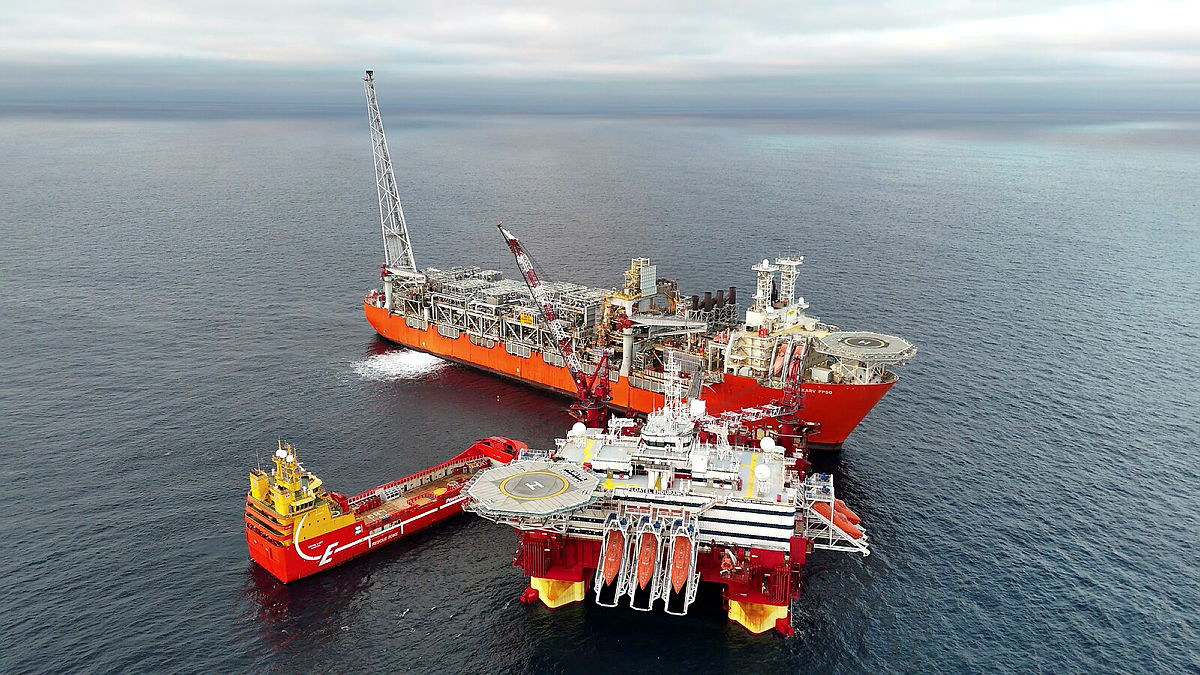
Orlen Upstream Norway, together with its licence partners, has started gas production from the Idun Nord field in the Norwegian Sea. Over the next few weeks, the company will bring on stream two further fields, Alve Nord and Ørn. All three fields are located in the Skarv area, which is one of Orlen’s main production hubs in Norway. Together they will provide the company with approximately 30 million barrels of oil equivalent, most of which is natural gas.
Orlen Upstream Norway is the Norwegian subsidiary of the Polish multi-energy group, responsible for exploration and production on the Norwegian Continental Shelf. The company holds interests in several dozen licences and is one of the largest foreign investors in the Norwegian oil and gas sector.
The start of production from the three new fields is another step in the implementation of Orlen’s 2035 strategy, which aims to increase hydrocarbon output and strengthen Poland’s energy security. All three fields were developed as part of a single project, which made it possible to use the same infrastructure and reduce costs. The varied ownership structure of the individual fields required close coordination and effective cooperation between the partners.
The total resources of the three new fields are 120 million barrels of oil equivalent, of which Orlen’s share is over 30 million boe. As much as 80 percent of the resources are natural gas. From Orlen’s perspective, the Ørn field is of key importance, as it will provide the company with approximately 22 million boe. Orlen Upstream Norway holds a 40 percent stake in this field, with the other partners being Aker BP, which acts as operator, and Equinor, each with 30 percent.
In the case of Idun Nord, Orlen Upstream Norway holds an 11.9 percent stake, with the remainder held by Aker BP (operator, 23.8 percent), Equinor (36.2 percent) and Harbour Energy (28.1 percent). The shareholders of Alve Nord, in addition to Orlen Upstream Norway (11.9 percent), are Aker BP (operator, 58.1 percent), Harbour Energy (20 percent) and JAPEX Norge (10 percent). The varied ownership structure of the individual fields required close coordination and effective cooperation between the partners.
– The start of production from the Idun Nord, Alve Nord and Ørn fields means additional volumes of natural gas that will strengthen the energy security of Poland and the region. Together, the new fields will provide Orlen with more than 4 billion cubic metres of natural gas. This is particularly important in the context of increased geopolitical uncertainty, including tensions in the Middle East, which remind us of the importance of stable and diversified supply routes. Thanks to very good cooperation with our partners, we have developed three fields as part of a single project, reducing costs and shortening the schedule. As a result, production is starting a year earlier than planned. In the current circumstances, this is not only an operational success, but also a significant strengthening of supply security for Poland and the region – said Ireneusz Fąfara, CEO of Orlen.
Connection to Skarv FPSO
The new fields have been tied into the Skarv FPSO, the main production unit in the Skarv area. FPSO stands for Floating Production, Storage and Offloading unit, which receives raw materials from subsea wells, processes them and stores them before shipment to shore. The use of existing infrastructure has reduced the carbon footprint of the investment, so production from the new fields will have an emissions intensity of just 4.5 kilograms per barrel. By comparison, the global average for oil and gas production is around 15-20 kilograms per barrel, showing how low-carbon Norwegian production is.
In addition, the start-up of Idun Nord, Alve Nord and Ørn will allow better use of the Skarv FPSO’s potential and extend its operating life to at least 2040. Without the new fields, the unit could have been shut down earlier due to declining production from existing fields. The new resources extend its life and improve the economics of the entire project.
– By increasing the utilisation of the Skarv FPSO, we can develop production in Norway in a more cost-effective and environmentally efficient way. The connection of the new fields extends the production horizon of the Skarv area and will allow Orlen to increase its production in this area from 3.3 to 9 million boe in 2027, which translates into the achievement of the goals of Orlen’s 2035 strategy. This is also a good example of how to make better use of existing infrastructure without having to build new installations from scratch – said Wiesław Prugar, Vice President of Orlen’s Management Board for Upstream.
Growing importance of Norway
Production from the three new fields will be brought on stream successively to ensure operational safety. Once completed, the number of Orlen’s producing fields on the Norwegian Continental Shelf will increase to 24. In May 2026, Orlen Upstream Norway started production from the Eirin field in the North Sea, which provides further volumes of gas to Poland.
Norway is one of Poland’s main sources of natural gas, and the raw material extracted on the shelf reaches the country via the Baltic Pipe pipeline. Last year, gas delivered via this route met more than 40 percent of Poland’s demand. A significant part of the raw material came from Orlen Group’s own fields in Norway.
In 2025, Orlen Upstream Norway produced approximately 4.4 billion cubic metres of gas, illustrating the scale of the group’s Norwegian operations. The company plans to further increase production through exploration and development of new fields, optimisation of production from existing assets, as well as mergers and acquisitions.
The new fields Idun Nord, Alve Nord and Ørn are part of this strategy and fit into Orlen’s long-term plans to secure gas supplies for Poland. They give Poland an additional, stable source of raw material, which is particularly valuable in the face of geopolitical uncertainty and price volatility on global energy markets.
The development of Orlen’s Norwegian assets is also part of building the country’s energy independence. Increasing production in Norway allows for the diversification of supplies and reduces dependence on other import routes. Orlen is consistently implementing its strategy, which assumes that by 2030 Norway will remain a key production region for the Polish group.
Photo: Aker BP




