The visits of US President Donald Trump and Russian President Vladimir Putin to Beijing in May did not bring the expected results. While Trump was hosted with ceremonial honors and Putin sought progress on the Siberia-2 pipeline, neither achieved a strategic breakthrough. Meanwhile, traditional rivals Japan and South Korea are deepening their cooperation, underlining the shifting balance of power in East Asia.
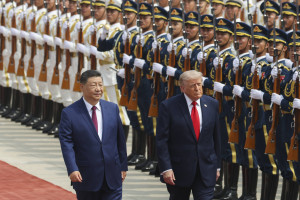
Donald Trump visited Beijing from May 13 to 15, his second trip to China as president. He was welcomed with what many observers called “imperial” treatment, reminiscent of his 2017 visit, which included a dinner at the Forbidden City. The US president brought a large business delegation including CEOs of Tesla, Nvidia, Apple, and Boeing, signaling a focus on economic deals. However, each executive had their own agenda: Nvidia’s Jensen Huang, for example, hoped to secure deals for H200 advanced processors, but faces both US export restrictions and Chinese preference for domestic solutions.
According to a White House statement, Trump secured an agreement for China to buy $17 billion in US agricultural products and 200 Boeing aircraft. Yet Beijing’s official statement did not confirm these figures, leaving the actual outcome uncertain. The US also postponed approval of arms sales to Taiwan, officially citing the ongoing war with Iran. – The agreement covers $17 billion in US agricultural products and 200 Boeing aircraft – stated the White House statement.
Putin’s unmet ambitions
Vladimir Putin arrived in Beijing on May 19-20, just days after Trump, though the timing was coincidental. The Russian president aimed to mark the 25th anniversary of the Russia-China friendship treaty and push for a breakthrough on the Siberia-2 gas pipeline. However, China, which now supplies up to 90% of sanctioned components critical to Russia’s defense industry, holds the stronger hand. Beijing is reluctant to increase its dependency on Russian energy unless offered exceptionally favorable terms.
Both leaders used the meeting to criticize US “unilateral interference in international trade and supply chains,” as stated in their joint communiqué. But for Putin, the visit was a reminder of Russia’s diminished status. – China has become Russia’s indispensable partner, but the relationship is increasingly asymmetrical – noted a regional analyst. The next opportunity for Xi Jinping to continue this narrative was his visit to North Korea on June 8.
Seoul-Tokyo: pragmatic cooperation
On May 19, Japanese Prime Minister Sanae Takaichi met South Korean President Lee Jae Myung in Seoul. This was the fourth meeting between the two leaders in six months, reflecting a warming of ties between historic rivals. Recent visits included Takaichi’s trip to Lee’s hometown Andong, and Lee’s earlier visit to Nara, Takaichi’s hometown. The two countries have signed agreements on LNG cooperation, including joint storage and cargo swaps, and emphasized their security alliance with the United States.
The geopolitical shocks of the past year – including the US-Iran conflict and the Ukraine war – have pushed Tokyo and Seoul to prioritize pragmatism over historic grievances. – We are seeing these smaller powers trying to shield themselves from the economic consequences of great-power competition – commented a geopolitical expert.
All three visits share a common thread: major powers seek to reshape the international order to their advantage, while smaller nations try to build resilience. Putin’s war in Ukraine accelerated Russia’s dependence on China; Trump’s focus on Iran distracted from challenging Beijing; and China gained confidence to demand more concessions. The resulting shifts are forcing every country in the region to adapt.
Źródło: Instytut Boyma, Fot. PAP/EPA/Reuters