
A Brazilian federal court has for the first time criminally convicted a mining company and its managers over the failure of the Fundão dam in Mariana. Almost 11 years after the Samarco dam collapsed, Samarco Mineração was banned from entering into contracts with public administration for 10 years, while three former managers were sentenced to between more than seven years and eight years and nine months in prison. The verdict changes the legal situation surrounding one of the largest environmental disasters in the history of Brazilian mining.
The decision was issued on 3 September by the second panel of the Federal Regional Court of the Sixth Region, TRF 6, in Belo Horizonte. The judges unanimously partially upheld the appeals against the first instance ruling, which acquitted the defendants in 2024. In the criminal case, responsibility was assigned to Samarco and three former managers: Germano Silva Lopes, Daviély Rodrigues Silva and Wagner Milagres Alves. The court, however, upheld the acquittals of the other defendants, including representatives of Vale, BHP and VOGBR. The September ruling remains subject to appeals.
For Samarco, the criminal consequences include fines exceeding 6 million reais and an additional 1 million reais allocated to the National Environmental Fund. The company was also barred from entering into contracts with the public sector for 10 years. In the case of the individuals, Daviély Rodrigues Silva, a former geotechnical manager, and Germano Silva Lopes, a former structural projects manager, were each sentenced to eight years and nine months in prison, initially under a closed regime. Wagner Milagres Alves, a former mining operations manager, was sentenced to seven years, three months and 14 days in prison, initially under a semi open regime.
The Fundão dam ceased to exist within minutes
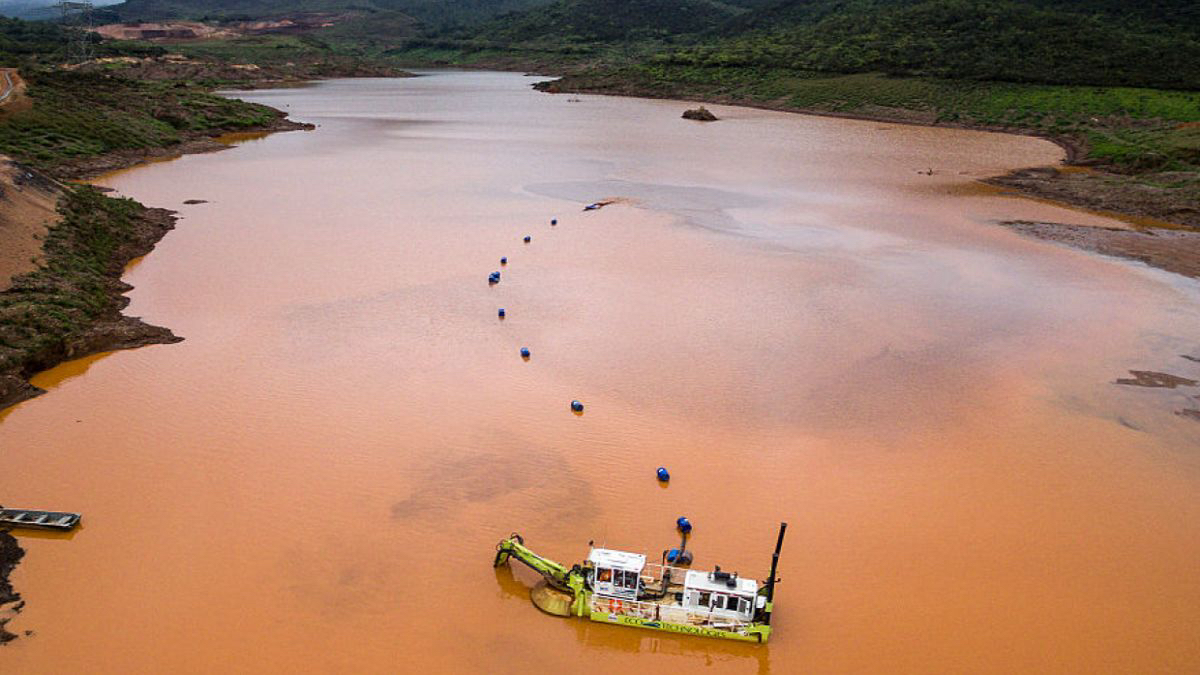
The disaster occurred on 5 November 2015 in Mariana, in the state of Minas Gerais. At a mine owned by Samarco, the Fundão dam failed. It had been holding waste generated during the processing of iron ore. Samarco is a joint venture between Vale and BHP. The released waste entered the river system and flowed down the Doce River valley towards the Atlantic Ocean.
According to findings cited in current materials concerning the case, the disaster released around 40 million cubic metres of waste. Nineteen people were killed, and the town of Bento Rodrigues was among the places destroyed. The wave of waste then passed through successive sections of the Rio Doce basin, reaching the Atlantic Ocean coast. The scale of the event meant that its effects extended far beyond the immediate surroundings of the mine.
The problem was not limited to the loss of the structure itself. In the case of this type of facility, the time between detecting a dangerous phenomenon and the complete failure of the dam is crucial to the possibility of evacuation. One element of the criticism surrounding the disaster was the lack of an effective immediate warning system for residents located in the danger zone. As a result, people living below the dam had very limited opportunity to respond to the rapidly moving wave of waste.
The disaster also affected the economies of local communities. Pollution affected the Doce River and its tributaries, with consequences including access to water, agriculture, fishing and economic activity carried out along the river. The environmental and social effects did not end when the first wave of waste passed, because part of the material was deposited in river channels and floodplains.
The court overturned the earlier acquittal
The significance of the September verdict also stems from its relationship to the earlier proceedings. In November 2024, the court of first instance acquitted the defendants in the criminal case, finding that their direct criminal responsibility had not been demonstrated to the required degree. The Federal Public Prosecutor’s Office appealed against that ruling, and the case was brought before TRF 6.
The second panel of the appellate court accepted some of the prosecution’s arguments and changed the ruling with regard to four parties. In the case of the three former managers, the issue concerned responsibility for causing a flood resulting in deaths as well as environmental offences. With regard to Samarco, the court imposed sanctions on the legal entity, including a financial penalty and a ban on entering into contracts with public administration.
The verdict does not mean, however, that all entities previously identified in connection with the disaster were found guilty. The court upheld the acquittals of the other defendants. This is an important distinction because from the beginning the case involved a broad group of people and entities connected with the operation of the mine, the design of the dam and its supervision.
Mariana became a turning point for the entire sector
The Fundão disaster was the first of two events that fundamentally changed Brazil’s approach to the safety of mining waste dams within a few years. On 25 January 2019, another catastrophic dam failure occurred at the Córrego do Feijão mine owned by Vale in Brumadinho.
The scale of the tragedy in Brumadinho was even greater in terms of the number of victims. According to current data from the authorities of the state of Minas Gerais, the 2019 disaster caused the deaths of 272 people. Around 12 million cubic metres of waste were released from the dam and entered the river system.
The two disasters also had a common regulatory dimension. They showed that the safety of a facility cannot be treated solely as a matter of the technical maintenance of a dam. It also includes monitoring, the responsibility of managers, warning systems, evacuation planning, and the way such facilities are designed and decommissioned.
Brazil tightened the rules for dams
Following the Brumadinho disaster, Brazilian regulations governing mining waste dams were tightened. Particular attention was paid to structures built using the method known as upstream, in which successive stages of the structure are raised towards the waste reservoir. This type of construction became the focus of debate following the disasters in Mariana and Brumadinho.
The new approach envisaged eliminating this solution and converting existing facilities. The regulations also included requirements concerning technical designs for dam decommissioning, monitoring, and restrictions on locating infrastructure and places of permanent human residence directly within the danger zone.
The changes also concerned emergency systems. For facilities whose failure could threaten residents, the key issue is not only the probability of dam failure, but also the time required to communicate information and carry out an evacuation. Alarm sirens, monitoring and the designation of danger zones therefore became elements of a broader risk management system.
The disasters forced a global standard
Mariana and Brumadinho did not remain solely a Brazilian problem. Subsequent failures of tailings dams led to an international discussion about how the management of such facilities should be carried out throughout their entire life cycle.
In 2019, the International Council on Mining and Metals, ICMM, the United Nations Environment Programme, UNEP, and the Principles for Responsible Investment organisation began the Global Tailings Review process. Its outcome was the Global Industry Standard on Tailings Management, published in August 2020, which established a global standard for the management of tailings storage facilities. The document covers the entire life cycle of a facility, from site selection and design through construction, operation and monitoring to closure and the post closure period.
The standard consists of six thematic areas, 15 principles and 77 auditable requirements. It covers, among other things, engagement with communities within the facility’s area of impact, risk management, management responsibility, structural monitoring, emergency response and public disclosure of information. One of its principles is to place responsibility for safety at the highest level of the organisation rather than treating the dam solely as a technical problem assigned to a particular facility.
The verdict changes the risk calculation for mining
The September ruling has significance extending beyond Samarco itself. For years, discussion of dam disasters focused primarily on environmental costs, compensation, infrastructure reconstruction and regulatory changes. Criminal liability of managers and the company itself now becomes an explicit part of that calculation.
This is particularly important in the case of infrastructure whose failure can cause deaths and destroy entire communities within minutes. Responsibility does not end with the question of whether the structure met technical parameters on the day of an inspection. Decisions concerning monitoring, responses to warning signals, facility maintenance, risk management and readiness to halt operations become crucial when information emerges indicating a threat.
For Brazilian mining, the Fundão case therefore remains open on two levels. On the one hand, the legal stage following the TRF 6 ruling is continuing, with possible further appeals. On the other hand, the consequences of the disaster are part of a long term remediation process, while the lessons from Mariana and Brumadinho have already been incorporated into regulations and international safety standards. The most important test now is not simply whether new rules exist, but whether they make it possible to detect a threat early enough for a technical decision and a management decision to be made before a disaster, rather than afterwards.




