
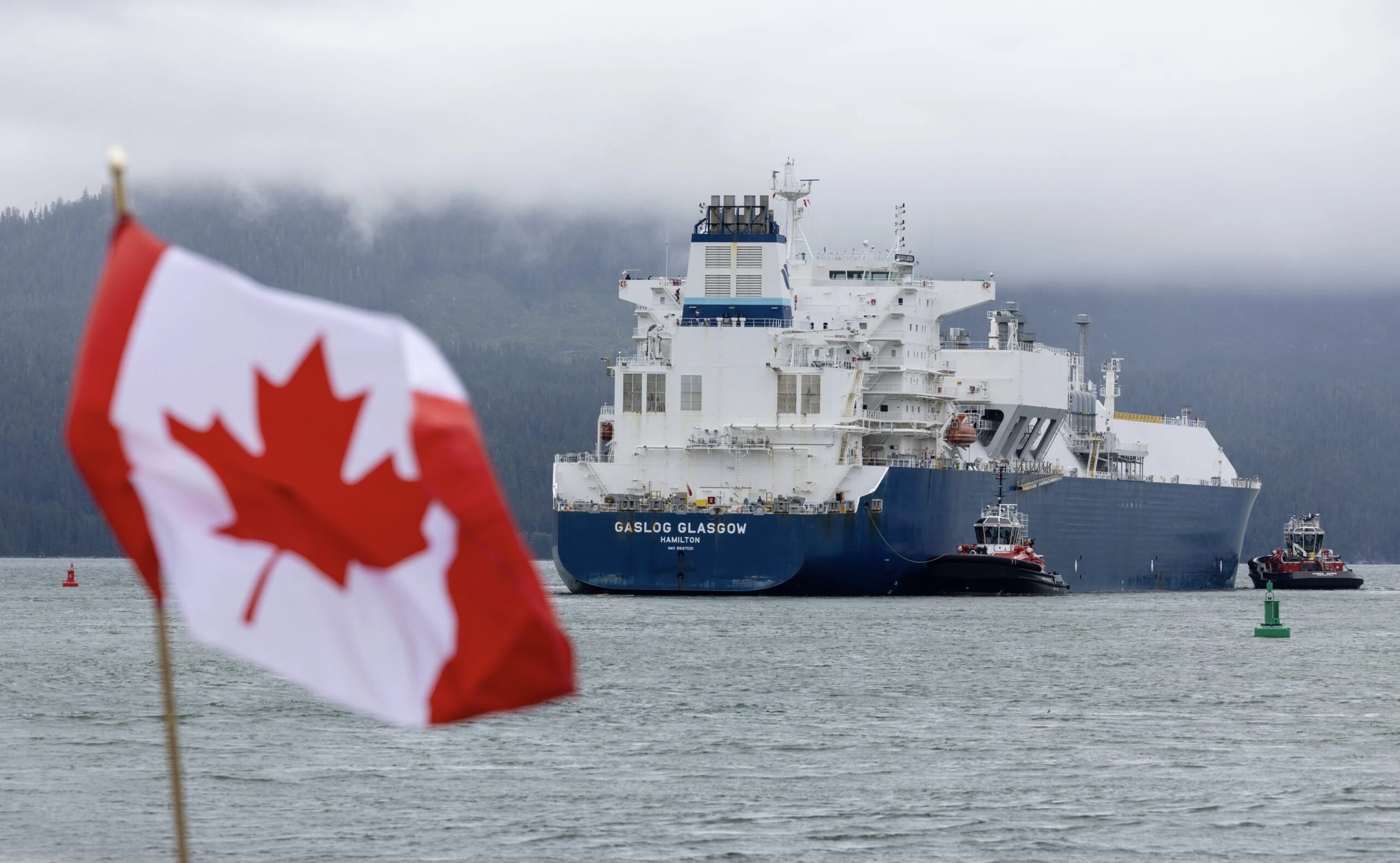
France wants to leverage Canada’s gas resources to strengthen Europe’s energy security. Following a meeting with Canadian Prime Minister Mark Carney on Saint Pierre and Miquelon, Emmanuel Macron said Canadian LNG projects could become an important element of the European gas market and that the two countries had begun discussing specific solutions. The key issue, however, is not the production of the commodity itself, but how to direct larger volumes of Canadian LNG toward the European market, as Canada’s existing export infrastructure is more heavily oriented toward the Pacific.
The meeting took place on September 20 on the French archipelago of Saint Pierre and Miquelon, located off the coast of Canada’s Newfoundland. For Macron, the location of the talks had both political and economic significance, as it is France’s only territory in North America and, at the same time, a direct point of contact between France and Canada. The Canadian prime minister’s office confirmed that the talks covered energy, the energy transition, critical minerals, security, space, and advanced technologies.
Even before meeting Carney, Macron spoke explicitly about the need to increase Canadian LNG supplies to the European side of the Atlantic. The French president said Canada is a major producer of energy commodities and that some of its gas could be used to diversify Europe’s supplies.
– Canadian liquefied natural gas projects can contribute to and are important for our Europe, and will also help open up new prospects between our two countries – Emmanuel Macron said.
In an official statement, the Élysée Palace clarified that the talks concerned increasing the amount of LNG that could reach the European side of the Atlantic. France wants to take advantage of Canada’s expanding export capacity, while recognizing that its existing infrastructure is not yet configured to direct gas evenly toward both coasts.
– Canada is a country that has a lot of resources, critical minerals and rare earth metals. These are things that we want to contract from France, as well as from the European Union, and Canada is also, as you know, a major producer of fossil hydrocarbons. It produces gas which, through its production, but also through what it does in refining, helps balance the global market. So several European countries have entered into swap agreements, exchanges. We want to see how — or rather, not simply see how, but consolidate and conclude agreements so that we can very clearly have more liquefied gas that can reach the Atlantic coast. Today, there is a lot of it, but much of it goes to the Pacific coast. The aim is therefore to enable diversification – Macron said.
The difference between the two coasts matters for the European market. Canada has substantial gas resources, but LNG exports require liquefaction terminals, pipelines bringing the commodity to those terminals, as well as suitable shipping and port infrastructure. If gas is to reach Europe, it must be directed to terminals capable of handling Atlantic exports and then transported by ship to European import terminals. Expanding export capacity on Canada’s west coast therefore does not automatically solve the problem of supplying Europe.
LNG is part of a broader energy security strategy
France does not view its talks with Canada solely as negotiations over individual LNG cargoes. Macron linked gas supplies to a broader strategy of securing energy supplies and reducing Europe’s vulnerability to disruptions. The importance of this issue has increased in recent months amid tensions on global energy markets and the need to seek alternative supply routes.
– We must also work together to secure our energy supplies and control fuel prices, which is an extremely sensitive issue for France today. The situation in the Middle East and the broader region is, of course, causing these tensions. Canadian LNG projects can contribute to this and are important for our Europe. They will also help open up new prospects between our two countries. We have also begun a bilateral discussion with the prime minister on very concrete projects. I want to thank him for responding so quickly to our request concerning the most sensitive products, so that we can build solutions together, because Canada is a major producing country. We will continue this discussion both bilaterally and within the G7 on energy, which will be organized shortly – Macron said.
From Canada’s perspective, energy cooperation with Europe also forms part of a broader shift in economic policy. Carney’s government has spoken about strengthening ties with European partners amid growing uncertainty in global trade and the need to diversify export markets. In their official statement following the meeting, Macron and Carney pointed to the possibility of building a future partnership between Canada and the European Union aimed at strengthening economic resilience and security on both sides of the Atlantic.
Canada has the gas, but Europe needs the infrastructure
For European buyers, the key issue is not only the size of Canada’s gas resources, but above all the ability to export LNG on a regular basis. The European market needs supplies that can be directed to different terminals depending on demand, prices and the availability of other sources. Canada could become one of those suppliers, but increasing its share of Europe’s energy mix requires sufficient export capacity and infrastructure links.
The French proposal therefore focuses on the Atlantic export route. Macron pointed out that a significant portion of Canada’s LNG potential is currently being developed on the Pacific side. For Europe, this means overcoming the additional distance and using infrastructure capable of delivering gas to the European market in an economically viable way. If larger volumes are directed eastward from Canadian gas fields, shipping to Europe will be a much more natural route than sending gas west and then arranging a long-distance journey to European buyers.
Canadian authorities had already identified energy as one of the main areas of discussion with France ahead of the meeting. In announcing Carney’s visit, his office also listed space, critical minerals and advanced technologies — including quantum technologies, satellites and supercomputers — alongside energy and defence.
France also wants Canadian critical minerals
Gas is only one part of the picture. France and Canada also want to expand cooperation on critical minerals, which are needed by the energy, electronics, defence and technology industries. Canada has significant resources that could provide Europe with an alternative to supplies from more geographically concentrated sources.
The cooperation would therefore cover two distinct aspects of economic security. LNG can provide greater flexibility in energy supplies, while access to critical minerals can reduce the risk of disruptions in materials needed to manufacture technologies and infrastructure. Both areas are also important for Europe’s industrial development and for reducing dependence on individual suppliers.
During the visit, Macron emphasized that France and Canada want to strengthen their ability to make independent decisions in strategic sectors. In energy, this means seeking additional sources of gas and oil, while in technology and industry it means increasing access to raw materials, infrastructure and domestic production capabilities.
Energy was one of the key topics of the talks, but the scope of French-Canadian cooperation is considerably broader. The leaders agreed to deepen cooperation between space agencies, defence ministries and businesses. They intend to develop joint space infrastructure, including launch systems and ground infrastructure used for reception and control.
Carney also highlighted the need for cooperation on artificial intelligence. In his view, Canada, France, the United States and China are among the countries at the forefront of AI development and should work together on solutions that are safer and more effective. In his official remarks, the Canadian prime minister also stressed the importance of access to artificial intelligence, space, semiconductors, critical minerals, payment systems and clean energy in the modern understanding of national sovereignty.
The visit also carried symbolic significance. Mark Carney became the first Canadian prime minister to officially visit Saint Pierre and Miquelon. The archipelago is a French overseas territory located just a few kilometres off the coast of Canada’s Newfoundland and represents France’s direct presence in North America. Macron emphasized that the islands’ location allows them to be viewed as a physical link between France, Canada and Europe.
Canada is turning toward Europe
The Macron-Carney meeting took place at a time when Canada is intensifying its relations with Europe. In Saint Pierre and Miquelon, the Canadian prime minister spoke about building an alliance between Canada and the European Union that would strengthen the economic resilience of both sides. He listed energy security, technology, raw materials and industrial cooperation among its components.
For France, Canadian LNG could be one of the concrete elements of this closer relationship. Paris is no longer speaking only about general supply diversification, but is pointing to the need for specific agreements that would allow larger volumes of Canadian gas to reach the European market. Reuters reported on September 21 that Canadian Foreign Minister Anita Anand said Canada could potentially enter into an energy partnership with a European country involving LNG exported from Canada’s west coast.
At this stage, there is no information about a specific contract for a defined volume of LNG or about the final delivery model. The direction of the talks, however, is clear: France wants to leverage Canada’s gas production and export capabilities, while Canada is seeking closer economic ties with Europe. If the two countries translate these declarations into infrastructure investment and long-term agreements, Canadian gas could become another source of LNG for the European market alongside supplies from the United States, Norway, Qatar and other exporters.
For Europe, the key question will therefore not be simply how much gas Canada can produce, but how much of that volume can actually be directed toward the Atlantic and delivered to European terminals. France has already begun discussions on the issue, and Macron has said they will continue both bilaterally and within the G7.




