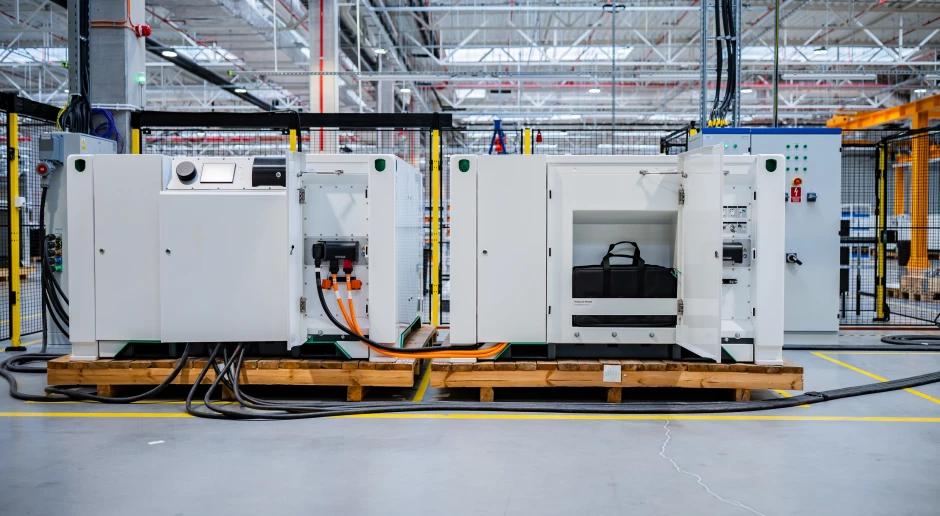
The American company Lyten has taken over the assets of the bankrupt Northvolt in Gdańsk and resumed production of energy storage systems. The plant can already produce installations with a capacity of 3 GWh per year, and the company has ready equipment for another 3 GWh. Lyten has also announced that it will conduct a feasibility study for an industrial hub that would include a data centre for artificial intelligence as well as production lines for 3D graphene and concrete additives.
Lyten is an American technology company based in San Jose, California, founded in 2015. The company specialises in the production of 3D graphene – a material used in batteries, composites and sensors. In 2025, Lyten took over the bankrupt Swedish company Northvolt, which was building one of the largest energy storage factories in Europe in Gdańsk. Northvolt declared bankruptcy in 2024 after financial and technological problems. Lyten acquired its assets in Poland and Sweden, although the transaction amount was not disclosed.
The Gdańsk plant currently produces proprietary energy storage systems under the name Voltpack Mobile System. Each Voltpack module has a capacity of 281 kWh and can be combined into larger systems for industry, electricity grids or wind and solar farms. For now, Lyten uses the lithium-ion technology it inherited from Northvolt.
– Since October, we have been restarting the plant’s operations, taking it to a higher level with Lyten. We have installed lines with an output of 3 GWh per year and ready equipment for another 3 GWh, and in the future we can scale this up to even 12 GWh – and that is only in the area of energy storage – said Robert Chryc-Gawrychowski, General Manager of Lyten Poland.
Robert Chryc-Gawrychowski is the same manager who ran the factory under Northvolt. He stayed on, as did part of the workforce. Thanks to this, Lyten did not have to build a structure from scratch. The recent „housewarming” of the Lyten Dwa plant in Gdańsk was an opportunity for the American company to talk about its plans in Poland. Until now, it had been mainly associated with taking over Northvolt’s assets and continuing lithium-ion storage production.
Lyten has already announced that it will conduct a feasibility study for an industrial hub in Gdańsk. In addition to the energy storage factory, the hub is to include a data centre for artificial intelligence as well as other Lyten plants related to the production of 3D graphene and specialised concrete additives.
– In the medium term, we want this to become the central point of our ecosystem – the Lyten industrial hub – said Keith Norman, Director of Marketing and Sustainability at Lyten.
– We see huge synergy between energy storage and data centres – they can share common infrastructure and stable power supply – added Keith Norman.
Lithium-sulphur cells
Lyten devotes most of its attention to its proprietary lithium-sulphur (Li-S) cell technology. Its advantages include the fact that it does not require large quantities of rare elements such as nickel, cobalt, graphite or manganese. The raw materials for producing lithium-sulphur batteries are widely available.
Switching the plant from producing storage units with lithium-ion batteries to lithium-sulphur ones is said to be relatively simple and requires no additional investment. Manufacturing the batteries themselves in these two technologies, however, is a different matter and requires different production lines. Lyten has not yet decided whether it will produce Li-S cells in Gdańsk or only assemble storage units from them.
– The advantage of lithium-sulphur batteries is a local supply chain independent of China. The raw materials are available directly in Europe and the US. At the same time, we have already started a next-generation cell line in California – for lithium-sulphur – and we are preparing to produce them in Sweden – said Keith Norman.
Lyten already has a lithium-sulphur cell production line in California. Another will be built in Sweden. In Sweden, Lyten has announced an investment of approximately $10 billion in foreign direct investment. The company has not disclosed whether a similar scale is planned for Poland.
Dual-use for military applications
The second element of Lyten’s strategy is dual-use, meaning products that will be used by both the military and the civilian sector. In the US, the company already cooperates with the Department of Defense, supplying batteries for military applications.
– This significantly improves the economic balance of our investments. Moreover, lithium-sulphur technology is based on by-products that do not require mining. Therefore, in this model, recycling is not such a critical link in the supply chain. Sulphur itself is cheap and common, and we produce graphene from natural gas – said Keith Norman.
3D graphene is the material from which Lyten produces battery anodes and cathodes. The company produces it from natural gas using a chemical vapour deposition process. This process is energy-intensive, but Lyten uses its own energy from storage to power it.
Lyten’s representatives admit that lithium processing is a problem. It is not a question of the availability of this raw material, but of the ability to process it into the form of lithium foil needed for lithium-sulphur batteries. Lyten currently produces such foil at its US plant. The company is considering building a similar plant in Europe to serve its investments in Sweden and Poland. Keith Norman did not disclose whether such a lithium foil factory could be built in Gdańsk or rather in Sweden, where billion-dollar plans have already been announced.
Talks with the Polish government
Lyten is holding talks with the Polish government on support for its planned investments. Keith Norman said that in the coming months the company will focus on working out with the Polish government a full infrastructure plan that it wants to implement in Gdańsk. Lyten is counting on the Polish side to provide tax breaks, infrastructure support and access to EU funds. In Sweden, Lyten received an incentive package worth $2 billion from the government and local authorities. The company has not disclosed how much support it expects from Poland.
The Gdańsk plant currently employs about 500 people. Most of them are former Northvolt employees whom Lyten took over with the assets. Robert Chryc-Gawrychowski runs Lyten Poland and previously was Vice President of Operations at Northvolt Poland. The company has not presented specific recruitment plans in the event of the industrial hub being built.
Lyten has announced that it should complete the feasibility study for the industrial hub in Gdańsk by the end of 2026. During this time, the company will also hold talks with potential investors and with the Polish government. After the feasibility study is completed, Lyten will decide on the construction of the data centre, graphene production lines and the possible start of lithium-sulphur cell production. Keith Norman did not give specific dates for the start or completion of the various stages of the investment. He also did not disclose what amounts Lyten plans to spend on developing its Gdańsk plant.
Acquisition of Northvolt’s assets
Northvolt went bankrupt in 2024 after problems with cell production efficiency. The Swedish company had an ambitious plan to close the loop by recycling used batteries into new ones. Northvolt secured billions of euros in funding from the European Investment Bank and the German government, but delays in plant construction, technological problems and a drop in cell prices from China led to its downfall.
Lyten acquired Northvolt’s assets in Gdańsk and Sweden. The American company did not, however, take over Northvolt’s financial liabilities to creditors. Northvolt left debts estimated at around $6 billion, which are currently the subject of bankruptcy proceedings.
Lyten is developing its production capacity in three locations: California (US), Sweden and Poland. In California, the company has launched a lithium-sulphur cell line. In Sweden, Lyten has announced an investment of approximately $10 billion, which includes continuing cell production at the Northvolt Ett plant and building new lines for lithium-sulphur technology. Poland is the third country where Lyten intends to invest, but the scale of its involvement has not yet been determined.
Keith Norman emphasised that the advantage of lithium-sulphur batteries is a local supply chain independent of China. The raw materials for producing these cells – sulphur, lithium, natural gas for graphene production – are available directly in Europe and the US. Lyten therefore does not need to import cobalt, nickel, graphite or manganese from China. The company did not disclose, however, exactly where it will source sulphur and lithium for its European plants. Nor did it say whether it has already signed long-term supply agreements for these raw materials.