At this year’s St. Petersburg International Economic Forum, Russia’s top businessmen and officials openly admitted that companies are cutting investments and demand in key sectors is clearly weakening. At the same time, resistance is growing against the Kremlin’s latest ideas for increasing state control – including controversial concepts reaching back to Stalin’s times, such as a tax on childlessness.
Russian business elites are rebelling more loudly against the current state of affairs in their country. Open criticism of the war in Ukraine has not yet been voiced, but the fact remains that this year’s St. Petersburg Forum, traditionally a propaganda showcase of Russian economic successes, has turned into a long series of laments and complaints. Despite official optimism from the Kremlin, top financial decision-makers and oligarchs are openly warning of structural problems that could lead to years of stagnation.
Business leaders sound the alarm
German Gref, head of Sberbank, Russia’s largest lender, stated bluntly that maintaining economic growth under current wartime conditions is 'already a miracle.’ He warned of a 'disturbing’ trend – a drop in investment that has persisted for four consecutive quarters. Gref called for 'abandoning pipe dreams’ and focusing on real technology development instead of relying solely on manual control of the economy.
The situation in the real economy was best illustrated by the words of Alexei Mordashov, owner of steel giant Severstal and Russia’s richest man according to Forbes. He admitted that domestic demand for steel had fallen by 30% over the past three years. As a result, the company had to cut nearly a quarter of its investment portfolio, as cash flows turned negative. Mordashov stressed that almost all business leaders in Russia are now revising their development programs, signaling a deeper GDP decline in the coming years.
Fear of returning to Soviet practices
Forum participants also expressed concern about a return to Soviet-era practices and growing state intervention. Igor Shuvalov, head of the state development corporation VEB.RF and a former deputy prime minister, criticized proposals to reintroduce mandatory job assignments for university graduates and the discussion of a tax on childlessness, known from Stalin’s times.
Andrei Makarov, an influential Duma deputy, pointed to the arbitrariness of law enforcement agencies and the mass seizure of private assets by the state on dubious legal grounds, which drastically reduces investor confidence. According to Shuvalov, building 'technological leadership’ based on total state control rather than freedom is doomed to failure.
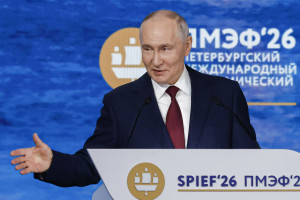
Źródło: WNP.PL, Fot. PAP/EPA/ANATOLY MALTSEV