While gas prices for individual consumers are regulated by the Energy Regulatory Office (URE), what businesses pay for this fuel largely depends on their ability to make informed purchasing decisions based on an analysis of their needs and available offers. This expertise can be gained at the Gas Purchasing Academy 'How to buy wisely on a volatile market’.
The Polish gas market, having undergone liberalization and the development of trading on the Polish Power Exchange (TGE) over the past dozen years, now offers a wide range of contract models. A key challenge for companies is choosing the right purchasing strategy.
Business customers generally face two approaches: a standard price list applied uniformly to all users, or term contracts with individually negotiated conditions. The simplest option for SMEs is the 'Gas for Business’ offer, where the price is based on the arithmetic average of TGE monthly index quotations. However, for companies where gas constitutes a significant cost, more sophisticated solutions are needed.
Fixed versus flexible contracts
In term contracts with a fixed price, the customer decides when to sign – a month, a year, or even two years before delivery. The guaranteed price reflects market conditions at the moment of contracting. myORLEN, formerly PGNiG Obrót Detaliczny, sets the price at contract signing, so later market fluctuations have no impact. This option is chosen mainly by firms seeking cost stability and predictability.
Greater opportunities to benefit from market volatility come with variable-price term contracts – indices and tranches. These are typically used by industries where gas is a major production cost, such as heating, ceramics, glassworks, or heavy industry.
– High market volatility in recent years has changed customers’ approach to gas contracting – from simple purchasing models toward more advanced strategies based on tranches, indices, and hybrid solutions. Customers can hedge volumes in stages using different instruments, spreading price risk over time – says Maciej Kołodziejek, director of the Gas and Energy Offer Management Office at myORLEN.
Market factors driving price swings
Gas prices in Poland can fluctuate significantly. The main European benchmark TTF currently stands at around 45-50 EUR/MWh for the front-month contract. Before the energy crisis, it hovered around 20 EUR/MWh, but in 2022 it spiked to 300 EUR/MWh. In recent years, it has ranged between 30-60 EUR/MWh, with periodic deviations. The unusually harsh winter of 2025-2026 depleted European storage, further influencing prices.
Global events, such as the US-Iran conflict, have caused supply disruptions in LNG, driving up gas prices worldwide. Geopolitical instability, competition between Europe and Asia for LNG, low storage levels, and potential supply chain disruptions from Norway all contribute to price uncertainty.
– The European gas market today is deeply embedded in global conditions and much more diversified in supply sources than a few years ago. Therefore, prices are rarely driven by a single factor. What matters is the interplay of many impulses – from geopolitics, weather, storage levels, to LNG market changes. We are dealing with high absolute price volatility, manifesting in more frequent and shorter fluctuations – says Damian Wilczek, director of the Portfolio Office at myORLEN.
Long-term scenarios suggest potential price reductions due to structural decline in EU gas demand from renewables and energy efficiency, though global LNG demand remains strong, especially in Asia. Increased LNG supply could ease competitive pressure and stabilize prices in the longer term.
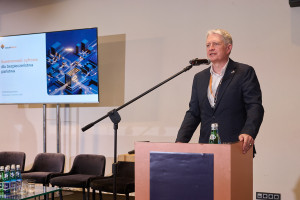
To help companies navigate this complexity, the Kozminski University in Warsaw, together with myORLEN, the Polish Power Exchange (TGE), and the Chamber of the Polish District Heating Industry (Ciepłownictwo Polskie), has launched the Gas Purchasing Academy 'How to buy wisely on a volatile market’. Its third edition took place on May 27-28, 2026, offering a two-day training to raise awareness about gas purchasing – crucial for the security and competitiveness of the Polish economy and the profitability of individual enterprises.
Źródło: WNP.PL, Fot. myOrlen / Materiały prasowe