Hospitals are cutting services, and the National Health Fund (NFZ) faces a multi-billion zloty shortfall. The government is returning to excise hikes and the idea that tax surpluses should flow to healthcare, but in practice the solution may become more of a political trap for the president’s veto than a real way to close a system that requires deep change.
Closed obstetric wards, limits on diagnostics, and signals of non-payment for hospital overperformances – 2026 in Polish healthcare resembles a car speeding down a highway with the barriers removed. Nominal spending is rising, but in many parts of the system this does not translate into shorter queues or genuinely wider access to services. The gap between estimated needs and the NFZ’s revenue plan is put by employer organisations at at least PLN 23 billion, and in more expansive analyses at PLN 50-60 billion.
Since 2026, the healthcare system has been covered by a stabilising expenditure rule, combined with strengthened fiscal oversight by the Fiscal Council. In practice, this changes the logic of NFZ financing – additional funds are no longer a simple transfer from the central budget, but become a decision requiring an indication of a funding source or cuts in other public spending. Healthcare thus enters direct competition for fiscal space with defence, social policy, and investment.
Minister announces return to vetoed projects
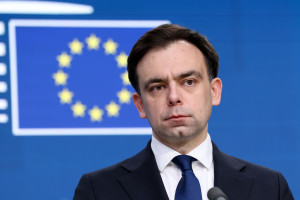
A pledge of fundamental change came in the June speech by Finance Minister Andrzej Domański at the European Financial Congress in Sopot. He indicated a return to fiscal projects that had previously been vetoed by the president. – We will return to projects that were halted, such as higher excise on alcohol and the sugar fee – Domański said, stressing that the goal is to increase the state’s fiscal space, i.e. its ability to finance growing expenditures, including healthcare.
This logic is precisely reflected in the bill on excise duty re-submitted to the Sejm, which assumes a 15% rate increase this year and another 10% in 2027, combined with a new surplus mechanism. With current alcohol excise revenues of around PLN 15-16 billion per year, this means a budget revenue increase of about PLN 2-3 billion assuming unchanged consumption. The key change concerns the flow of funds. Up to PLN 14.7 billion, revenues stay in the state budget. Only the surplus above this threshold is to be automatically transferred to the NFZ under the so-called surplus mechanism.
This means the transfer to the Fund would not result from the excise hike itself, but from the actual exceeding of the threshold – i.e., in practice, from maintaining or increasing consumption. Under realistic market scenarios, this means potentially several hundred million to about PLN 1-3 billion annually, and even less if sales decline. The real effect for the NFZ depends more on consumer reaction than on the tax decision itself.
Political trap or real remedy?
The same construction – a threshold for revenues and automatic surplus for the NFZ – could also be applied to other consumption taxes mentioned by the finance minister: the sugar fee, excise on tobacco products, or further health taxes. Formally, this does not guarantee any specific cash flows to the Fund – everything depends on the scale of consumption and the elasticity of demand. Politically, the mechanism has a strong effect: any attempt to reject it by the president can be presented as blocking funds for children’s treatment, senior care, or drug programmes, which significantly raises the cost of a veto and future presidential decisions.
In the most optimistic scenario, applying this model in several tax areas could generate an additional PLN 2-5 billion per year for the NFZ – still clearly below the scale of the financial gap. Former Deputy Finance Minister Jan Sarnowski, tax advisor and head of the tax practice at Fieldfisher Poland, cools expectations about consumption taxes as tools for closing NFZ financing. He points out that any changes to tax rates require a statutory act under Article 84 of the Constitution, which rules out arbitrary adjustment by executive order. In his view, this limits the Ministry of Finance’s room for manoeuvre and shifts the debate from tools to the real scale of fiscal effects.
Sarnowski recalls that the healthcare financing gap is estimated by the Federation of Polish Entrepreneurs at around PLN 18-23 billion in 2026, and could reach PLN 90 billion in subsequent years. In this context, even multi-year excise increases generate only marginal effects on the system’s scale. Referring to the earlier excise hike project on alcohol, he notes that its fiscal effect would amount to about PLN 1.8 billion in 2026 and about PLN 2.8 billion annually in later years – which, he stresses, is a drop in the ocean of the NFZ’s needs. In a broader perspective, Sarnowski indicates that improving tax collection could offer greater fiscal potential than raising rates. He cites recent European Commission data showing Poland’s VAT gap at around 16% in 2023, which, with projected revenues of PLN 341.5 billion in 2026, would mean a potential loss of around PLN 65 billion. A significant part of this gap results from organised crime, pointing to a structural problem in tax enforcement rather than nominal rates.
Prof. Monika Raulinajtys-Grzybek of the Warsaw School of Economics points out that the deepening NFZ gap is multi-factorial. On the expenditure side, the system has been significantly expanded: access to modern medical technologies increased, co-payments for some drugs for selected groups abolished, and service limits reduced, raising the volume of procedures. On the revenue side, deviations from the principle of universal financing persist – some income remains outside the contribution base, and selected groups operate under separate regimes. At the same time, the health contribution has not been systemically raised despite rising system costs. Demographics add pressure: a growing share of older people lowers the contribution base while raising treatment costs. In parallel, some costs have been shifted from the state budget to the NFZ in recent years without full additional funding, structurally increasing pressure on the Fund.
Poland still maintains exceptions. An example is the KRUS system, from which about PLN 4.5 billion in health contributions will flow to the NFZ this year, but the vast majority of this amount will be subsidised by the state budget, not by the farmers themselves. Meanwhile, some forms of business activity – including partners of limited partnerships, parts of structures within capital companies, and selected self-employment models – benefit from solutions where the effective health contribution burden is relatively lower than for standard employment. On top of this come staff shortages, wage pressure, and the effects of the law on minimum wages in healthcare, which raised wages across the system, affecting not only the lowest-paid groups but also subsequent segments of medical personnel.
Against this backdrop, Poland remains below the levels of contributions seen in many European systems. Health contributions are about 14-16% in Germany, about 15% in Slovakia, about 16% in Croatia, and about 13% in the Czech Republic – with the contribution base being more standardised in those countries and systemic exemptions less widespread. According to expert estimates, current contribution revenues cover about two-thirds of healthcare costs. In the expert’s view, without decisions on the revenue side, the gap will deepen structurally. In the most far-reaching scenario, a lack of change could lead to an escalation of the deficit from tens to hundreds of billions of zlotys, turning the problem from a budgetary one into a systemic one.
Źródło: wnp.pl, Fot. Iftekhar Emon / Shutterstock