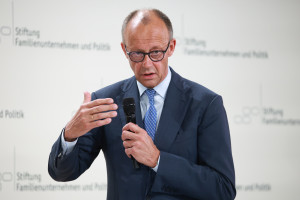
Twenty-five years ago, Germany began a gradual phase-out of nuclear power, a process that culminated in April 2023 with the shutdown of its last three reactors. Today, the country is paying a heavy price: rising energy costs, increased carbon emissions, and a shift from energy exporter to importer. Chancellor Friedrich Merz now calls the decision an 'irreversible’ error.
On June 11, 2001, the government of Chancellor Gerhard Schröder – a coalition of the SPD and Greens – signed an agreement with nuclear plant operators to phase out atomic energy. The deal, known as the Atomkonsens, was formalized a year later in a law that set legal framework for the Atomausstieg. – 25 years ago, on June 11, 2001, the government of Chancellor Gerhard Schröder, formed by the SPD and Greens, reached an agreement with nuclear plant operators on a gradual nuclear phase-out. The negotiated settlement from a year earlier (June 14, 2000) went down in German history as the nuclear consensus (Atomkonsens). Its provisions became the foundation of the 2002 law on the orderly termination of nuclear energy use, which created the legal basis for the phase-out – wrote Michał Kędzierski, an analyst at the Centre for Eastern Studies, on social media.
Economic and environmental toll
The three remaining nuclear plants – Isar 2, Neckarwestheim 2, and Emsland – were disconnected from the grid on April 15, 2023. The Polish Economic Institute noted that the shutdown was criticized by both public opinion and the Bavarian government, where Isar 2 was located. Scientists from Columbia University had warned that the cost of closing reactors since 2011 amounted to €3–8 billion per year. Researchers from the London School of Economics, the University of California, and Carnegie Mellon estimated that between 2011 and 2035, cumulative avoided emissions if coal capacity had been retired instead of nuclear would have reached 1.4 gigatonnes.
Immediately after the shutdown, Germany turned from a net electricity exporter into an importer. In 2024, the country had to import 24.8 TWh – 5% of its annual consumption – according to the Polish Economic Institute. The instability of the power grid also increased.
Irreversible regret
Recently, Chancellor Friedrich Merz stated that he shares the view of EU Commission President Ursula von der Leyen that Europe’s abandonment of nuclear power was a mistake. – I regret that Germany’s decision to phase out nuclear is irreversible – said Merz. His comments reflect a growing sense of buyer’s remorse in Berlin, where policymakers now grapple with the economic and environmental consequences of a policy once hailed as a green milestone.
Źródło: WNP.PL, Fot. PAP/EPA/CLEMENS BILAN