
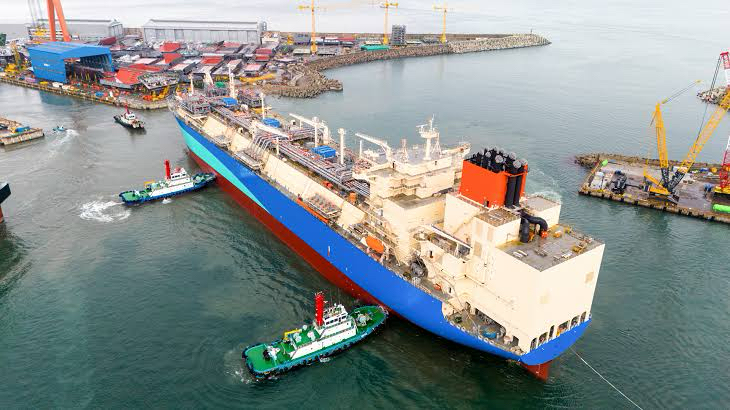
The FSRU regasification unit for Poland’s Gaz‑System has been launched at the HD Hyundai Heavy Industries shipyard in South Korea. The vessel is nearly 295 metres long and 46 metres wide, with tanks capable of holding 170,000 cubic metres of LNG.
The regasification unit FSRU for Poland’s Gaz‑System was launched at the HD Hyundai Heavy Industries shipyard in South Korea. The vessel, nearly 295 metres long and 46 metres wide, has tanks for 170,000 cubic metres of LNG, and once operational the terminal will be able to regasify more than 6 billion cubic metres of natural gas per year. The unit will arrive in the Gulf of Gdańsk at the end of 2027.
An FSRU is a floating storage and regasification unit for liquefied natural gas. The vessel is permanently moored in the port, and LNG carriers deliver the liquefied gas, which is stored in cryogenic tanks. Regasification consists of heating the liquid gas to a temperature at which it returns to its gaseous state, after which it enters the transmission system. FSRU technology allows faster terminal start‑up than building an onshore installation, because most of the key systems are integrated on the vessel at the shipyard. Gaz‑System’s FSRU programme is one of the largest infrastructure investments in Poland’s energy sector.
Launch in Korea
Launching marks the completion of the main hull construction work and the transition to the next phase. A few months earlier, Gaz‑System had announced the keel‑laying, which is the traditional start of shipbuilding. The vessel is now afloat for the first time. The HD Hyundai Heavy Industries shipyard in Ulsan, South Korea, is one of the world’s largest shipbuilders, specialising in LNG carriers, container ships and offshore units. The contract to build the FSRU for Gaz‑System was signed after an international tender in which shipyards from Korea, China and European consortia took part.
– Poland is implementing an ambitious strategy to build a modern and resilient energy system that strengthens the security of the country and the entire Central and Eastern European region. We are developing infrastructure that not only allows us to effectively diversify gas supply routes, but also increasingly reinforces our position as a regional energy hub and a key link in the European security of supply system. The FSRU programme and the other investments carried out by Gaz‑System are increasing our import capacity, opening up new prospects for international cooperation and building a lasting strategic advantage for Poland in the energy sector. The launching of the FSRU unit is an important stage in the implementation of this strategy and further proof that we are consistently strengthening the energy resilience of Poland and the region – said Miłosz Motyka, Minister of Energy.
Technological systems
Although the launched vessel already resembles a finished ship, the contractors still face a series of advanced works related to outfitting and the integration of technological systems. One of the most important stages is the construction of the membrane system in the LNG tanks, which ensures the safe storage of liquefied natural gas. The membrane system consists of thin layers of stainless steel and insulation that adhere to the hull, maximising tank capacity while minimising weight. Another key element is the installation of the regasification module, which allows LNG to be converted back into gas by heating it with heat exchangers.
– The launch of the FSRU unit is a symbolic moment in the implementation of one of the most important investments for Poland’s energy security. Our coastline is becoming a gateway to the global LNG market for the countries of Central and Eastern Europe. The FSRU terminal in the Gulf of Gdańsk reinforces Poland’s position as a regional gas hub. We are consistently building a modern energy system based on the diversification of gas sources and supply routes. This investment is strategic from the perspective of the state and the safety of citizens, as well as the future of the Polish economy and the regional gas market – said Wojciech Wrochna, Government Plenipotentiary for Strategic Energy Infrastructure.
Sea and gas trials
The coming months will involve the start‑up and integration of ship systems, including shore power connection, start‑up of generators and boilers, and testing of the vessel’s power systems. Shore power allows the auxiliary diesel engines to be switched off during port stays, reducing exhaust emissions and noise. Subsequently, sea trials and gas trials will be carried out to confirm the correct operation of the propulsion system, safety systems and regasification plant under operational conditions. Sea trials include manoeuvrability tests, speed and fuel consumption checks, while gas trials consist of filling the LNG tanks and testing the entire regasification process at full load.
– The launch is one of the key moments in the implementation of the entire FSRU programme and at the same time a confirmation that the strategic energy infrastructure for Poland is being built according to plan. We are consistently developing a system that will increase the security of gas supplies and open up access for Poland to additional volumes of gas delivered by sea from various parts of the world. In parallel, we are carrying out both the offshore and onshore parts of the investment, thus step by step building the next elements of the country’s modern and resilient energy infrastructure – said Sławomir Hinc, President of Gaz‑System.
Subsea tunnel and pipelines
Work is also progressing on the onshore part of the FSRU programme in Poland. In recent days, the head of a Tunnel Boring Machine (TBM) arrived at Górki Zachodnie near Gdańsk; it will drill a micro‑tunnel over one kilometre long for the submarine gas pipeline being built for the terminal. The tunnel will run under the coastal forest, dunes, beach and the seabed of the Gulf of Gdańsk, enabling the terminal to be connected to the national transmission system. Micro‑tunnelling technology eliminates the need for excavation on the beach and allows the pipeline to be laid under the surface without disturbing the coastal landscape and environment. In the coming months, the main construction work on the FSRU terminal quay in the Gulf of Gdańsk will also begin.
The quay will consist of a robust mooring pier and an LNG transfer system from the vessel to the regasification facilities. Work is also well advanced on the onshore gas pipelines on the Gdańsk–Gustorzyn route, which will connect the terminal to Gaz‑System’s national transmission network. All elements of the investment – from the offshore infrastructure to the onshore transmission grid – are being carried out in parallel.
Commissioning date
The completed FSRU unit will arrive in the Gulf of Gdańsk at the end of 2027. Transporting the vessel from South Korea to Poland via the Suez Canal and the Mediterranean Sea will take approximately 45‑60 days, depending on weather conditions and possible delivery delays. After arrival, the unit will be moored at the prepared quay and connected to the submarine pipeline. The start of regasification services is planned for the first quarter of 2028. The FSRU terminal in the Gulf of Gdańsk will be Poland’s second LNG terminal after Świnoujście, significantly increasing the country’s import capacity and allowing additional volumes of liquefied natural gas to be received from world markets. Once operational, the terminal will be able to regasify more than 6 billion cubic metres of gas per year; together with the Świnoujście terminal,
Poland will achieve an import capacity of about 14 billion cubic metres annually. The gas delivered by sea to the Gulf of Gdańsk will then enter the national transmission system, which is operated by Gaz‑System and comprises more than 11,000 kilometres of high‑pressure gas pipelines.


