
On May 7, 2026, the first of 89 concrete elements that will form the 18‑kilometre road and rail tunnel between Denmark and Germany was immersed in the Fehmarn Belt. The module, 217 metres long and weighing over 73,500 tonnes, was towed to the site by five tugboats and then lowered to the seabed using a specialised pontoon vessel, Ivy, built at the Crist shipyard in Gdynia. Most of the 1,500 workers on the construction site are Poles. A special settlement has been built for them, which the locals call the Polish village.
The Fehmarn Belt tunnel is currently the largest infrastructure project in Northern Europe. The link connects the Danish island of Lolland with the German island of Fehmarn and will ultimately shorten travel between Scandinavia and the continent. The idea of a fixed crossing over this waterway first emerged in the 19th century, but it was only in 2008 that Denmark and Germany signed a treaty to build it. In 2015, the Danish parliament approved the financing law, and actual construction work began in 2022.
Once completed, the tunnel will measure 18 kilometres in length, making it the longest immersed tunnel in the world. For comparison, the Channel Tunnel (Eurotunnel) is 50 kilometres long, but it was bored, not immersed. Immersed tunnels consist of prefabricated concrete segments that are lowered onto a pre‑dredged trench on the seabed and then joined together to form a single structure. This technology works well in shallow waters such as the Baltic Sea, where the depth at the construction site does not exceed 40 metres.
– In the coming years, the remaining 88 elements will be immersed one by one and joined together in a trench dug in the seabed up to 40 metres below the sea surface – stressed Sund & Baelt, the Danish company responsible for the construction.
Each of the 89 modules is 217 metres long, 42 metres wide and 10 metres high. The elements are produced at a temporary factory in Roedbyhavn on the Danish island of Lolland, where the tunnel entrance on the Danish side will be located. On the German side, in Puttgarden, a parallel transport hub will be built. Producing one module takes about nine weeks and requires 25,000 cubic metres of concrete and 3,000 tonnes of reinforcing steel.
Poles on the construction site
Most of the 1,500 workers on the construction site, which began in 2022, are Poles. A special settlement has been built for them nearby, which the locals call the Polish village. According to Danish media reports (TV2 Øst, 5 May 2026), about 900 Polish workers live in the settlement, some with their families. It includes residential barracks, a canteen serving Polish food, a chapel with a Polish priest and a small shop selling Polish products.
Recruitment of Polish workers was carried out by subcontractors from Poland, mainly companies specialising in bridge and tunnel construction, such as Budimex, Porr Polska and Strabag Polska. Hourly wages range from 80 to 120 Danish kroner (approximately 45‑70 zlotys net), which is higher than the Polish national average for construction work (about 35 zlotys net). Some workers commute from Poland on shifts – a week on site, a week at home. Operators of specialist machinery, such as cranes or concrete mixers, can earn as much as 150 kroner per hour.
The Ivy pontoon vessel used to immerse the first module was built at the Crist shipyard in Gdynia. The contract for its construction was signed in 2020, and the hull was launched in 2022. Ivy is 120 metres long, 45 metres wide and has a deadweight of 80,000 tonnes. It is equipped with 12 cable winches that allow concrete elements to be lowered to a depth of up to 50 metres with an accuracy of 2 centimetres.
The Crist shipyard in Gdynia has existed since 1991 and specialises in building specialist vessels, including those for laying submarine cables and pipelines. The contract for Ivy was one of the largest in the shipyard’s history – its value was 220 million euros. For comparison, building a typical passenger ferry costs about 80‑100 million euros.
The pontoon was delivered in 2024 and was tested in dry dock in Gdynia before sailing to Denmark in March 2026. Three Danish tugboats and two Polish ones („Swarożyc” and „Wiking” from the Gdańsk tug fleet) also took part in the immersion operation. The overall operation was commanded by a Danish merchant navy captain, but the technical team was half composed of Polish engineers from the Crist shipyard.
Cost and delays
The estimated cost of the project is about 7 billion euros. Financing comes 80 percent from the Danish budget and 20 percent from the German infrastructure fund. The European Union contributed 500 million euros under the Connecting Europe Facility. In the autumn of 2025, the Danish consortium announced that the original opening date of 2029 was unlikely to be met due to delays.
There are two reasons for the delays. First, the COVID‑19 pandemic disrupted steel and cement supply chains. Second, in 2024 it was discovered that some of the concrete elements (about 12 percent) had micro‑cracks caused by too‑rapid setting in high temperatures. Those modules were rejected, and production was halted for four months to modify the concrete mix. The new formula, containing blast‑furnace slag and fly ash, proved more resistant to extreme temperature fluctuations (ranging from -20°C in winter to +35°C in summer on the Danish coast).
10 minutes by car, 7 minutes by train
Once the tunnel opens, cars will cross from Germany to Denmark on four lanes in just 10 minutes. Trains – on two electrified tracks – will cover the same route in 7 minutes, at a maximum speed of 200 km/h. Currently, travelling between Roedbyhavn and Puttgarden requires taking a ferry. The crossing itself takes 45 minutes, but in practice one must add the waiting time for the next vessel, which during the summer peak season (July‑August) ranges from 30 to 90 minutes. During peak hours, queues of cars can stretch for a kilometre.
The tunnel will have a capacity of around 20,000 cars and 200 trains per day. In 2025, the ferries carried 3.2 million vehicles and 8.1 million passengers (data from the Danish statistics office, Danmarks Statistik). Once the tunnel opens, the ferry service will be completely withdrawn. The ferries currently operating on this route will be sold or scrapped, which has sparked protests from local environmentalists concerned about the loss of jobs for seafarers and port workers (about 300 people). The Danish government has announced a 15‑million‑euro retraining programme for those workers.
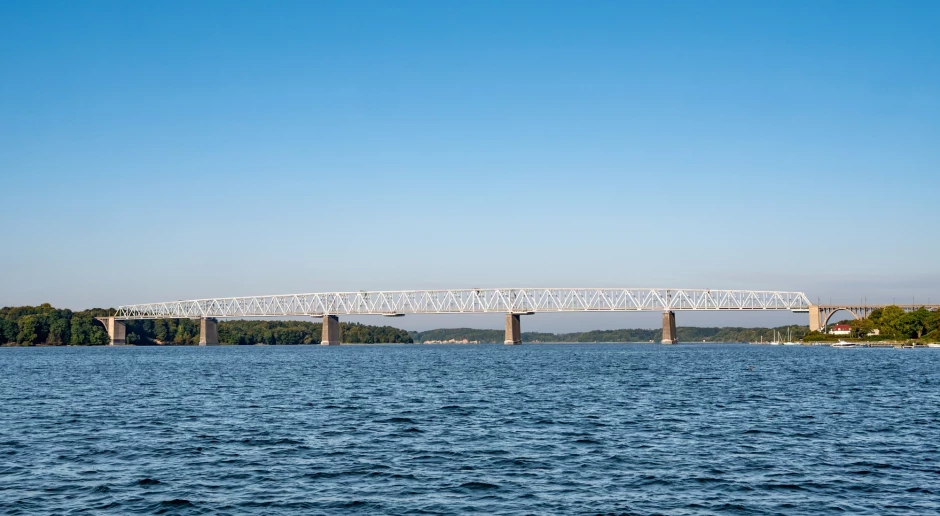
A bridge across the strait was initially considered. However, the Fehmarn Belt is 18 kilometres wide, and a suspension bridge of that span would be technically very complex and more expensive. Moreover, a bridge would require pylons 250 metres high and navigational clearance for ships that currently enter the Baltic Sea through this strait. A vessel with a draught of up to 15 metres (such as a container ship or gas carrier) could pass under a bridge without difficulty, but Denmark and Germany concluded that a tunnel would be less intrusive for the environment and shipping. A tunnel does not interfere with ship traffic – vessels sail over it, while vehicles pass through underneath.
Another advantage of the tunnel is its independence from weather conditions. A bridge on such an exposed route would have to be closed during high winds (above 25 m/s), which occur in this part of the Baltic on about 30 days a year. The tunnel is resistant to wind and storms. Rising sea levels have also been taken into account – according to forecasts by the Intergovernmental Panel on Climate Change (IPCC), the Baltic Sea level could rise by 20‑30 centimetres by 2070. The tunnel has been designed with a minimum clearance of 2 metres above the current seabed, so changes in sea level will not affect its operation.
Impact on travel and logistics
The improved connection between Scandinavia and the continent will be important not only for tourism but above all for logistics. Today, lorries from Denmark to Germany travel by ferry or through Jutland (bridges connecting the islands and the peninsula). The ferry route is shorter but unpredictable. The tunnel will provide a constant, 24‑hour link. Carriers estimate that they will save an average of 1.5 hours on every route between Scandinavia and Central Europe. With 1.2 million lorries a year (2025 data), that amounts to 1.8 million saved hours – roughly 200 years of work for a single driver.
The train journey from Copenhagen to Hamburg will be cut from the current 4 hours 30 minutes to about 2 hours 30 minutes. Danish State Railways (DSB) plans to run hourly high‑speed connections between the two capitals. Freight trains will be able to carry heavy loads without transhipment onto ferries – currently all wagons have to be shunted, because the ferries carry only diesel locomotives, while in Denmark and Germany electric locomotives are used. The tunnel will be electrified (25 kV AC) and compatible with the ETCS Level 2 signalling system.


