
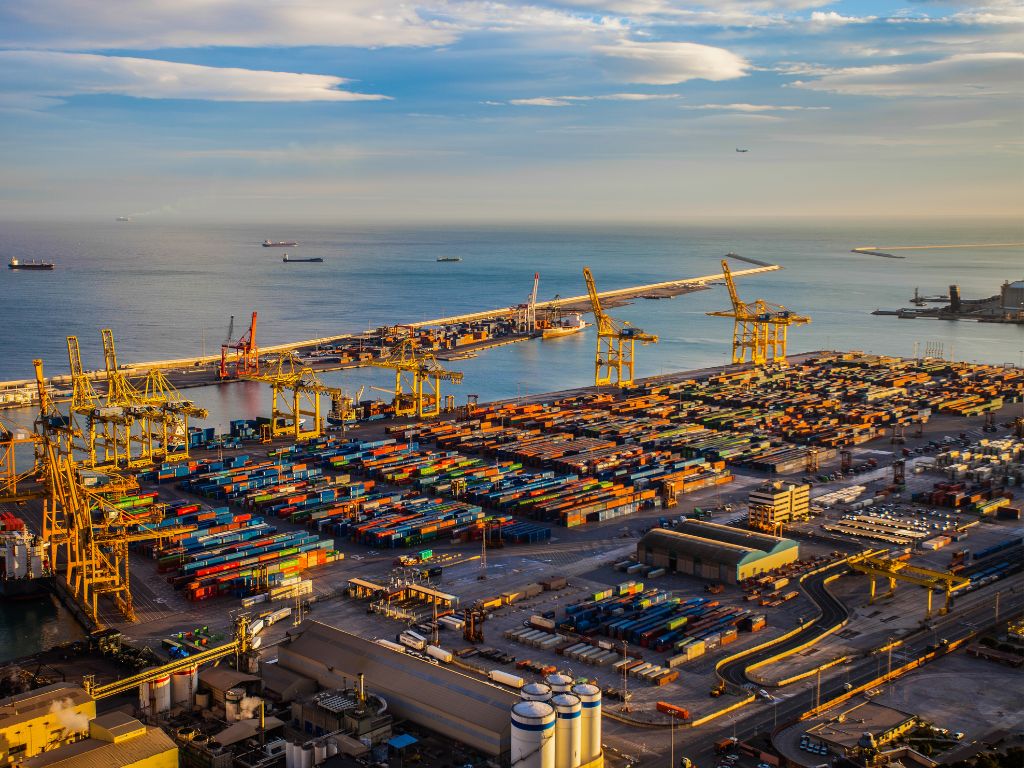
European maritime transport is concentrated around a handful of giant ports. Rotterdam handled nearly 400 million tonnes of cargo in 2024, clearly ahead of Antwerp Bruges and Hamburg. Gdańsk is also among the leaders, handling 71 million tonnes and ranking as the seventh-largest freight port in the European Union, although it handled a larger volume a year earlier.
According to Eurostat, EU seaports handled around 3.4 billion tonnes of goods in 2024. The figure was virtually unchanged from the previous year, but remained below the record 3.6 billion tonnes recorded in 2019. Rotterdam alone accounted for around 11.8 percent of all EU maritime freight transport measured by the weight of goods handled, while Rotterdam and Antwerp Bruges together accounted for almost one-fifth of the EU’s total volume. The ten largest ports handled 36.8 percent of all cargo processed by EU ports.
Rotterdam has been the European Union’s largest freight port for years, and the gap separating it from the next ports is enormous. In 2024, it handled 397 million tonnes of cargo, compared with 244 million tonnes at Antwerp Bruges, which ranked second. The difference was 153 million tonnes — more than the annual volume handled by each of the ports ranked fourth through tenth. Rotterdam therefore handles not only huge container flows, but also vast quantities of bulk cargo, including crude oil, petroleum products, gas, metal ores and other raw materials.
The scale of Rotterdam is a result of its location and the role it plays in Europe’s logistics system. The port is situated directly at the mouth of the Rhine and has inland connections with a large part of continental Europe. A vessel delivering cargo to Rotterdam can therefore become the first link in a much longer supply chain, with goods subsequently transported by barge, rail, road or pipeline into Germany, Belgium, France and other countries.
Data for 2025 show that Rotterdam increased its overall throughput to 428.4 million tonnes. This nevertheless represented a 1.7 percent decline from the previous year. Dry bulk throughput fell particularly sharply, while container throughput measured in TEUs increased by 3.1 percent to 14.2 million TEU.
Antwerp Bruges is battling for second place
The European Union’s second-largest port is Antwerp Bruges. In 2024, it handled 244 million tonnes of cargo, more than two and a half times the volume handled by Hamburg. The port is particularly important for industry because, in addition to containers, it handles large quantities of bulk cargo and products linked to the chemical industry, energy and processing. Its importance is also a result of the integration of the two port hubs, Antwerp and Zeebrugge, which operate as part of a single port system.
In 2025, Antwerp Bruges handled a total of 266.5 million tonnes, 4.1 percent less than a year earlier. The decline was mainly driven by bulk cargo, while general cargo, including containers and Ro-Ro traffic, increased by 0.7 percent. The port nevertheless remains one of Europe’s most important trade hubs, and in 2025 the United States became its largest trading partner by total cargo volume.
Hamburg remains Germany’s largest port
Hamburg ranked third, handling 97 million tonnes of goods in 2024. The gap with the two largest ports is substantial, but Hamburg remains hugely important to the German economy and Central Europe. The port is one of the continent’s major container hubs, with an economic hinterland that includes Europe’s largest industrial economy.
The latest quarterly Eurostat data also show signs of improvement in Hamburg. In the third quarter of 2025, it handled 25.3 million tonnes, 2.5 percent more than in the same period a year earlier. During the same quarter, Rotterdam handled 99 million tonnes, Antwerp Bruges 56.5 million tonnes, Gdańsk 20.8 million tonnes and France’s HAROPA port system 20.5 million tonnes.
Spain has two major ports
Algeciras ranked fourth in 2024, with 82 million tonnes. Its importance is largely due to its location at the Strait of Gibraltar, one of the key routes connecting the Atlantic and Mediterranean. This allows the port to handle both cargo destined for Spain and transit traffic associated with shipping between Europe, Africa and Asia.
Valencia ranked ninth, handling 64 million tonnes in 2024. It was one of the ports among the EU’s largest terminals to record an increase in throughput compared with 2023. Its volume rose by 3.6 percent, while Algeciras recorded a 2.6 percent increase.
Amsterdam and France’s HAROPA among Europe’s leaders
Amsterdam ranked fifth, with 79 million tonnes. The port is particularly important for bulk cargo, while its location makes it part of the Netherlands’ extensive logistics system, which also includes Rotterdam. Amsterdam’s high ranking shows that the strength of Dutch port infrastructure is not based solely on a single terminal. The Netherlands has an entire network of ports handling different types of cargo and performing different functions within the European supply chain.
France’s HAROPA system ranked sixth. It includes the ports of Le Havre and Rouen and handled 77 million tonnes in 2024. It is an important example of how the structure of a country’s port system can affect rankings. Eurostat treats HAROPA as a single port entity, meaning the volumes handled by the two ports are counted together.
Gdańsk os Poland’s highest-ranked port
Gdańsk ranked seventh among all EU ports in 2024, handling 71 million tonnes of goods. A year earlier, the figure was 80 million tonnes, representing a decline of around 11 percent and one of the largest drops among Europe’s biggest ports. Despite this, Gdańsk remained by far Poland’s largest port and one of the most important ports in the Baltic region.
Gdańsk’s position is particularly significant because there is no equivalent of Rotterdam in the region in terms of total throughput. In 2024, it was almost twice as large in terms of total volume as the next major Baltic ports included in Eurostat’s rankings. Its importance therefore extends beyond handling Poland’s foreign trade and includes part of the flows destined for Central European countries.
Quarterly data also show that the decline recorded in 2024 does not necessarily indicate a lasting deterioration in Gdańsk’s position. In the third quarter of 2025, the port handled 20.8 million tonnes, 0.9 percent more than a year earlier. During the same period, Gdańsk was the EU’s fourth-largest port by the weight of goods handled, behind Rotterdam, Antwerp Bruges and Hamburg.
The North Sea still dominates
The ranking of Europe’s largest ports shows a very clear geographical concentration of maritime trade. Rotterdam, Antwerp Bruges, Hamburg and Amsterdam — all associated with the North Sea — are among the top ten, along with France’s HAROPA system. Together, these ports account for a huge share of European throughput and are connected to the industrial hinterlands of Germany, the Benelux countries and northern France.
Southern Europe, meanwhile, has its own group of major ports linked to the Mediterranean. These include Algeciras, Valencia and Marseille, while Constanța is located on the Black Sea. According to Eurostat, among the EU’s 20 largest ports in 2024, eight were located on the Mediterranean, seven on the North Sea, three on the Atlantic, one on the Baltic Sea and one on the Black Sea.
For Poland, Gdańsk’s position is particularly important because it illustrates the Baltic Sea’s changing role in the European logistics system. The port is not yet a rival to Rotterdam in terms of total tonnage, but its scale is already comparable with that of major ports in Western and Southern Europe. Gdańsk’s position is increasingly determined not only by its role in handling Polish imports and exports, but also by its ability to capture part of the cargo flows serving the wider Central European region.




