
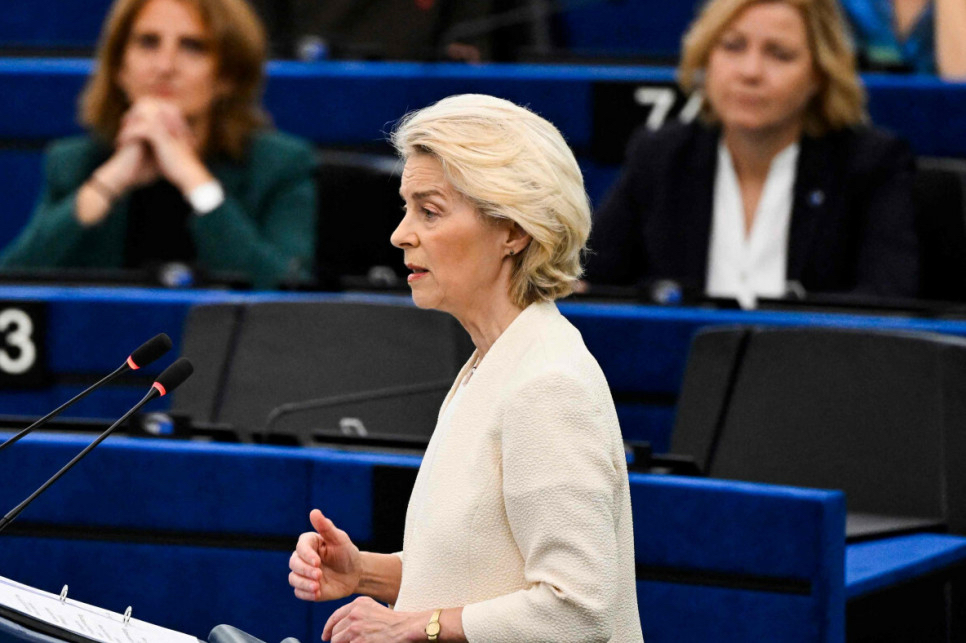
Ursula von der Leyen has announced the creation of a European Security Council and a mechanism modeled on Article 4 of NATO, which would allow EU countries to respond more quickly to common threats.
The President of the European Commission’s address to the European Parliament in Strasbourg covered several areas, but security occupied a particularly prominent place. von der Leyen proposed creating a new crisis consultation mechanism that could be activated by a single member state in a situation it considers to pose a security threat. In such a case, the other member states would be quickly convened to agree on a common response. She also announced that she would present a proposal to establish a European Security Council, although she did not yet specify its composition, powers, or decision-making procedures.
A European Equivalent of NATO Article 4
“It is time for a European equivalent of Article 4, an emergency security protocol. Its activation by one member state would result in the convening of all member states to coordinate a European response, prevent further escalation, and mitigate the consequences,” Ursula von der Leyen said during her State of the Union address.
Article 4 of the North Atlantic Treaty does not mean the automatic launch of military action. It is a consultation mechanism that allows a member state to request discussions when it believes that its territorial integrity, political independence, or security is threatened. Only through subsequent consultations can NATO countries agree on further action. The mechanism proposed by von der Leyen would therefore primarily concern the speed of information-sharing and the coordination of a response, rather than creating an automatic mechanism for the military defense of an EU member state.
This distinction is important because the European Union and NATO have different competences. NATO remains a military alliance based on a commitment to collective defense, while the EU has economic, regulatory, civilian, and partly defense-related instruments at its disposal. The new mechanism could therefore be used in situations where a threat to one member state requires the simultaneous use of multiple European instruments, such as infrastructure protection, a response to a hybrid attack, a cyberattack, migration pressure, disruptions to energy supplies, or other destabilizing actions.
European Security Council to Coordinate the Response
The second element of the proposal is a European Security Council. von der Leyen announced that she would present a proposal for its establishment, but during the State of the Union address she did not provide details on how such a body would operate. At this stage, it is therefore unclear whether the council would be a permanent political body, a format for meetings of the leaders of the member states, or an institution with its own powers.
The significance of the announcement lies primarily in the problem of coordination. European countries have their own intelligence services, armed forces, infrastructure-protection systems, and crisis-response procedures. At the same time, some threats are cross-border in nature. A cyberattack may begin in one country and affect systems in several others within hours. Sabotage of energy infrastructure may affect more than one market, while disruptions to transport or raw-material supplies can quickly spread across borders.
In such a situation, the problem may not be a lack of tools, but the time needed to activate them and agree on a common response. If member states agree to sufficiently broad powers, the European Security Council could become a forum in which such decisions are made more quickly. For now, however, this is a political direction announced by the Commission rather than an operational mechanism.
Canada to Move Closer to the European Union
von der Leyen’s address also had a clear economic and geopolitical dimension. Canadian Prime Minister Mark Carney was the guest of honor at the State of the Union address, and the Commission President presented closer relations with Ottawa as one element of strengthening European resilience.
“Europe and Canada believe in democracy. They believe that power does not belong to the strongest, the richest, or those who have held it the longest, but to all of us,” von der Leyen said.
The Commission President referred to the existing CETA trade agreement, noting that trade in goods between the EU and Canada has increased by 75 percent thanks to the agreement over less than a decade. The next stage is intended to involve much broader cooperation covering industry, technology, economic security, and defense. Mark Carney attended the State of the Union address as the guest of honor, and the European Parliament also scheduled an address by him for the following day.
“Now we are moving from CETA to an alliance for the future, to create a space of shared prosperity and economic security,” von der Leyen said.
Canada Could Receive a New Status
von der Leyen also announced talks on creating a special framework for Canada’s relationship with the European Union. This does not currently mean full EU membership for Canada, but rather the possibility of obtaining the status of the first associated member.
“I want to work with Carney to open a pathway for Canada to become the first associated member of the European Union,” the Commission President said.
Such a status would first require the creation of specific rules. It is not currently an existing category of membership that would automatically give Canada the rights of an EU member state. Rather, the idea would be to create a new model of cooperation allowing a non-EU country to participate much more deeply in selected areas of European economic, technological, and security cooperation.
For Ottawa, this could offer an opportunity to reduce its dependence on the United States. For Brussels, Canada is a partner with natural resources, industry, technology, production capacity, and extensive transatlantic relations. von der Leyen announced cooperation in areas including smart manufacturing, technology, and industrial defense capabilities.
“We will cooperate on smart manufacturing. We will build a technology alliance. We will integrate our defense industrial bases. We will make the Arctic our flagship joint project,” von der Leyen said.
The Arctic Is Becoming Part of Europe’s Strategy
The inclusion of the Arctic in plans for cooperation with Canada is not accidental. Canada has vast Arctic territories, and the region is becoming increasingly important economically and strategically. Climate change is affecting the accessibility of some maritime routes, while interest in critical raw materials and infrastructure located in the northern part of the world is also increasing.
For the European Union, cooperation with Canada could provide access to a partner with resources and experience in operating in Arctic conditions. For Canada, cooperation with the EU would offer an opportunity to link part of its industrial, technological, and security policy to Europe’s largest single market.
“This is not a partnership directed against anyone, but one aimed at building our common strength,” von der Leyen said.
Commission Wants to Prepare Europe for the Increasing Costs of Climate Change
In the second part of her address, von der Leyen linked climate issues with economic security. According to data presented by the Commission President, this year’s summer brought wildfires, agricultural losses, and high mortality during heatwaves in Europe.
“This summer was a moment of truth when it comes to climate change. Almost no corner of our continent escaped its effects,” von der Leyen said.
According to the figures she presented, 660,000 hectares of land were burned, around 12 million tonnes of crops were lost, and more than 35,000 additional deaths were recorded during heatwaves.
“This is only a taste of what lies ahead. These were the hottest summer months on record, and at the same time the coolest compared with those that are yet to come,” the Commission President added.
The European Commission announced that it would present a framework for action on climate resilience in October. Examples mentioned included drought-resistant crops, flood defenses, and energy-efficient cooling systems. The aim is not only to reduce emissions, but also to adapt infrastructure and the economy to the effects of climate change that are already generating costs for governments, businesses, and households.
Climate Insurance Could Reduce the Burden on Governments
One of the specific problems identified by von der Leyen concerns how losses caused by natural disasters are financed. Private insurance currently covers around one-quarter of losses associated with natural disasters. The remaining costs largely fall on businesses, households, and public finances.
“This means that national budgets too often become the insurer of last resort,” von der Leyen said.
The Commission wants to create a climate insurance alliance that would aim to reduce this protection gap. The issue is particularly important in the case of floods, droughts, wildfires, and extreme temperatures, because increasing risks may lead to higher premiums or to situations in which some risks become too costly for private insurers to cover.
If an increasing share of losses has to be covered by governments, the consequences of climate change will have a direct impact on public budgets. The costs of rebuilding infrastructure after a flood or wildfire compete with other government expenditures, while repeated disasters may increase the need for investment in flood defenses, energy networks, cooling systems, water management, and wildfire protection.
von der Leyen’s address therefore demonstrated a broader direction for the Commission’s policy in the coming months. Security is to be understood more broadly than simply as military capability. The proposals simultaneously include crisis consultation mechanisms, cooperation between defense industries, relations with Canada, technology, the Arctic, and the resilience of infrastructure and the economy to climate change.
The details of the most important new mechanisms, particularly the European Security Council and the European equivalent of NATO Article 4, are yet to be presented.




