
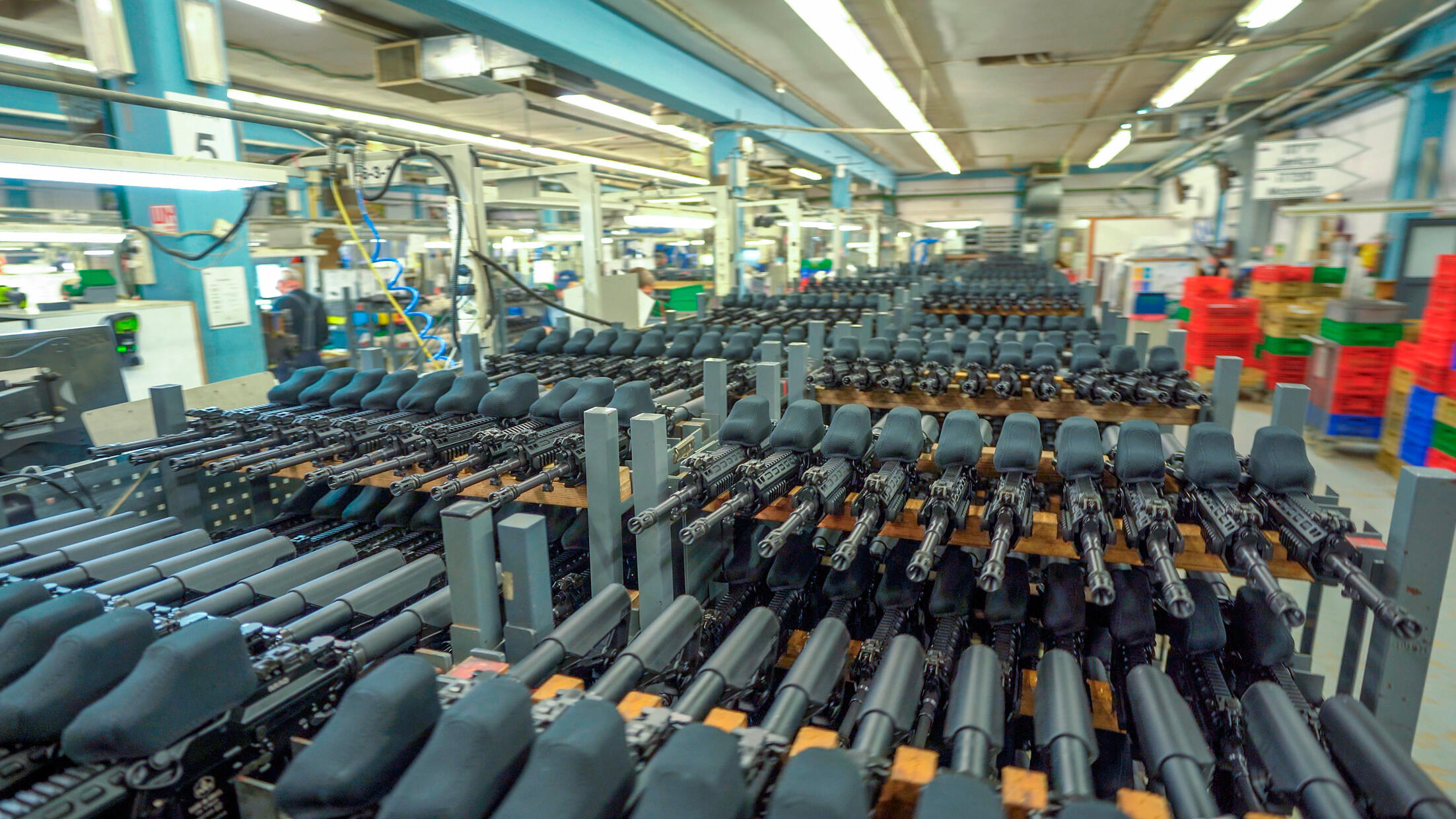
The European Union is changing the rules governing defense-related investments. The European Parliament has approved a package of legislation designed to reduce administrative delays in the construction and expansion of defense facilities, facilitate the movement of defense products between member states, and simplify companies’ access to EU funding. For businesses, this primarily means a more predictable investment process, while for governments it means a shorter path from the decision to increase production to the launch of new industrial capabilities.
The new rules are part of the Defence Readiness Omnibus, a package prepared in response to the need to accelerate the expansion of European defense capabilities. An agreement between the European Parliament and the Council of the EU was reached on June 10, 2026, and Parliament voted on three related legislative acts on September 16. The package includes separate measures covering permits for defense projects, the operating conditions of the defense industry, and transfers of defense products between EU member states.
The significance of the changes is best illustrated by an industrial investment project. Building a new ammunition factory, a drone-production facility, or expanding an existing production line requires companies in member states to go through administrative procedures involving, among other things, construction permits, environmental approvals, and other authorizations required under national law. Until now, the time needed to complete these procedures could become one of the factors delaying the launch of production. The new rules are intended to establish a common framework for projects designated by a member state as defense-readiness projects, while leaving national authorities responsible for determining which investments meet these criteria.
Permits within a maximum of 102 working days
The basic deadline for the permitting procedure will be 42 working days from confirmation that an application is complete. In the case of more complex investments, the relevant authority may extend the procedure a maximum of two times, by no more than 60 working days each time. Even if both extensions are used, the total duration of the procedure may not exceed 102 working days.
For an investor, the significance lies not only in shortening the deadline but also in streamlining the procedure. An application will first be checked for completeness, allowing the investor to receive more quickly an indication of whether the documentation is sufficient to begin the substantive proceedings. If the authority decides to extend the procedure, it will have to provide a reason and indicate the expected date of the decision. This limits situations in which a company has no clear information for an extended period about the status of its project or when it can expect a decision.
The rules also provide for the principle of tacit approval. If the competent authority does not inform the investor of its decision within the prescribed deadline, the application may, in certain cases, be considered approved. Member states will retain the ability to introduce exceptions to this principle in national law, including in situations involving serious threats to human health or national security.
For a company planning an investment in the defense sector, this primarily means greater ability to plan the project schedule. When building a production facility, the time required to obtain approvals affects not only when production can begin, but also the timing of machinery orders, supplier contracts, employee recruitment, and the start of contract deliveries. Shortening and standardizing the administrative part of the process can therefore reduce the risk that the industrial investment itself will be completed later than the equipment deliveries stipulated in the contract.
A single point of contact for investors
Member states will have to establish single points of contact for investors carrying out defense-readiness projects. Their role will be to coordinate the permitting process and enable companies to communicate with the administration in a more organized manner than through parallel proceedings involving multiple institutions. Member states will retain flexibility in how these contact points are organized, and their role may include both coordination and certain decision-making powers, depending on the national administrative system.
The contact points will also enable digital monitoring of application progress and the transmission of information to the European Commission concerning procedures and support for small and medium-sized enterprises. This is important for companies seeking to enter the defense sector but lacking the extensive legal and administrative departments typically found at the largest industrial groups. For a smaller manufacturer, the time spent determining which government authority is responsible for a particular element of an investment can represent a real barrier to launching a project.
At the same time, the rules do not take away member states’ right to decide which investments they consider to be related to defense readiness. This means that the EU framework does not create an automatic fast track for every factory seeking to produce goods that could potentially be used in the military sector. The scope of the new rules will also depend on decisions made by national authorities.
Equipment will be easier to move between EU countries
The second major element of the package concerns transfers of defense-related products between member states. The EU wants to reduce situations in which a company operating a production facility in one country has to go through complicated procedures to deliver a component of a weapons system to a facility located in another EU member state.
The new rules provide for a general transfer licence for defense products, which member states will be required to publish. The aim is to create more predictable conditions for companies operating across several countries.
The significance of this change goes beyond simply reducing paperwork. The European defense industry is spread across multiple countries, and a single product may be manufactured at several facilities located in different jurisdictions. One manufacturer may supply components, another may integrate the system, and a third may carry out final assembly. If transferring parts between these facilities requires separate and time-consuming procedures, companies must factor them into their production schedules. Harmonizing the rules could therefore make it easier to build supply chains spanning several EU member states.
The measure also matters for joint procurement programs. If several countries purchase the same system or jointly finance its development, companies need to be able to move components, prototypes, and finished products efficiently between the facilities participating in the project. The EU wants to reduce the administrative obstacles that make such projects more difficult to implement.
European defence fund to open up more to smaller companies
The package also includes changes concerning the European Defence Fund. They are intended to simplify its management and implementation and clarify how projects seeking funding are assessed. Particular attention has been given to small and medium-sized enterprises, whose participation in projects financed by the EDF is to receive stronger support.
For smaller companies, the key issue is the opportunity to participate in projects that have so far been dominated by large industrial groups. The defense industry increasingly relies on technologies developed by smaller businesses, particularly in areas such as unmanned systems, reconnaissance, electronics, software, and counter-drone technologies. EU financial instruments are intended to make it easier for such companies to participate in projects jointly implemented by businesses from several countries.
More broadly, the changes form part of the EU’s policy of increasing defense spending and expanding Europe’s industrial defense base. The Council of the EU says the Defence Readiness Omnibus is one element of the measures associated with Readiness 2030, whose objective is to create conditions for a substantial increase in investment in European defense.
Ukraine to gain access to european funding for testing
The new regulations also provide for a measure related to Ukraine. As an EU candidate country, Ukraine may be included in certain activities connected with the European defense industry, while the costs of tests carried out on its territory may be eligible for funding from the European Defence Fund.
This is particularly relevant for technologies whose real-world capabilities can be verified under conditions resembling those of a modern battlefield. Testing equipment outside a laboratory makes it possible to assess its performance in conditions involving electronic interference, the operation of unmanned systems, limited infrastructure availability, and other factors that cannot be fully replicated during standard trials.
The package also allows member states to apply certain exemptions from EU environmental and chemicals regulations when justified by defense-readiness considerations. At the same time, the Council of the EU emphasizes that these measures are intended to maintain a high level of protection for human health and the environment.
Industry gets a shorter path, but member states retain control
The new regulations do not mean that every defense investment will be able to proceed without standard administrative requirements. The main change is the creation of a special procedure for projects considered important from a defense-readiness perspective, limits on the duration of proceedings, the introduction of points of contact, and the facilitation of cooperation between companies operating in different EU member states. Governments will continue to decide which projects qualify for the fast-track procedure, while national legislation may provide for exceptions to the tacit-approval principle in certain situations.
For European industry, the significance of the package will depend on how the new rules are applied in practice by individual member states. Changing EU law alone will not shorten the time required to build a factory, deliver machinery, or recruit workers if other elements of an investment continue to constrain the pace of the project. Shortening administrative procedures nevertheless removes one of the barriers companies must take into account when planning new production capacity.
The rules are expected to enter into force on the 20th day after their publication in the Official Journal of the European Union. For companies, this means preparing to operate within the new framework; for member states, it means organizing systems for handling defense projects and adapting national procedures to the new rules. At a time when Europe wants to rapidly increase production of ammunition, drones, air-defense systems, and other military capabilities, the time required to move from an investment decision to the launch of a facility is becoming one of the practical elements of the EU’s broader industrial security system.




