
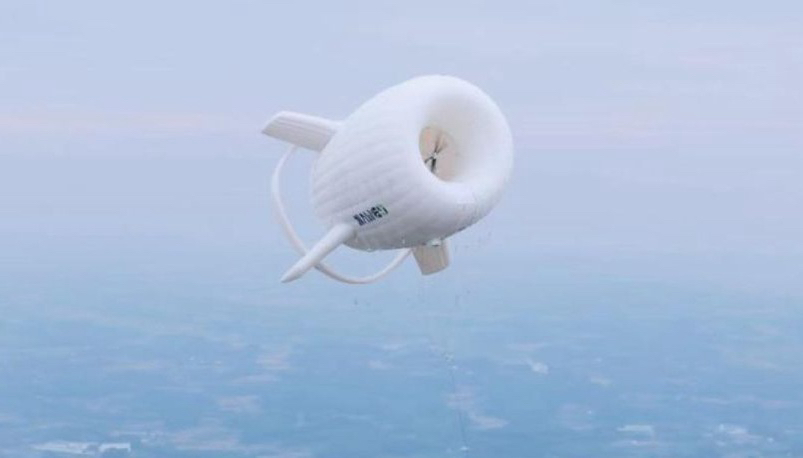
This is not an exaggeration, nor a figurative analogy, or an allusion to the world’s tallest wind turbines. It is reality, as reported by the Chinese portal Global Times at the end of August. It informed about a successful experiment of placing a wind turbine at an altitude of 4 kilometers in the mid-troposphere.
Traditional energy wind turbines
The tallest wind turbine in the world so far is considered to be the German design with a tower height of 360 meters, built this year on the site of a former lignite mine in the small town of Schipkau, Brandenburg. Poland’s tallest wind turbine tower is located in the Suwałki Wind Farm and has a height of 237 meters. Turbines are placed increasingly higher on towers because efficiency and the amount of energy produced increase with height, which results from the increase in wind speed with distance from the ground.
Chinese innovation
The Chinese have utilized this principle innovatively by placing, at an altitude of 4 kilometers, a weather balloon adapted for this purpose, shaped like an airship or a Zeppelin from the times of World War I.
However, it is significantly shorter and has a bulge in the central part, ending with vertical and horizontal stabilizers. At the rear, in its tapering section, a circumferential system is placed that harvests energy from the force of the wind. All this can be discerned from the photograph attached to this communiqué, because the Chinese communication is concise and lacks technical details.
Regarding this experiment, it informs that tests and research on constructing a suitable model of a wind turbine placed at this altitude had been conducted for a long time. The latest experiment turned out to be a success, which will be replicated throughout the country.
Western reactions
Despite such modest Chinese information on the subject, Western specialists reveal considerably more details related to the Chinese experiment. The energy from the Chinese balloon is transmitted to the ground via the tethering cable. They indicate that at these altitudes, wind speed is constant and ranges from about 100 to 500 kilometers per hour.
Moreover, these winds never cease. The effect of placing an appropriate energy-harvesting device there is the difference in energy production between traditional wind turbines and their Chinese airborne projects. Individual units of this traditional form generate energy measured in megawatts (MW), while the latter generate energy in multiples of megawatts.
Airborne energy vehicle
Western experts write that this is not a conventional wind turbine. It is a flying device – a tethered aircraft that harvests wind energy at altitudes where the wind never stops blowing. With a maximum operating altitude of 4,000 meters and a 20-year service life. They claim that this kite, named S4000 – Stratosphere Airborne Wind Energy System (SAWES), constitutes an important milestone in Chinese high-altitude wind power technology, transitioning from iterative (multi-stage) development to engineering implementation.




