
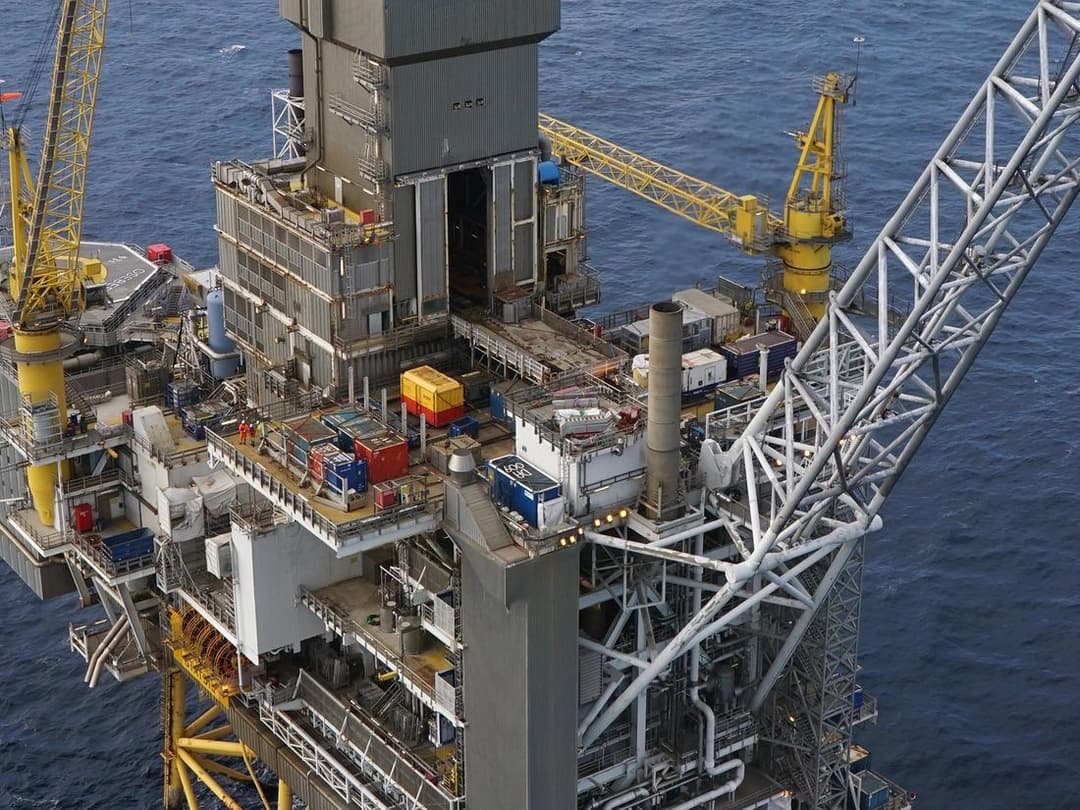
The discovery of the Grimsnes deposit near the Oseberg field could increase hydrocarbon production from the Norwegian continental shelf. Preliminary estimates indicate resources equivalent to between 19 and 50 million barrels of oil equivalent. Equinor and its partners intend to use existing infrastructure to reduce costs and shorten the time needed to begin production. An investment decision could be made as early as summer 2027.
The Grimsnes exploration well, 30/8-7 S, was drilled in production licence PL 190 using the Deepsea Bergen drilling rig. The work confirmed the presence of crude oil and natural gas. The location is approximately 15 kilometres south west of the Oseberg Sør platform and 145 kilometres west of Bergen. The discovery is another indication that areas close to fields already in production may still contain resources that can be extracted without building entirely new infrastructure.
The exploration work is being carried out by Equinor together with its partners Petoro and TotalEnergies. Their plan is to prepare the project for development quickly and connect the new discovery to existing subsea installations. Production is expected to be carried out through the Oseberg Sør platform, allowing the project to make use of existing production facilities.
Grimsnes is set to make use of existing infrastructure
Preliminary estimates indicate resources of between 19 and 50 million barrels of oil equivalent, or approximately 3 to 8 million cubic metres. The range shows that the size of the discovery requires further clarification, but the partners are already preparing at an early stage to develop it as quickly as possible.
The location of Grimsnes close to the existing Oseberg field is particularly important. Connecting new wells to operational installations could reduce the investment required to start production and improve the project’s economics. There is no need to base the entire project on building new, independent extraction facilities.
– This confirms that the area around the Oseberg field remains very attractive. We plan to connect the discovery quickly to existing subsea installations and produce these volumes through the Oseberg Sør platform. By using infrastructure that has already been paid for, we can make efficient use of resources and achieve competitive production costs per barrel – says Frode Skarstein, Equinor’s senior vice president for exploration and production in the western region.
This approach is consistent with a strategy of developing smaller deposits located near fields already in production. The success of such projects depends on more than the size of the resources. The cost of drilling wells, the availability of installations and the time between discovery and the start of production are equally important. Using existing facilities can make resources economically attractive even when developing them independently would be less profitable.
Investment decision possible in summer 2027
Equinor expects the partnership to be able to make an investment decision on Grimsnes as early as next summer. If the schedule is maintained, production could begin within three years. This would mean a relatively short period between confirming the presence of hydrocarbons and bringing them into production.
Gunnar Nakken, Equinor’s senior vice president for projects and subsea installations on the Norwegian continental shelf, emphasises that achieving this pace requires changes to the way investments are prepared.
– To turn these discoveries into reality, we need to radically change how we plan and develop subsea projects. Our aim is to halve costs and shorten the time from discovery to production through simpler and faster processes, greater standardisation, repeatable solutions and wider use of industry standards. We expect the partnership to be able to make an investment decision on Grimsnes as early as next summer, with production starting within three years – says Gunnar Nakken, Equinor’s senior vice president for projects and subsea operations on the Norwegian continental shelf.
The announced 50 per cent cost reduction illustrates the scale of the changes the company wants to introduce in preparing subsea projects. The aim is not simply to accelerate work once drilling has been completed, but to plan the entire process so that some technical and organisational decisions can be made earlier. This should enable investors to move more quickly from assessing a discovery to implementing a project once the resources have been confirmed.
Equipment ordered before final approval
One element of the new approach is to move some preparatory work to an earlier stage. In the case of Grimsnes, the development concept is to be prepared in advance, before all stages of the discovery assessment have been completed. This will shorten the time needed to prepare the investment if the partners decide to proceed.
Under current assumptions, the deposit will most likely be developed using two or three wells placed in a standard template with four slots, meaning designated positions for wells. This solution is intended to simplify installation preparations and align the project with repeatable standards used for similar developments.
The purchase of subsea production equipment is planned for early 2027, before the project receives formal approval. This step involves risk, but Equinor intends to limit it by using standardised equipment. If the partnership or the relevant authorities do not approve the Grimsnes investment, the equipment could be transferred to another project.
This represents a significant change in the organisation of the investment process. Under a traditional approach, equipment orders and infrastructure preparations are closely linked to successive project approval stages. Starting some of these activities earlier is intended to save time, provided that the risks associated with purchasing equipment before a final decision remain under control.
Norway wants to maintain oil and gas supplies to Europe
The Grimsnes discovery is significant in the broader context of the future of Norway’s extraction sector. Norway is an important supplier of energy resources to Europe. According to data cited by Equinor, it accounts for 20 per cent of Europe’s oil demand and 30 per cent of its natural gas demand. At the same time, production from existing fields is gradually declining as their resources are depleted.
Maintaining high supply levels therefore requires not only efficient use of fields already in operation, but also continued exploration. Smaller discoveries near existing installations could play a particularly important role. Developing them does not always require large scale infrastructure construction, and using operational platforms and subsea connections can improve the economics of extraction.
By 2035, Equinor intends to drill 200 exploration wells near existing fields and deliver around 75 subsea projects. The scale of these plans indicates that the company wants to rely more heavily on new discoveries and the development of resources located close to fields already in operation to support future production.
The company’s goal is to maintain production on the Norwegian continental shelf at 1.3 million barrels of oil equivalent per day through to 2035. Around 70 per cent of this volume is expected to come from new wells and the development of additional resources. This means that future production levels will depend to a large extent on the success of exploration and the ability to turn discoveries into operational projects quickly.
Grimsnes as part of a long term extraction strategy
The new discovery near Oseberg fits a development model in which the focus is not only on finding large, standalone deposits, but also on gradually increasing production from areas that have already been developed. For Equinor, three elements will be particularly important: confirming the size of the resources, limiting investment costs and shortening the time needed to bring production online.
The immediate test for this approach will be preparing the project for the investment decision planned for summer 2027. Only once that decision has been made will the project be able to proceed in line with the proposed schedule. At this stage, Grimsnes remains a discovery with preliminary resource estimates, while the announced timelines and development parameters are plans set out by the partnership.
If the project is approved and production begins on schedule, Grimsnes could become another example of using existing infrastructure to sustain production on Norway’s mature continental shelf. As output from established fields gradually declines, investments of this kind will be one of the ways Equinor seeks to maintain oil and gas supplies over the next decade.
Photo: Equinor




