
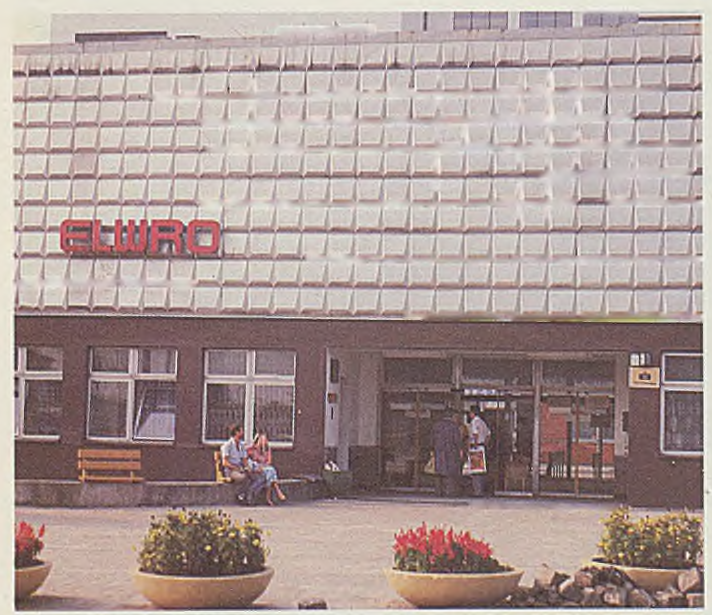
The Wrocław Electronic Works ELWRO manufactured Odra computers, calculators and equipment for industry. In 1980, it employed more than 5,800 people, and its designs were supplied to Polish companies, scientific institutions and foreign customers. In 1993, Siemens bought an 80% stake in the plant. Computer production was soon discontinued, employment was cut and the dismantling of a substantial part of the factory infrastructure began. In 2000, the company was acquired by the American firm Telect, and in 2009 the plant closed. What remained were the machines that had once been in operation, documentation, archival photographs and the memories of people who helped create Polish computing. To understand why such a large enterprise disappeared, it is necessary to look not only at privatisation, but also at the technologies it developed, changes in the global computer market and the decisions made over the following years.
The Wrocław Electronic Works ELWRO was established in early 1959. The company’s name combined the Polish words for “electronics” and “Wrocław”. The plant was allocated the buildings of a former sugar factory on Obornicka Street. At the same time, an office complex and production halls were being built on Ostrowskiego Street. Initially, the company was involved in, among other things, manufacturing channel selectors for the Warsaw Television Works and measuring instruments. Work also began on developing the facilities needed to design digital machines, which at the time were known as mathematical machines.
The choice of this direction was no coincidence. The development of electronics was becoming one of the prerequisites for modernising the economy. Computers made it possible to perform calculations that had previously required enormous amounts of work, and the growing range of applications increased demand for data processing equipment. Poland, however, lacked a developed domestic computer industry. Building one meant training specialists, designing machines, launching component production and developing methods for testing increasingly complex devices.
ELWRO established a Mathematical Laboratory that cooperated with the Mathematical Apparatus Department of the Polish Academy of Sciences and the Institute of Nuclear Research. These institutions were working on digital machines, and cooperation with them helped develop the expertise needed to build computers. The first few years did not immediately produce a machine that could be manufactured without major problems. At the turn of 1960 and 1961, the Odra 1001 and Odra 1002 designs were developed. Both had technical limitations and suffered frequent failures, so neither entered serial production.
The setbacks with the first models did not bring the work to an end. In a new industrial field, building a prototype was only the beginning. A machine had to perform calculations, operate reliably, be suitable for repeatable manufacturing and allow repairs. Designers had to solve problems involving component reliability, temperature, power supply, memory and the interaction between different parts of the system. Each new design provided experience that could be applied to subsequent projects.
As the company developed, its mechanical and electronic capabilities also expanded. Computer manufacturing required much more than assembling ready made components. It needed casings, subassemblies, input and output devices, measuring equipment and test stations for quality control. Having its own production departments gave the company greater control over manufacturing, but it also meant high infrastructure maintenance costs and a constant need to modernise its facilities.
ELWRO therefore developed as a large electronics enterprise in which design and manufacturing were closely connected. This model was important in a period when access to modern equipment and components was limited. It allowed the company to accumulate experience across many stages of product development, but over time it could also make rapid adaptation more difficult if individual parts of the plant required costly upgrades.
The Odra 1304 paved the way for serial production
Significant progress came through cooperation with the British company ICL. Drawing on the experience gained, ELWRO developed a new generation of computers, including the Odra 1304. Its prototype was built at the turn of 1968 and 1969, and the machine entered serial production in the early 1970s. Computers from this family were used in the energy sector, mining, railways, banking and statistical institutions. They were also exported abroad, including to the Soviet Union, Czechoslovakia, the German Democratic Republic, Vietnam and Hungary. Overseas service centres were established to support the equipment.
Cooperation with ICL shows that the development of Polish computers did not involve completely isolating the country from foreign technology. In practice, the computer industry required manufacturers to draw on the experience of others, gain access to technical documentation and adapt solutions to users’ needs. A partnership could accelerate design development and make products more useful. At the same time, it raised questions about the extent of domestic expertise: which elements were developed in Poland, which relied on the partner’s solutions and how much of the system could be modernised independently.
In the following years, the Odra 1300 series was developed, including the 1305 and 1325 models. These machines used more advanced technologies, including integrated circuits. They bore little resemblance to today’s personal computers. They were part of larger installations, required specialist support and processed data for institutions where system availability was critical. Users needed more than the machine itself. They also required software, peripheral equipment, servicing and personnel capable of maintaining the entire system.
This distinction is important when assessing ELWRO’s competitiveness. For large computers, designing a processor or central processing unit was not enough. The manufacturer had to supply a solution that could be implemented in a particular company, integrated into its procedures and maintained over subsequent years. Software compatibility, spare parts availability, service response times and the ability to expand the system all mattered. ELWRO had experience in these areas, but its ability to continue using that expertise depended on whether it could finance successive generations of products.
Calculators and production under a Japanese licence
Computers were not the factory’s only speciality. In 1971, ELWRO signed an agreement with the Japanese company Busicom covering calculator manufacturing technology. Production of the Elwro 105 LN calculators began in Wrocław, with the plant manufacturing all their components. Expanding the product range made it possible to apply existing electronic and mechanical expertise to devices with a different purpose from large computer systems.
Calculators represented a different market segment. They did not require infrastructure on the same scale as large computers, but their production still depended on manufacturing capabilities, component quality and costs. As consumer electronics became more widespread, competition in this area could increase rapidly. A licensing agreement provided access to a particular technology, but a manufacturer’s long term position depended on its ability to update its products and adapt them to changing customer needs.
The example of calculators is important for another reason. It shows that ELWRO was not dependent on a single computer model. The plant manufactured different kinds of equipment and made use of technology partnerships. This does not automatically mean, however, that it could easily move into any area of electronics. Every new market segment required its own expertise, suitable equipment, suppliers and customers. Diversification could reduce risk, but it could also spread resources too thinly if the company lacked sufficient capital to develop every product line.
Five thousand eight hundred employees and a growing enterprise
Expanding production quickly changed the size of ELWRO. In the early 1970s, the plant employed around 2,500 people. By 1975, the workforce had grown to more than 4,300, and in 1978 it reached approximately 5,900. In 1980, the number of employees stood at 5,832. It was one of Wrocław’s largest industrial plants, employing not only production workers but also designers, engineers, technologists, quality control staff and specialists responsible for installing equipment at customer sites.
Such a large workforce demonstrated the industrial scale of the business, but it also implied a particular operating model. ELWRO needed a steady flow of orders, materials and components, as well as substantial funding to maintain its buildings, equipment and entire organisation. In a planned economy, the size of an enterprise and its production capacity played a different role from that in a system where companies must secure customers and finance development themselves. Institutional orders and the needs of state owned enterprises created a market, but they did not always impose the same pressure on costs and the pace of change that international competition would later bring.
ELWRO was also part of a broader industrial structure. In 1976, it was merged with ELMAT to form the MERA ELWRO Centre for Computer Automation and Measurement Systems. The organisational changes reflected an attempt to bring together expertise in computers, automation and measurement. Such integration could make cooperation between teams easier and allow shared facilities to be used more effectively. At the same time, it means that understanding the plant’s later history requires consideration of changes to its organisational structure, rather than focusing only on the history of Odra production.
The company did not operate in isolation. Wrocław was an academic and industrial centre, and the plant provided employment for people with technical qualifications while generating demand for specialist services. Large manufacturers develop relationships with suppliers, service providers and institutions that train future employees. Losing such a plant therefore affects not only those directly employed there, but also the surrounding economy.
However, the scale of employment should not obscure the changes that occurred before the company was sold. In 1989, ELWRO employed 4,459 people. In 1991, following the separation of the automation plants in Wrocław and the electroautomation plant in Góra, the workforce fell to 2,133. In 1993, when Siemens acquired a majority stake, only 1,052 people remained at the company. This means that the most substantial reduction in employment had begun before the German group took over.
These figures are crucial to assessing the privatisation. They do not allow the entire decline in employment to be attributed to Siemens, because cuts and organisational changes had already begun. Nor do they mean that the new owner’s subsequent decisions had no significant effect on the plant’s fate. They show, however, that ELWRO entered the privatisation process after a profound reduction in its original scale. By 1993, it was no longer the same industrial organisation it had been a decade earlier.
The crisis of the old model and disrupted international ties
The 1980s brought problems for Polish industry that went beyond the circumstances of individual plants. Martial law, economic restrictions, disrupted or more difficult international contacts and shortages of materials all affected production planning. These consequences were particularly significant for ELWRO because the computer industry depended on access to components and knowledge that was also being developed abroad.
According to the company’s history, the plant’s militarisation following the introduction of martial law was associated with the termination of international contracts. In 1987, some overseas technical service points were closed and replaced by offices of the Foreign Trade Bureau attached to the commercial counsellors’ offices at Polish embassies in Sofia and Berlin. These changes show that ELWRO’s international presence involved more than exporting finished computers. It also included servicing equipment and maintaining relationships with users who needed technical support.
In the computer industry, customer relationships have long term consequences. A company purchasing a large computer system must account for installation costs, staff training, software maintenance and possible expansion. If the manufacturer loses the ability to deliver equipment regularly or provide servicing, customers may begin looking for alternatives. Regaining their trust after several years of disruption is more difficult than securing a single order.
Maintaining international sales also required reliable supplies and the ability to compete with manufacturers that had greater resources. Under conditions of a shortage economy, simply having a design that met a customer’s needs did not guarantee that enough units could be delivered. As the Polish economy opened up, these constraints took on a different significance. Customers could compare products from different countries, and domestic companies had to compete not only on quality but also on price, financing terms and the availability of support.
This is an important element of ELWRO’s history because the transformation after 1989 did not begin from a blank slate. The company had experience of international cooperation, but it had also gone through a period in which trade and service relationships were restricted by the political situation. The new environment offered opportunities to find partners and obtain technology, while exposing the enterprise to a scale of competition it had not previously faced to the same extent.
What exactly did Siemens buy?
The agreement to sell 80% of ELWRO’s shares was signed on 23 September 1993. The remaining 20% initially belonged to the State Treasury. Historical records from the plant indicate that decisions concerning the demolition of some buildings were taken towards the end of the same year. In 1994, Siemens increased its stake to 99.2%, and the workforce fell to 394. By 1996, only 194 people remained at the company.
The scale of this change was enormous. Between 1993 and 1994, the number of employees fell by more than half. However, this process cannot be equated solely with the discontinuation of computer production, because the plant was also undergoing organisational restructuring and reducing other areas of activity. A detailed reconstruction of the restructuring process would require an examination of company records to establish which departments were closed, which functions were transferred to other entities and which assets remained with the business.
The context of the transaction also matters. Siemens was involved in the transformation of Poland’s telecommunications market, and the acquisition of ELWRO was linked to its purchase of the Warsaw Telephone Equipment Manufacturing Works. According to a historical study of the final stage of the Wrocław factory’s operations, the acquisition of the entire enterprise was connected with Siemens gaining the ability to operate in the Polish telephone exchange market. Adam Urbanek, a former ELWRO employee and the author of the study, described the computer division as a business that the new owner considered incompatible with its strategy. This is the author’s assessment, rather than independent proof of all the group’s motives.
This distinction matters. Siemens was a multinational corporation that made decisions in line with its own business objectives. It was not obliged to treat the continuation of computer manufacturing in Poland as an end in itself. From the perspective of employees, designers and the Polish economy, however, preserving technological capabilities could have been a different priority from that of the new owner. Privatisation therefore did not guarantee that the acquired plant would continue developing every area of its previous business.
At the same time, without the transaction documents, it is impossible to determine conclusively what investment commitments Siemens undertook, which restructuring options were considered or whether the continuation of computer manufacturing was the subject of serious negotiations. The purchase of shares alone does not mean that the buyer agreed to finance every division of the enterprise. On the other hand, if the privatisation process was intended to preserve strategically important technological capabilities, it would be necessary to establish whether that objective was reflected in the sale conditions and in the monitoring of their implementation.
Another important question is who was responsible for evaluating alternative scenarios. The seller was the State Treasury, which had the ability to set the terms of the transaction. An assessment of the process should consider not only Siemens’s decisions after the acquisition, but also the objectives set by the public owner before the sale. Was the priority to generate privatisation revenue, ensure continued manufacturing activity, preserve jobs or find an investor for the entire complex? Without answers to these questions, it is difficult to determine whether the fate of ELWRO’s computer division resulted from a deliberate strategy or from the absence of a plan for that part of the enterprise.
Why couldn’t Odra production simply continue?
Odra had a genuine history of use and an established customer base. It was not merely an experimental project that had never progressed beyond the laboratory. Successive versions were used by institutions and companies, and selected models were exported to other countries. This does not mean, however, that continuing production after 1993 would have been a straightforward decision.
The biggest challenge was technological change. Computers were becoming more powerful, smaller and cheaper per unit. Advances in microprocessors and integrated circuits were changing equipment design, while the growth of personal computers and workstations was influencing how data processing was organised. Manufacturers had to make decisions about successive product generations before the previous ones stopped generating revenue. Falling behind by one generation could make it harder to win customers, while losing market share reduced the funds available for the next project.
Large computer systems also had their own economics. They required design teams, production infrastructure, software and service support. Manufacturers had to maintain the necessary expertise for years, even when orders were limited in a particular period. When sales volumes were lower, the cost of developing a new design had to be spread across fewer units. A company with a large market and substantial capital could more easily finance successive generations of equipment than a business operating mainly in its domestic market.
ELWRO therefore had to decide whether to develop further computers of its own design or seek a partner that could provide technology and help with sales. A third option was to specialise in industrial equipment and automation systems, while a fourth was to use some of its infrastructure for contract manufacturing for other companies. Each option required different equipment, capabilities and investment.
There is no basis for claiming that Odra computer production could have continued without substantial investment. There is also no basis for assuming in advance that every form of computer related activity had to be shut down. The answer depends on which products ELWRO could have developed, how many customers it could have secured, what modernisation would have cost and whether a partner was willing to finance further development. Without financial and technical data, it is impossible to determine reliably whether such a plan would have had a reasonable chance of success.
Another option worth considering would have been to stop manufacturing complete computers while retaining some design capabilities and engineering teams. These could have worked on control equipment, industrial electronics or systems intended for specific sectors. This approach would not have preserved the company’s former employment levels, but it might have allowed some of the knowledge accumulated over several decades to be put to use. This remains a hypothesis that would need to be assessed against the company’s actual technical and market capabilities in the early 1990s.
From computers to telecommunications equipment
After Siemens acquired the company, ELWRO’s activities increasingly diverged from its former profile. The enterprise gradually lost its importance as a computer manufacturer, and its continued operations became associated with other types of production. In 2000, Siemens sold its 99.2% stake to the American company Telect. Press reports at the time indicated that Telect was already an ELWRO customer, purchasing equipment used in the construction of telephone networks.
This information shows that, before the final closure, the plant was not simply an empty complex left behind by the former computer manufacturing operation. It still had a business producing telecommunications equipment and a customer purchasing its products. However, this is not enough to establish the profitability of that activity or its prospects for further development. Data on revenue, costs, order volumes and the new owner’s plans would be needed.
The acquisition by Telect did not lead to a revival of the former computer business. In 2000, only 173 employees remained at the plant, a small fraction of the workforce employed two decades earlier. The company itself was removed from the commercial register in May 2000. This did not mean that all manufacturing activity on the factory site ceased immediately. Industrial operations continued there for several more years, until a decision was made to close the plant completely.
During this period, the property itself also changed in significance. An industrial complex located within a large city could have value independent of what had previously been manufactured in its buildings. Maintaining extensive facilities generated costs, while adapting them for new uses required investment. From the owner’s perspective, scaling back operations and selling equipment could have been more attractive than rebuilding a business that was no longer part of its core specialisation.
Nevertheless, the ownership changes alone do not establish that the dismantling of the infrastructure was driven exclusively by economic calculations. Assessing the demolition decisions would require information about the condition of the buildings, maintenance costs, their potential for adaptation and the value of alternative uses for the site. It would also be important to establish whether the sale of individual parts of the plant to investors interested in manufacturing had been considered.
Demolished halls and equipment sold off
The liquidation of ELWRO took place over a number of years. Some buildings began to be demolished after Siemens acquired the enterprise. Historical records indicate that, towards the end of 1993, a resolution was adopted to demolish buildings and clear the site. Later stages also included plans to demolish the electroplating and paint shop buildings.
According to Adam Urbanek, in 2004 Telect decided to demolish another multistorey production building along with its auxiliary facilities. The author described the process as the removal of a substantial part of the infrastructure of the former computer factory. In February 2009, the last production stations were shut down, and the equipment, machinery and warehouse stocks were put up for auction. The plant ceased operations that year.
Demolishing a factory hall is not the same as losing the technology, just as preserving a building does not guarantee that production can be restarted. A factory is, above all, an organised process. It requires equipment, technical documentation, tools, skilled employees, suppliers and customers. If these elements become dispersed, restoring operations can be far more difficult than simply finding a suitable building.
In ELWRO’s case, the preservation of documentation is a separate issue. The State Archive in Wrocław holds materials relating to the enterprise, including product documentation, catalogues, brochures and technical records for individual Odra models. The archive contains materials relating to the Odra 1001, 1003, 1013, 1204 and 1304, among others. These sources make it possible to study the designs and activities of the plant even after most of its infrastructure has disappeared.
From the perspective of the history of technology, these materials are highly valuable. They make it possible to trace the evolution of designs, organisational changes and production volumes. However, they cannot replace the full body of experience accumulated at the plant. Documentation may describe an assembly method or a device’s specifications, but it does not always capture all the problems employees solved during manufacturing and servicing. Some of this knowledge was practical and passed on through work rather than recorded in manuals.
The closure of the plant therefore meant that many elements of the former system became dispersed. Some equipment may have been reused by other manufacturers, some sold, while other items lost their usefulness as technology changed. Without complete auction records and equipment inventories, it is impossible to determine how many machines found further use and which had particular value for Poland’s electronics industry.
What can the privatisation process actually be criticised for?
The debate over ELWRO often comes down to two opposing interpretations. According to the first, the plant had no chance of survival because the global computer industry was developing too quickly and the Polish enterprise lacked the resources needed to compete with international manufacturers. According to the second, its liquidation was primarily the result of decisions made by the owner, who did not want to develop the inherited production business and gradually dismantled its supporting infrastructure.
Each interpretation describes part of the problem, but neither is sufficient without detailed evidence. Technological change did indeed create serious barriers. At the same time, the owner’s choice of strategy influenced whether a particular business received funding, was sold to another company or was gradually wound down. Market conditions limit the available options, but they do not automatically dictate a single decision for every enterprise.
An assessment of the privatisation should begin with the transaction and financial records. It would require ELWRO’s financial statements from the period before the sale, information about debt, orders and production costs, as well as investment plans prepared by the management and potential buyers. It would be useful to establish whether proposals existed for another investor to acquire the computer division and what conditions a company interested in continuing production would have had to meet.
A comparison of the costs of different options would also be important. Maintaining the entire factory with its former workforce may have been uneconomic, but that does not establish that closing every area of activity was economically justified. A smaller plant focused on selected industrial equipment or technical services would have required a different level of funding. Its prospects would have depended on its order book, employees’ capabilities and ability to find a market niche.
Nor should it be assumed that every potential investor would have been interested in rescuing computer manufacturing. A company acquiring a plant might be motivated by access to customers, technology, property, personnel or the possibility of integrating selected operations into its own production network. That is why the transaction price is not the only relevant factor. The terms of the sale and any efforts by the seller to safeguard the continued use of the most important assets also matter.
The time constraints must also be taken into account. Poland’s economic situation changed rapidly during the 1990s, and companies had to make decisions amid considerable uncertainty. Not every restructuring could succeed, and public funding for further development would not have guaranteed success. Any assessment should therefore consider the real costs and risks rather than assume that the plant could have been preserved at any price.
Employees and the loss of expertise
As ELWRO scaled back its operations, its workforce declined. From more than 5,800 people in 1980, employment fell to 1,052 in 1993, then to 394 the following year, and to 194 in 1996. In 2000, 173 people remained at the enterprise. These figures show the scale of the transformation, but they do not capture all its consequences.
The closure of a large plant affects people in different ways. Some employees may find jobs at other companies, some retire, and others have to change careers. For specialists with narrow qualifications, the problem is that their experience cannot always be readily applied in another industry. An engineer familiar with the architecture of a particular computer has technical skills, but the value of some of that knowledge depends on whether there is a company still developing similar equipment.
It should not be assumed that all former ELWRO employees left the electronics industry. Some may have found work at other companies, started their own businesses or applied their experience in new technological fields. To establish the actual impact of the closure on the labour market, information would be needed about employees’ subsequent careers, qualifications and new places of employment. The number of people made redundant alone does not provide a complete picture of their circumstances.
From an industrial perspective, however, the key question is whether the teams’ expertise was preserved in an organised form. Individual specialists can move to other companies, but dispersing an entire team makes it harder to continue projects that require cooperation across multiple disciplines. Computer design, component manufacturing, equipment commissioning and system maintenance required collaboration between designers, technologists, programmers and service engineers. Such a structure cannot be replaced simply by acquiring the documentation.
ELWRO’s expertise should therefore be considered separately from the value of its physical assets. Buildings can be sold, machines relocated and products withdrawn from the market. Employees’ experience is harder to value and cannot always be preserved in documents. Once a team ceases to exist, rebuilding it requires recruiting specialists, providing suitable working conditions and re establishing cooperation across different disciplines.
Documents that help reconstruct the history
The history of ELWRO does not survive solely in the memories of former employees. In 2017, the State Archive in Wrocław published the monograph Polish computers were born at Elwro in Wrocław: The role of the Wrocław Electronic Works Elwro in the development of computing in Poland. The book was prepared by Barbara Maćkowiak, Andrzej Myszkier and Bogdan Safader, all former employees of the plant. It draws on archival documents and private collections and covers the company’s history from 1959 to 2000.
The archival materials include information about successive designs, product catalogues, technical documentation and employment figures. They make it possible to compare recollections with documentary evidence and trace changes in the scale of operations. Employment figures are particularly important because they show that the company’s contraction began before Siemens took over and proceeded in several stages.
However, a detailed assessment of the privatisation also requires documents relating to the transaction itself, restructuring plans and decisions to close individual parts of the plant. It would be worth examining management board minutes, financial statements, the terms of the share sale and records concerning the demolition of buildings. These should be supplemented by accounts from people responsible for managing the company in the 1990s, representatives of the investor and employees from technical departments.
Such materials would help distinguish facts from later interpretations. The date of the share sale, the decline in employment, the end of production and the demolition of buildings can be documented. It is harder to establish which alternatives were realistic at the time, what financial forecasts were presented and why particular options were rejected. These are precisely the details needed to assess whether the loss of ELWRO’s computer business was an unavoidable consequence of market transformation or was due to a significant extent to the owner’s chosen strategy.




