
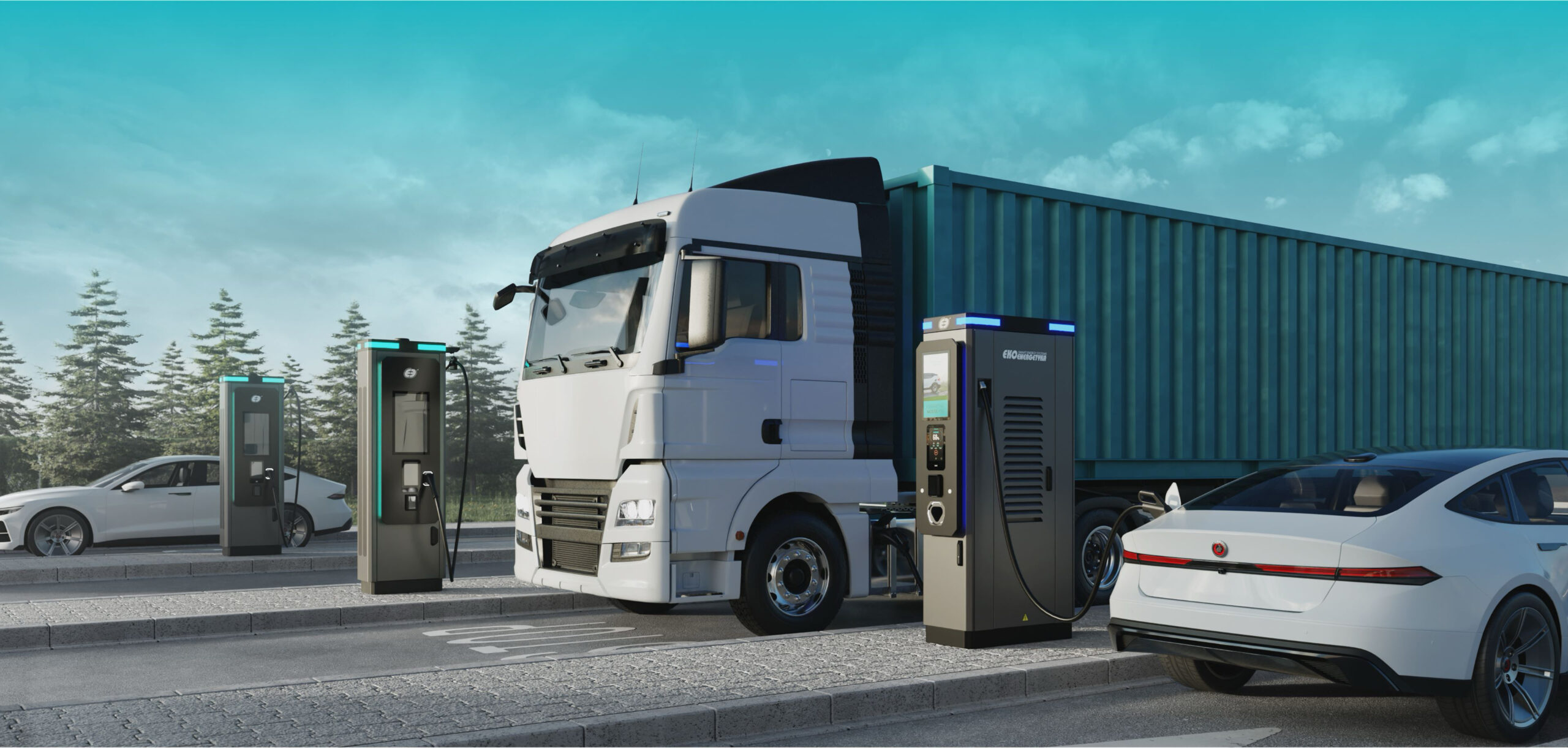
Europe is preparing for a rapid increase in electric heavy trucks, but the charging infrastructure required to keep them moving cannot simply be built by adding larger chargers for passenger cars. Long distance freight requires high power charging, large parking areas, space for articulated vehicles, reliable grid connections and stations positioned according to the actual movement of freight. The European Commission expects the number of zero emission trucks in the EU to increase from around 26,000 today to almost 400,000 by 2030. That would put pressure not only on charging operators, but also on motorway networks, truck parking areas and electricity grids.
A passenger car can usually charge in a relatively small parking bay, while a heavy truck needs enough space to enter the site, manoeuvre with a trailer, connect to the charger and leave without blocking other vehicles. A motorway charging site designed for trucks therefore needs wider access roads, larger turning areas and charging bays that can accommodate articulated combinations. The location also has to provide enough space for drivers to take mandatory breaks without forcing other trucks to move away from the charging area.
The timing of charging creates another difference. A truck travelling between distribution centres may stop for a relatively short period and therefore needs very high charging power. Another vehicle may remain at a motorway parking area overnight and can use a lower power charger for several hours. ACEA has identified both types of locations in its analysis of truck movements, distinguishing short stops that could require Megawatt Charging System equipment from longer stops where overnight charging is sufficient.
The location of the charger is therefore determined by transport operations rather than by the availability of an empty piece of land. An analysis conducted for ACEA using GPS data from around 400,000 trucks identified 31,145 locations suitable for future charging infrastructure for long distance trucks. The study found that many of these locations are concentrated around motorways, logistics centres, ports and other places where trucks already stop regularly.
Motorways are becoming part of the charging network
Long distance electric trucks cannot depend entirely on charging at company depots. A vehicle travelling across several countries may leave its home base with a full battery and still need several charging sessions before reaching its destination. The charging network therefore has to follow the main freight routes and allow trucks to cross borders without having to change their operating patterns.
The European Union is already building regulation around this model. The Alternative Fuels Infrastructure Regulation requires charging infrastructure for heavy vehicles along the Trans European Transport Network and in designated urban and secure parking locations. The requirements are separate from those applying to passenger cars because heavy vehicles need different charging power and physical infrastructure.
The European Commission is now coordinating the development of dedicated zero emission truck corridors. In June 2026, ministers from nine member states endorsed roadmaps for the Scandinavian Mediterranean and North Sea Baltic corridors. The plans identify infrastructure gaps, investment needs and energy requirements along the routes, with the Commission planning to extend the initiative to all TEN T corridors.
The scale of the planned network becomes clearer when compared with current deployment. Milence, one of the companies developing public charging hubs for heavy trucks, reported 34 operational hubs across eight European countries in May 2026. Another 16 sites were under development, with the company targeting 90 operational hubs by the end of 2028. Milence also reported nearly 1,800 truck suitable public charging points along major European freight corridors.
The electricity grid can become the real constraint
A charging hub for trucks can require a much larger electricity connection than a typical passenger car charging site. Several heavy vehicles may arrive within a short period, and operators need enough available power to charge them without creating long waiting times. Megawatt charging increases the electrical demand further because a single truck can draw a very high amount of power during a relatively short charging session.
The physical installation of chargers is therefore only one part of the project. A suitable motorway location may have enough space for a charging hub but lack the grid connection required to operate it. Extending the electricity network can require new equipment, planning procedures and additional construction, while the connection process may take longer than the installation of the charging equipment itself.
ACEA and Eurelectric warned in 2025 that grid constraints, lengthy permitting procedures and regulatory barriers were already slowing the deployment of heavy duty charging infrastructure. Their recommendations included earlier investment in electricity networks, better information about available grid capacity and more flexible connection arrangements.
This creates a different investment problem from the one faced by passenger car charging operators. A truck charging hub needs to be located where freight demand is high, but the most attractive freight locations may also require expensive upgrades to the electricity network. A company can install chargers only when the grid can supply them, while grid operators have to decide how much capacity to build before the full demand from electric trucks actually appears.
Existing truck stops are becoming strategic locations
Europe does not need to invent an entirely new geography for truck charging. Thousands of trucks already stop at motorway rest areas, logistics centres, ports and commercial truck parks. These locations provide an existing connection between freight traffic, parking and driver rest periods, which makes them natural candidates for charging infrastructure.
ACEA analysis found that the most frequently used 10 percent of truck stop locations account for roughly half of all truck stops recorded in its European dataset. The organisation has argued that these heavily used locations should receive suitable charging infrastructure first, with the most heavily used sites equipped by 2027 and a broader network operational by 2030.
The duration of a stop determines what type of charger makes sense. A truck stopping briefly needs to recover a large amount of energy in a short period, which points toward very high power charging. A truck parked overnight can take electricity more slowly, allowing several vehicles to charge without requiring every parking bay to have megawatt capacity.
That distinction matters because installing the most powerful possible charger everywhere would make the network unnecessarily expensive. A motorway parking area where trucks spend several hours can serve more vehicles with lower power equipment, while locations with rapid turnover need a much larger electrical connection and charging capacity.
Megawatt charging changes the economics
The move toward Megawatt Charging System technology is intended to reduce charging time sufficiently for electric trucks to fit into existing driving and rest schedules. Instead of requiring a vehicle to remain at a charging station for a large part of the day, higher power equipment can deliver a substantial amount of energy during a scheduled break.
The technology also changes the design of charging hubs. A site equipped with several high power chargers needs sufficient grid capacity, transformers, electrical equipment and safety systems. The physical layout has to prevent one truck from blocking another, while the number of charging bays has to reflect the volume of freight using the route.
The investment becomes easier to justify when a hub serves a heavily used freight corridor. A charger that is occupied frequently can generate more revenue from the same infrastructure than equipment installed at a location where only a few electric trucks pass each day. This makes traffic density one of the most important factors in deciding where new charging capacity should be built.
Depot charging will remain necessary
Public charging along motorways will not replace charging at company depots. Many electric trucks will return to a logistics centre at the end of a route, making overnight depot charging one of the simplest ways to start the next working period with a full battery.
Depot charging also allows fleet operators to plan electricity consumption around vehicle schedules. Trucks can be connected when they return from deliveries and charged during periods when they are not required for transport. This reduces dependence on public charging for vehicles operating on predictable regional routes.
ACEA describes depot charging as a cornerstone of heavy duty vehicle electrification, while also pointing out that many operations will need access to a dense public network. The combination matters because a fleet can rely on depot charging for much of its daily operation but still need motorway charging when vehicles are used on longer routes.
Europe is building corridors, but demand can grow faster
The European Commission estimates that the number of zero emission trucks could rise from approximately 26,000 today to nearly 400,000 by 2030. That increase would represent more than fifteen times the current fleet within only a few years. The charging network therefore has to expand before the majority of those vehicles enter regular freight operations.
The difficulty is that truck infrastructure cannot be planned only by counting vehicles. Two hundred electric trucks concentrated on a major freight corridor can create a greater infrastructure requirement than a larger number of vehicles operating on short regional routes with access to depot charging.
Freight traffic also crosses national borders, while electricity infrastructure and permitting remain largely organised at national and regional level. A truck travelling from Poland through Germany and the Netherlands, for example, needs a usable charging network across the entire route rather than a very well equipped network in only one country.
This is why the European Commission is treating charging corridors as cross border infrastructure rather than as separate national projects. The first roadmaps cover major TEN T routes and are intended to identify gaps before the number of electric trucks becomes large enough to make missing charging capacity a direct constraint on freight operations.
Poland has a particularly important position
Poland is one of the countries where the development of truck charging infrastructure will have consequences beyond the domestic electric vehicle market. The country sits on major European freight routes connecting Western Europe with Central and Eastern Europe, so a significant share of international truck traffic crosses Polish territory.
That makes motorway charging locations particularly important. A network designed only around Polish fleet operators would not be sufficient, because many of the electric trucks using Polish roads in the future will belong to companies based in other European countries.
The European Commission already includes Poland among the nine member states involved in the first two zero emission corridor roadmaps. This places Polish motorway routes inside the initial European planning process for cross border heavy truck charging infrastructure.
The bottleneck is no longer only the truck
Electric truck technology is developing rapidly, but vehicle availability alone will not determine how quickly freight transport can be electrified. Charging hubs have to be built where trucks actually operate, connected to electricity networks capable of supplying them and integrated with parking and rest infrastructure.
The European market is already moving in that direction. Companies are building dedicated truck charging hubs, governments are introducing mandatory infrastructure requirements and European institutions are mapping the corridors where additional capacity will be needed. Milence alone expects to increase its network to 90 hubs by the end of 2028, while the European Commission is expanding its corridor planning across the TEN T network.
The difficult part will be synchronising these investments. Truck manufacturers can deliver vehicles faster than new grid connections can sometimes be built, while charging operators need sufficient traffic to justify large infrastructure projects. Grid operators, meanwhile, have to plan capacity before the full demand materialises.
Europe is therefore moving from a situation in which electric trucks were mainly a vehicle technology project toward one in which transport infrastructure, electricity networks, motorway planning and logistics have to be developed together. The number of charging plugs will matter, but the decisive question will be whether the right chargers are available in the right places, with enough electricity behind them, when hundreds of thousands of electric trucks begin using European freight corridors.




