
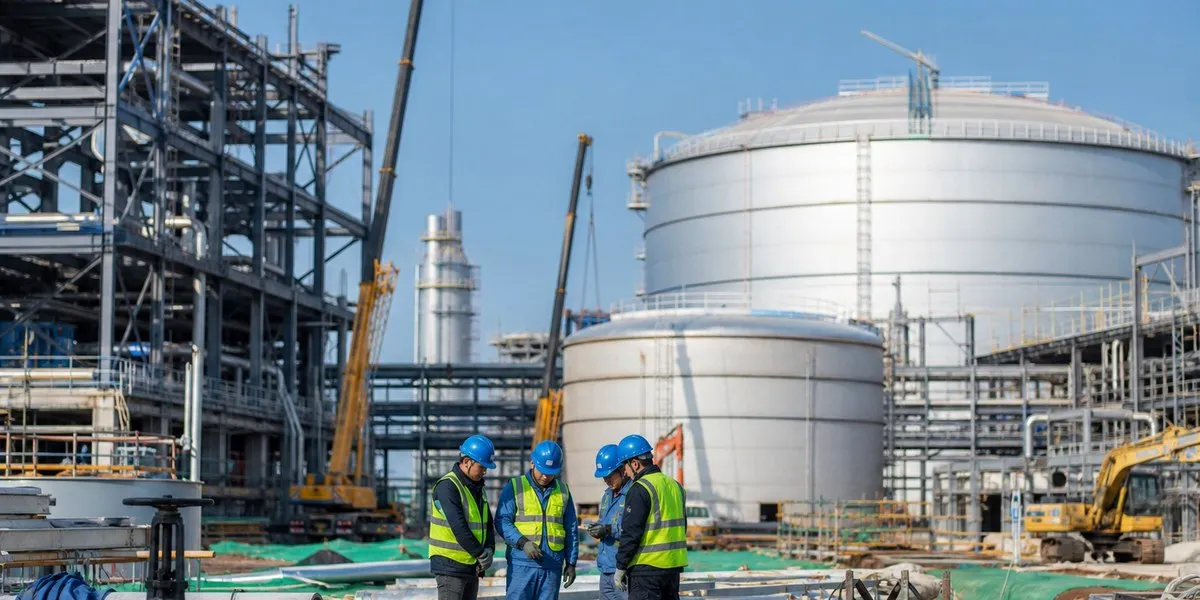
China’s Ruitan project combines molten salt energy storage with electricity generation using supercritical carbon dioxide. It is important, however, to distinguish this technology from a power plant that burns CO₂ or uses it as an energy source. At Ruitan, carbon dioxide acts as the working fluid in a turbine cycle, while the energy comes from heat previously stored in salt. Construction of the demonstration facility began in September in Shandong province, with commissioning scheduled for 2027.
Carbon dioxide, primarily associated with emissions responsible for global warming, will be one of the key components of a new energy facility being built in eastern China. In the Ruitan project, however, it will not be used as a fuel. Instead, it will be used in a turbine cycle, with heat supplied from an energy storage system based on molten salts. The Chinese project aims to demonstrate whether combining these two technologies will make it possible to use energy more efficiently during periods of low demand and feed it back into the grid when consumption increases.
The facility is being built at the Bajiao coal fired power plant in Yantai, Shandong province. Construction began on 16 September, and the facility is scheduled to begin operating in 2027. The first phase will include a 50 megawatt power generation unit using supercritical carbon dioxide and a molten salt thermal storage system with a capacity of 100 megawatts and an energy storage capacity of 400 megawatt hours. According to the South China Morning Post, it will be the first industrial scale facility to combine these two technologies in a single system.
Ruitan is intended to address a problem that is becoming more pronounced as China’s energy mix changes. In a system with a growing share of renewable energy sources, electricity generation does not always coincide with hourly demand. Solar and wind power can supply large amounts of electricity at times when consumers need less. If the grid cannot absorb all the available energy, some generation has to be curtailed, leaving potentially useful energy unused.
At Ruitan, surplus electricity will be directed into a thermal energy storage system. During periods of lower demand, electricity from existing coal fired units will be used to heat molten salts. The storage material will retain the energy as heat, which can then be used to generate electricity during peak demand hours. The facility is therefore designed to separate the time when energy is generated or consumed from the time when it is fed back into the grid.
This solution does not create new energy, but makes it possible to shift its use over time. From the grid operator’s perspective, this could reduce the need for sudden changes in the operation of generating units and limit losses resulting from a mismatch between supply and demand. In the case of Ruitan, the use of existing coal fired power plant infrastructure is also important, as it avoids the need to build an entire facility from scratch.
Why the turbine will run on carbon dioxide?
In a conventional thermal power plant, heat is used to warm water and produce steam, which drives a turbine connected to a generator. In the Ruitan project, this role will be performed by carbon dioxide maintained in a supercritical state. This means it will be subjected to temperatures and pressures high enough to exceed its critical point. Under these conditions, CO₂ behaves neither like an ordinary gas nor like a typical liquid. Instead, it has intermediate properties that can be used in a closed energy cycle.
The heated carbon dioxide will flow through the turbine system, transferring energy to it and driving the generator. After releasing some of its energy, it will be cooled, compressed and directed back into the cycle. Unlike a steam power plant, the system does not require water to be evaporated and condensed within the same cycle. This could simplify some of the equipment and reduce the space required, although the actual scale of these benefits will depend on the parameters of the specific installation.
Supercritical CO₂ technology is being developed, among other reasons, because it offers the possibility of building more compact turbine and compressor systems. Supercritical carbon dioxide has a high density while retaining the ability to flow through equipment like a fluid. This makes it possible to design cycles with different operating parameters from those of conventional steam power plants. It does not mean, however, that every CO₂ based installation will automatically achieve higher efficiency. Performance depends on the temperature of the heat source, equipment design, cycle losses and the conditions under which the system operates.
The thermal storage system will have a capacity of 400 megawatt hours
In its first phase, Ruitan will receive a molten salt storage system with a power rating of 100 megawatts and an energy storage capacity of 400 megawatt hours. Power determines how quickly a system can absorb or release energy, while capacity indicates how much energy it can store. Assuming operation at the full power rating of 100 megawatts, a capacity of 400 megawatt hours corresponds to four hours of energy storage.
Molten salts are used as a heat transfer medium because they can operate at high temperatures and store significant amounts of energy in a relatively small volume. In systems of this kind, salt is heated, stored in insulated tanks and then used to transfer heat to another cycle. At Ruitan, this will be the supercritical carbon dioxide system, which will drive the turbine.
Separating the storage system from the generating unit gives the operator the ability to adjust electricity production to the needs of the grid. The storage system can be charged during periods of lower demand, with the heat used later when the system requires additional power. The demonstration project will make it possible to test not only conversion efficiency, but also material durability, response times to changes in demand and operating costs.
The project’s location at the Bajiao power plant is significant from an industrial perspective. The existing facility has energy infrastructure and a grid connection, while the new system is intended to work alongside operating coal fired units. Instead of treating the power plant solely as a source of electricity generated at the moment fuel is burned, the project envisages using it for more flexible management of generation and storage.
This approach could be useful in energy systems where much of the generating capacity has already been built, but its operating model needs to change as renewable energy sources expand. Thermal power plants could then serve not only as electricity producers, but also as elements of infrastructure that stabilise supply. Ruitan is intended to test whether combining thermal storage with a CO₂ turbine can increase the flexibility of an existing facility without requiring its entire infrastructure to be replaced.
This concept should not, however, be confused with emissions free electricity generation. Storing surplus energy and using a different working fluid do not eliminate emissions produced when coal is burned in the units supplying energy to the system. The climate benefits will depend on where the energy used to charge the storage system comes from, how often the system operates and whether it helps reduce fuel consumption or energy losses across the entire system.
China is developing technology alongside infrastructure
Ruitan forms part of a broader direction in Chinese energy policy, in which the development of renewable energy sources is being combined with investment in storage, transmission networks and technologies that increase system flexibility. China is simultaneously expanding wind and solar power capacity, nuclear energy and infrastructure that enables electricity to be transmitted between regions. The growing scale of these investments means that the ability to absorb, store and deliver energy at the right time is becoming just as important as the amount of energy generated.
According to data cited in analyses of China’s clean energy sector, the share of Chinese entities in global patent applications related to this field has increased significantly since the beginning of the 21st century. This level of research activity matters not only for the domestic energy system. It also enables Chinese companies to develop equipment and solutions that may later be introduced to international markets.
The number of patents alone does not determine whether a technology will succeed commercially, however. Its significance will depend on construction costs, efficiency, reliability and the ability to deploy it under different grid conditions. In the case of Ruitan, the particularly important challenge will be moving from a demonstration facility to a system that can be replicated at other power plants and compete with battery storage, pumped storage hydropower and other balancing technologies.
The demonstration will show whether the technology is suitable for wider deployment
Ruitan is primarily intended to be an industrial test. The parameters of the first phase are large enough to test the system under real power plant operating conditions, but they are not yet sufficient to determine its usefulness across the entire energy system. Key indicators will include the efficiency of energy storage and reconversion, equipment availability, maintenance costs and response times to changes in demand.
It will also be important to see how the installation performs during frequent charging and discharging cycles. The thermal storage system must retain its operating parameters over many hours, while equipment using supercritical CO₂ will require precise control of temperature and pressure. In operation, the turbine’s performance will not be the only consideration. Heat losses, energy consumption by auxiliary equipment and the durability of cycle components will also matter.
If the project confirms its expected performance, the technology could be used at other thermal power plants, as well as in systems with a stable heat source. Its potential application in nuclear power generation will depend on adapting the cycle to reactor operating conditions and safety requirements. At this stage, Ruitan remains a demonstration project intended to provide the data needed to assess such applications, rather than a ready made solution for every type of power plant.




