
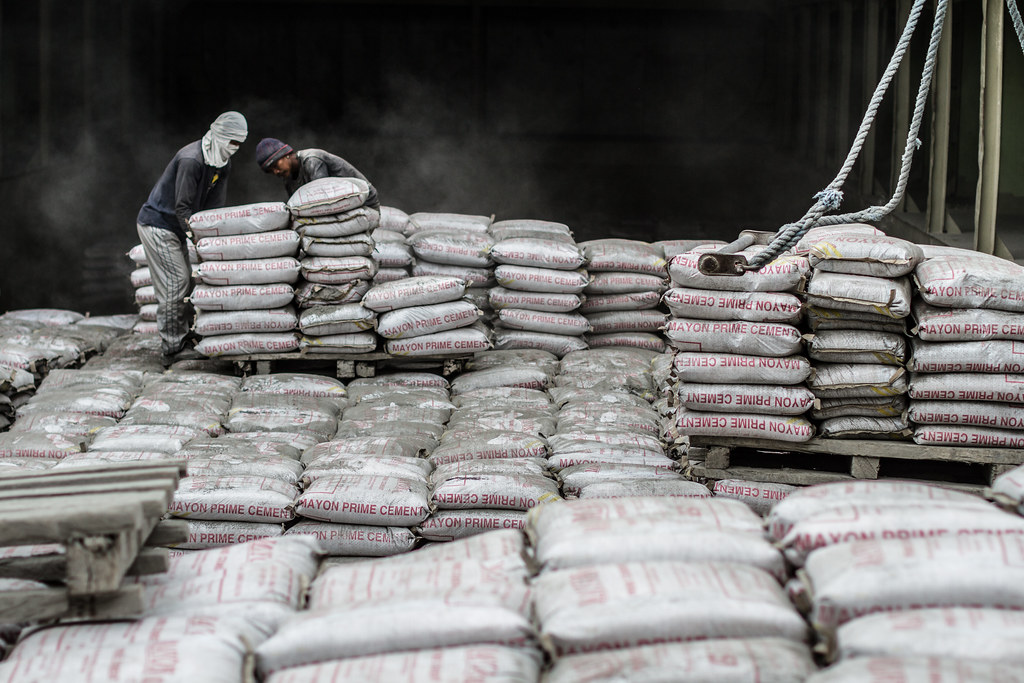
The cement industry accounts for about 8% of global CO₂ emissions (3.8% in Poland) and is essential for building zero-carbon infrastructure. Decarbonisation requires CCS technology and regulatory support.
Cement is the most widely used building material in the world. Without it, no modern city, bridge, road, dam, power plant, or transport infrastructure could be built. As industry representatives put it, „steel was called the material of the industrial revolution, while cement and concrete form the foundations of our civilisation, meeting basic needs – including housing and infrastructure.” At the same time, cement production is one of the most energy-intensive and emission-intensive industrial processes. The sector accounts for about 8 percent of global greenhouse gas emissions, making it the third-largest source of emissions after the energy and transport sectors. In Poland, according to the Central Statistical Office (GUS) for 2025, CO₂ emissions from cement production represent 3.8 percent of total national emissions.
The uniqueness of the decarbonisation challenge for cement lies in the fact that the vast majority of emissions – about 63 percent – are process-related rather than energy-related. These emissions result from the chemical reaction of calcination, during which calcium carbonate (CaCO₃) is decomposed at high temperatures into calcium oxide (CaO) and carbon dioxide (CO₂). Even if a cement plant were powered 100 percent by renewable electricity, process emissions would still occur as a by-product of the production technology itself. This means that traditional emission reduction methods, such as improving energy efficiency or switching to renewable fuels, are insufficient – it is necessary to adopt carbon capture and storage (CCS) technologies.
Strategic importance of cement for building zero-emission infrastructure
The energy transition is impossible without massive infrastructure investments, and such infrastructure cannot exist without cement. As representatives of the Polish Cement Association point out, the cement industry expects growth in production and sales in connection with government‑planned investments such as the Central Communication Port, offshore wind farms in the Baltic Sea, and nuclear power plants. Each offshore wind turbine requires foundations made of thousands of tonnes of high‑quality concrete. Every kilometre of new high‑voltage railway line, used to transmit energy from renewable sources to consumption centres, relies on poles and transformer stations whose core is concrete. Nuclear power plants, a pillar of the low‑carbon energy mix, require massive reinforced concrete structures with enhanced strength and tightness.
The paradox of the energy transition is therefore that building a zero‑emission economy requires huge quantities of a material whose production is itself highly emission‑intensive. Without decarbonising the cement industry, the entire transition is called into question – emissions associated with building new infrastructure could offset some of the savings achieved through the operation of renewable sources. That is why the European Union has included the cement sector in the Emissions Trading System (EU ETS) and the Carbon Border Adjustment Mechanism (CBAM), aiming to force emission reductions while maintaining the competitiveness of European producers.
Cement plants as waste incinerators and sources of secondary raw materials
The cement industry also plays an important, though often underestimated, role in achieving circular economy goals. The cement production process reaches about 1,450 degrees Celsius, allowing complete and safe thermal treatment of waste that could otherwise pose an environmental problem in other facilities. Polish cement plants have been using alternative fuels – derived from municipal waste, industrial waste, and organic fractions – as a substitute for fossil fuels, mainly coal, for over 25 years. This not only reduces CO₂ emissions but also decreases the amount of waste sent to landfills.
In plants such as Holcim Poland’s Kujawy and Małogoszcz cement plants, thousands of tonnes of fuels produced from municipal waste and industrial waste from the automotive, packaging and food industries are used to generate process heat. Similarly, in the Dyckerhoff Polska group, in 2022, 29.9 percent of total energy consumed came from alternative fuels, and 9.4 percent of raw materials for cement production consisted of materials recovered from other industrial processes, such as slag, fly ash and synthetic gypsum.
Crucially, cement plants not only burn waste but also recover raw materials from it. The ash produced after burning alternative fuels contains silicon, aluminium and iron oxides, which are valuable additives to the natural raw materials used in the clinker burning process. The whole process is an example of industrial symbiosis, where waste from one sector becomes a valuable input for another, and environmental goals are pursued alongside production goals.
EU ETS and CBAM as drivers and threats to transformation
EU climate policy affects the cement industry through two main instruments. The first is the Emissions Trading System (EU ETS), which from 2026 is undergoing a key reform involving the gradual phase‑out of free allowances for the cement sector. A gradual reduction of free allowances is planned, to be completed by 2034. Currently, free emission allowances for cement producers are set at benchmark levels lower than actual emissions, which further reduces competitiveness – as industry representatives point out. This means that soon cement plants will have to pay for every tonne of CO₂ emitted at market prices, which in 2026 are around €70‑80 per tonne, while long‑term forecasts indicate the possibility of an increase to €150 or more.
The second instrument is CBAM – the Carbon Border Adjustment Mechanism – which entered full operation on 1 January 2026. CBAM requires importers of cement from outside the European Union to purchase certificates corresponding to ETS allowance prices, aiming to equalise emission costs between EU production and imports. The full obligation to purchase CBAM certificates will apply from 2026, with the first compliance deadline on 30 September 2027, leaving a small window for importers during the transition period. In practice, this means that cement from Turkey, Ukraine, Egypt or China that enters Europe will face the same fiscal burden from CO₂ emissions as cement produced inside the EU. The European Cement Association, CEMBUREAU, estimates that the cement industry alone will pay between €100 and €160 billion into the ETS system over the next ten years. According to the industry, these funds should be allocated to support transformation and investment in CCS technologies.
The difficult situation of the Polish cement industry
The Polish cement industry finds itself in a particularly difficult situation compared to other EU member states. Poland, the third largest cement producer in Europe after Germany and Italy, produced 17.1 million tonnes of cement in 2025 (data from the Central Statistical Office – GUS). However, production has been systematically declining – in 2025 it amounted to 17.1 million tonnes (a year‑on‑year drop of 3.2 percent), and forecasts by the Polish Cement Association for 2026 expect a further decline of 2 percent, to about 16.8 million tonnes.
The main reason for the decline is rising cement imports from outside the European Union, which reached a record 1.73 million tonnes in 2025, i.e., more than 10 percent of domestic production. The competitiveness of Polish cement plants is also hurt by high electricity prices. According to 2026 data, electricity prices in Poland are among the highest in Europe. Term contracts for 2027‑2028 are around €100/MWh, while in France they are about €50‑53/MWh. For cement plants, which consume about 2 terawatt‑hours of electricity annually, these costs account for 30‑35 percent of total production costs, and their share will increase with the implementation of energy‑intensive CCS installations.
An additional risk factor is the sharp increase in cement imports from Ukraine. Before the war, in 2021, cement imports from that direction amounted to 53 thousand tonnes. The forecast for 2026 expects growth to over one million tonnes, which poses a serious challenge to the competitiveness of Polish cement plants. In response to these challenges, industry representatives are calling on the government to take urgent legislative action and to include cement in the system of indirect emission cost compensation, in order to prevent further loss of competitiveness against economies outside Europe, such as the United States or China, where energy costs and climate regulations are much less restrictive.
CCS technologies as an indispensable decarbonisation tool
Since process emissions cannot be eliminated through energy efficiency improvements or fuel switching, the only realistic solution for the cement sector is to deploy carbon capture and storage (CCS) technologies. CCS involves capturing CO₂ at the emission source – directly from the flue gases of the cement kiln – and then transporting and injecting it into suitable geological formations deep underground, where the carbon dioxide is hermetically and permanently isolated from the atmosphere.
In Poland, the most advanced CCS project is being implemented at the Kujawy cement plant, owned by Holcim Polska. A novel technology for capturing CO₂ is planned there. The aim of the project is to achieve climate neutrality for the plant through zero emissions. Holcim Polska plans to launch the CCS installation in Kujawy at a cost of €380 million, which would make it the first zero‑emission cement plant in Poland.
However, rolling out CCS across the entire sector requires several conditions to be met. First, huge investment outlays are necessary – the cost of a CCS installation for a single cement plant is in the order of hundreds of millions of euros, with Holcim Polska estimating the investment for its plant at about €400 million. Second, it is essential to create a legal framework at national level and provide transport infrastructure and CO₂ storage sites – this concerns all sectors covered by the EU ETS, including cement, steel, lime, fertilisers, paper, glass, chemicals and oil refining. Third, CCS installations are highly energy‑intensive and can increase a cement plant’s electricity demand by 30‑50 percent, which, given Poland’s high energy prices, further exacerbates the competitiveness problem.
Fot. Flickr


