
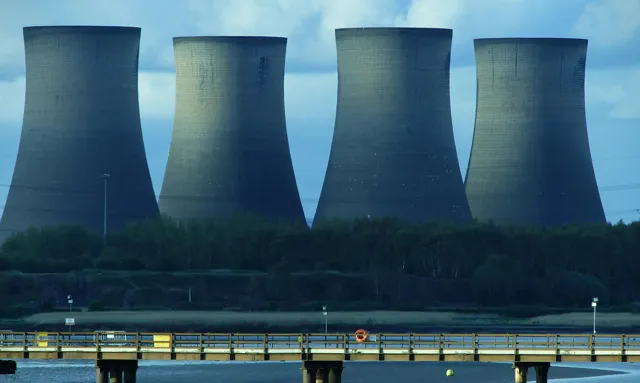
Canada is stepping up its efforts to participate in Poland’s nuclear power program. Ottawa wants to leverage its experience with CANDU technology, its industrial base, and financing capabilities to enter another major nuclear project in Poland. What is at stake is not only technology supplies, but also long-term contracts for industry, participation in the supply chain, and the opportunity to establish a lasting presence for Canadian energy companies in Poland.
The Canadian push in Poland has gained clear momentum in recent months. In February, Canada’s Minister of Energy and Natural Resources Tim Hodgson held talks in Warsaw with Poland’s Energy Minister Miłosz Motyka on cooperation in nuclear energy, while the Canadian government declared its readiness to mobilize its technological and industrial capabilities if Poland decides to cooperate on a second nuclear project. In September, during a visit by Canadian ministers to Poland, the issue returned to the agenda of talks with the Polish government. Ottawa is promoting CANDU as a technology based on Canada’s own experience in nuclear power.
Canada’s interest is not accidental. Poland is building its first nuclear power plant using Westinghouse’s U.S. AP1000 technology, while there is considerably more room for technological competition over the next major project. Canada wants to take advantage of this opportunity by competing for the contract with suppliers from other countries. According to information cited by Reuters, potential rivals include U.S. and French companies, among others, while Ottawa is seeking to present its offer as a broader partnership encompassing not only the reactor itself, but also fuel, industry, and financing.
Canada is not just selling a reactor
For Polish industry, the fact that Canada’s offer is being built around the entire value chain is important. CANDU uses natural uranium and heavy water, while Canada’s nuclear sector includes companies involved in design, component supplies, fuel, engineering services, and power-plant operations. For several years, the government in Ottawa has also been investing in modernizing its own technology in order to increase its competitiveness on international markets.
This matters because, in a nuclear project, the reactor technology contract represents only part of the overall cost. A power plant requires thousands of components and services, ranging from steel structures and mechanical equipment to automation and electronics, as well as construction, installation, maintenance, and subsequent operations. If a technology supplier wants to establish a long-term presence in Poland, it must create opportunities for its own companies within the domestic supply chain. For Polish companies, this could mean access to contracts that may continue for many years after the main agreement is signed.
Canada already has an example of this type of cooperation in Poland. Northland Power, a Canadian energy company, is a partner of ORLEN in the Baltic Power project. The 1.1 GW offshore wind farm is expected to generate approximately 4 TWh of electricity annually and, once fully operational, cover around 3% of Poland’s national electricity demand. The Canadian government presents the project as an example of cooperation that could be expanded to further investments, including nuclear energy.
CANDU has decades of operating experience behind it
Canadians can also point to the experience of their own nuclear sector. CANDU technology forms the backbone of Canada’s reactor fleet, and plants using the technology operate, among other places, in Ontario. Canada is also carrying out a program to modernize existing units. One of the largest examples is the refurbishment of four CANDU reactors at the Darlington nuclear power plant, at a cost of C$12.8 billion.
The same site is also seeing the construction of GE Hitachi’s BWRX-300 small modular reactors. Construction of the first of four planned units began in May 2025, and under the current schedule it is expected to begin operations in 2030. More than 100 Ontario companies are participating in the project, illustrating how much of the value of a nuclear investment can be generated outside the reactor supplier itself.
Canada’s nuclear sector wants to draw on this experience in Poland as well, although CANDU and BWRX-300 are two different technologies with different potential applications. Canada is interested in both large-scale nuclear power and the SMR market. Meanwhile, the Polish government is pursuing work on large nuclear power plants and modular technologies in parallel, including the BWRX-300 project being developed by ORLEN Synthos Green Energy.
The second nuclear power plant is the key battleground
The greatest value for Canadian industry would come from entering the project for Poland’s second nuclear power plant. Poland needs additional large-scale sources of energy, and the decision on the technology will also determine which foreign supplier gains access to a long-term investment program and which companies are brought into its implementation.
Canada is already talking about more than simply selling technology. In February, Minister Hodgson declared that Canada was ready to deploy its expertise, industrial capabilities, and government support if Poland chose a Canadian solution for the second nuclear project. During subsequent talks, the Canadian side also emphasized the possibility of cooperation on fuel supplies and investment financing.
In practice, financing could be one of the most important elements of the competition. A nuclear power plant requires enormous amounts of capital before the first megawatt-hour of electricity is sold, meaning that for both investors and governments, financing terms, guarantees, payment schedules, and the possibility of limiting public-sector risk can be just as important as the price of the technology itself. If a technology supplier can offer a financing solution together with its industrial sector and home government, its proposal may become more competitive than the price of the equipment alone.
For Polish companies, the supply chain may matter more
The choice of technology will have consequences extending far beyond the site of the future power plant. Every major nuclear project creates a long-term market for construction contractors, manufacturers of structures, equipment suppliers, automation companies, control-system providers, engineering firms, and specialized installation contractors. Some companies may enter the supply chain regardless of who becomes the main reactor supplier, but the scale of that participation will depend on the terms of the contract and the investor’s localization policy.
Canada is already signaling that it wants to develop the industrial dimension of its cooperation with Poland. In July, Poland’s Ministry of Energy said cooperation with Canada in the energy sector would include nuclear power, SMRs, and offshore wind, with one of the objectives being to increase the participation of Polish industry in strategic investments.
There is also another dimension to the cooperation, related to fuel security. Canada is one of the world’s largest uranium producers, and its nuclear industry covers the entire chain associated with the extraction, processing, and use of the resource. For a country building new reactors, this creates the possibility of broader agreements covering not only the power plant itself, but also the long-term security of fuel supplies.
Poland already has a strategic agreement with Canada
The legal foundations for expanding this cooperation are already in place. In January 2025, Poland and Canada signed an updated agreement on cooperation in the peaceful uses of nuclear energy. In August of the same year, the two governments announced plans to expand cooperation among companies, research institutions, and energy operators, as well as dialogue concerning Poland’s second nuclear power plant. A Polish nuclear-sector mission to Canada was also planned as part of the partnership.
Canada therefore already has channels for discussions with the Polish administration and businesses. In February, Minister Hodgson met not only with the energy minister but also with Poland’s Minister of State Assets, Wojciech Balczun. During the talks, the Canadian side emphasized its interest in participating in Poland’s energy transition and its readiness to offer nuclear solutions.
For Ottawa, the Polish market is attractive for another reason as well. Canada wants to increase exports of energy technologies and reduce its economy’s excessive dependence on the U.S. market. Poland could become one of the most important European markets for Canadian companies because over the coming decades it will need new nuclear capacity, is developing offshore wind, and is modernizing its transmission grid.
The stakes involve billions and a position for decades
If Canada secures a role in Poland’s second major nuclear project, the benefits for its industry will extend well beyond a single contract. The technology supplier would gain access to a long-term market for maintenance services, spare parts, fuel, upgrades, and plant operations. For Canadian companies, it would also provide an entry point into other European projects, as a reference plant operating in Poland could become an argument in future tenders.
For Poland, the key issue will be how much of the investment’s value remains within the domestic industrial sector. A declaration of industrial cooperation does not by itself determine the number of contracts Polish companies will receive. That will depend on requirements concerning domestic industrial participation, how contracts are divided, supplier qualification, and which elements of the technology can be manufactured in Poland.
Canada is already making clear that it wants to be at the table before Poland makes its final decisions on additional large-scale nuclear units. In February, Ottawa spoke of its readiness to deploy its industry and technology for the second nuclear power plant, while in September the issue was raised again during high-level economic and energy talks. The competition for Poland’s nuclear program is therefore also becoming a competition for a future market for technology manufacturers, contractors, and component suppliers, as well as for which foreign industrial supply chain Poland’s energy sector will be tied to for decades to come.
Canada’s involvement in Poland is already being officially confirmed by the governments of both countries. Ottawa is explicitly pointing to Poland’s second nuclear project, its CANDU capabilities, and the possibility of industrial and government support, while Warsaw is emphasizing the increased participation of Polish industry in strategic investments.
Photo: Pixabay




