
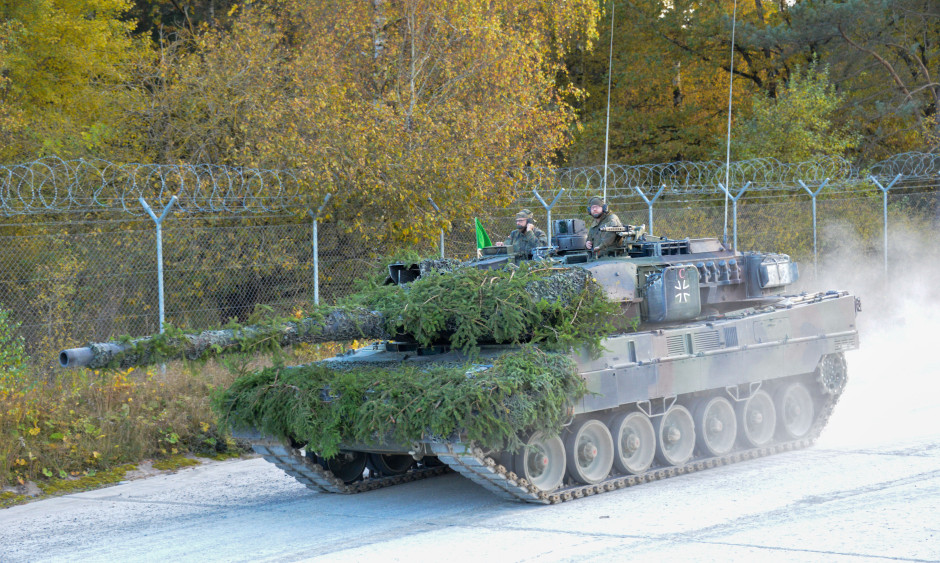
Germany is preparing the biggest restructuring of the Bundeswehr in decades. Berlin wants to increase the number of soldiers, expand its land forces, air defence, air force and navy, and by 2035 devote enough resources to defence to build one of the largest armed forces in Europe. A comparison of Germany’s and Poland’s current plans shows, however, that Warsaw may have greater potential in one area. That area is the land forces.
The German plan is not being developed from the position of a country that is simply expanding its existing army. The Bundeswehr must simultaneously rebuild capabilities lost during years of austerity, increase personnel numbers, replenish equipment and create the capabilities needed to conduct large scale conventional operations. A report by the Centre for Eastern Studies, prepared by Justyna Gotkowska with the cooperation of Lidia Gibadło and Jacek Tarociński, indicates that the planned transformation is set to cover virtually every branch of the German armed forces.
The starting point for current German defence policy was Russia’s invasion of Ukraine in 2022. Then Chancellor Olaf Scholz announced Zeitenwende, meaning a change of era in German security policy. Berlin created a special fund worth 100 billion euros for the modernisation of the Bundeswehr, but the resources from this instrument were used in a way that did not lead to the full restoration of German military capabilities.
According to Justyna Gotkowska, the decisive acceleration came only after the change of government in 2025. The new funding policy made it possible to increase defence spending on a scale that would previously have been difficult to achieve. According to data presented by the Centre for Eastern Studies, planned German defence spending in 2026 amounts to 124.6 billion euros, or around 2.69 percent of GDP.
– The second Trump administration clearly said that conventional defence is the responsibility of European allies and that it would reduce its military capabilities that are assigned within NATO to regional defence plans. It also forced European allies to spend 3.5 percent of GDP on defence by 2035. All of this greatly motivated Germany, particularly under Chancellor Merz, to present far reaching plans for Bundeswehr reform and a far reaching increase in defence spending – Gotkowska said.
The change also means moving away from a model in which Germany spent years focusing primarily on its role as NATO’s logistical support base. Berlin is to develop capabilities allowing it to participate directly in defensive operations on the Alliance’s eastern and northern flanks. One of the most visible examples is the German armoured brigade being deployed in Lithuania. Germany is also increasing its ambitions in air defence, aviation and maritime operations in the North Atlantic and Baltic Sea.
The Bundeswehr must first rebuild lost capabilities
The scale of Berlin’s plans is all the more significant because the current Bundeswehr is not an army simply waiting for its budget to increase. For around two decades, the German armed forces were gradually adapted to operations of a different nature. The land forces were primarily expected to conduct expeditionary operations and participate in overseas missions. Capabilities needed to conduct a major conventional war were reduced.
– The Bundeswehr is starting from the level created by two decades of austerity, the transformation of the German armed forces into an expeditionary army and, in particular, the loss of the land forces’ ability to conduct conventional operations against an adversary such as Russia – Gotkowska said.
This is why money is only one element of the German plan. At the same time, the country must increase the number of soldiers, rebuild ammunition stocks, expand infrastructure, increase arms production and create units capable of operating within NATO defence plans. The Bundeswehr is to be primarily subordinated to NATO’s regional defence plan for central Europe, covering Germany, Poland and the Baltic states. The second direction covers the northern flank, the North Sea, the Norwegian Sea and the North Atlantic.
This explains why the German transformation involves more than tanks and artillery. Berlin also wants to develop maritime capabilities, air defence, aviation and capabilities related to NATO’s nuclear deterrence. Germany intends, among other things, to increase the number of Eurofighter aircraft to 183 by 2035, while its plans also envisage expanding the submarine fleet to 9 or 12 vessels.
The biggest problem may be people
The Bundeswehr’s technical capabilities will nevertheless depend on whether Germany can find enough people. This is currently one of the most concrete problems facing the entire programme. In June 2026, the German armed forces had around 185,600 soldiers, while the plan calls for around 260,000 active duty soldiers and 200,000 reservists by 2035.
For years, Germany did not conduct universal military registration. This meant that the state did not have a regular system for determining how many young citizens could be called up for service and what qualifications they possessed. The system has been reintroduced, but restoring registration alone does not solve the recruitment problem. The Bundeswehr has to compete for young people with Germany’s private sector, which is also suffering from labour shortages.
The new German military service law provides for a gradual increase in the number of recruits. Bundeswehr plans call for 20,000 new soldiers to be recruited in 2026, 30,000 in 2028 and 40,000 in 2030. The number of reservists is also expected to grow rapidly at first, from around 60,000 today to 140,000 in 2029.
This is where a political problem emerges that could affect the entire project. Germany provides for the possibility of introducing selective conscription if the number of volunteers proves insufficient. This is not an automatic solution, however. A decision to use this mechanism would require appropriate political action, while the issue of increasing the size of the army has effectively been pushed beyond the 2029 Bundestag election.
– In my view, it is very clearly linked to the political calendar, meaning the Bundestag election. In effect, it shifts the difficult decision on introducing selective conscription to the next government – the deputy director of the Centre for Eastern Studies said.
– Increasing the size of the armed forces after 2029 will, in my view, be quite a difficult political project to implement – she added.
There is money, but what happens after 2029 remains uncertain
The second problem concerns funding. Germany has created the possibility of rapidly increasing defence spending, including through debt financing. The government has planned an increase in spending through 2029. The spending schedule itself does not determine what the next government’s policy will look like, however.
This matters because building an army to its target size does not end when contracts are signed. Tanks, aircraft, ships and air defence systems subsequently require years of funding for operation, repairs, modernisation, crew training and the maintenance of ammunition and spare parts stocks. The larger the army, the greater the permanent share of costs that remains after the first wave of procurement has ended.
– What happens afterwards? We will see what kind of government is formed and whether it will be willing to continue increasing spending towards 3.5 percent of GDP. (…) I see major question marks that could simply limit the growth of the Bundeswehr or Germany’s ambitions to create the strongest conventional army in Europe – Gotkowska said.
This is why the Centre for Eastern Studies report points to uncertainty over the pace of spending increases after 2029. The German plan is laid out over many years, but its implementation will depend on subsequent political decisions and the economic situation.
Poland and Germany are building different force profiles
A comparison of Poland and Germany shows that both countries are increasing their military potential, but not necessarily in the same areas. Warsaw is focusing primarily on expanding its land forces. Berlin wants to build much more balanced armed forces, including large land forces, an expanded air force, a navy and a broad air defence system.
According to plans presented by Gotkowska, Germany is to have three operational divisions, two territorial defence divisions and one division equipped with strategic capabilities. Poland, by contrast, plans to have six divisions. The number of divisions alone cannot determine the combat value of an entire army, of course, because the structure of units, number of soldiers, weapons, ammunition, logistics, reconnaissance, air defence and command capabilities also matter. In the case of land forces, however, it shows the scale of Warsaw’s ambitions.
– I think Poland will have by far the strongest land forces in Europe. We can already see this at the planning stage. Germany will have three operational divisions, two territorial defence divisions and one division with strategic capabilities. Poland plans six divisions, and that already shows much greater armoured and artillery capabilities – Justyna Gotkowska replied.
The difference also results from the way the two countries are building their capabilities. Poland is carrying out very large purchases of land equipment, including tanks, artillery, rocket launchers and infantry fighting vehicles. Germany, by contrast, has to devote some of its new resources to rebuilding structures that were previously not maintained on the scale required for a major conventional conflict.
Air defence may be comparable, but Germany has an additional ambition
The comparison of air defence capabilities may be much more balanced. Both countries are investing in layered systems designed to protect troops and infrastructure against aircraft, helicopters, drones and missiles.
The German plan has an additional element that Poland is not currently developing on a similar scale. Berlin wants to have capabilities allowing it to intercept ballistic missiles beyond the atmosphere. This is part of a broader German approach to building European missile defence capabilities.
In practice, this means that comparing the two armies cannot be limited to the number of launchers or missiles. Radars, command systems, target detection capabilities, interceptor stocks and the ability to integrate different systems into a single network also matter. In Germany’s case, the development of air defence is part of a larger plan whose objective is to protect not only its own territory but also NATO forces deployed on the eastern flank.
In the air and at sea, Germany plans to have the advantage
The biggest difference between Polish and German plans appears in aviation and naval forces. Berlin has a larger economic and financial base, which allows it to develop land forces while simultaneously investing in costly air and maritime capabilities.
In aviation, Germany plans a significant increase in the number of Eurofighters. By 2035, there are to be 183 of them. The Bundeswehr is also developing its F35 fleet, which is to participate in NATO’s nuclear sharing system.
An even greater difference concerns naval forces. Germany plans to develop capabilities for operations in the North Atlantic, Norwegian Sea, North Sea and Baltic Sea. These include tasks related to protecting sea lanes, anti submarine warfare, escort operations and combat operations in the Baltic. The Centre for Eastern Studies also envisages a significant expansion of the fleet and the integration of crewed vessels with unmanned systems.
Compared with the Polish Navy, this represents a very large difference in the scale of planned capabilities. According to the Centre for Eastern Studies report, once the German plans are implemented, the Bundeswehr will have an advantage in almost all major areas of maritime capability. Poland will retain certain advantages in mine countermeasure vessels and land based missile systems designed to engage surface shipping.
The German army will also change the balance of power within NATO
The expansion of the Bundeswehr matters not only for the military balance between Berlin and Warsaw. Germany occupies a position that cannot be replaced simply by increasing the number of Polish or American units.
Key logistical routes for transporting troops and equipment from western Europe and the United States towards Poland and the Baltic states run through German territory. German ports, airports, roads, railways and military infrastructure form part of the support network for NATO’s eastern flank. Therefore, even if the Bundeswehr were not directly involved in every military operation in the east, Germany’s importance for conducting operations would remain very large.
– We have to think about alternative scenarios, but it will nevertheless be very difficult if Germany completely drops out of this equation. I can imagine a lack of direct Bundeswehr involvement in the defence of the Baltic states or Poland, or the Bundestag refusing to approve such involvement, but Germany’s logistical role for the eastern flank is enormously important – Gotkowska said.
The growth of German military potential will therefore affect Berlin’s position within NATO regardless of whether all planned units reach their target readiness. A country with large land forces, modern aviation, an expanded navy and infrastructure enabling troops to be moved across its territory has a broader range of options for influencing the Alliance’s overall defence planning.
The biggest unknown begins after 2029
On paper, the difference between the plans of the two countries is therefore fairly clear. Poland is focusing primarily on the scale of its land forces, while Germany is trying to create a broad set of capabilities covering land forces, aviation, the navy and air defence. In terms of land forces, current German plans do not envisage as many divisions as Warsaw’s plans. In aviation and at sea, the situation is reversed.
The problem is that the German plan is only the beginning of a long term process. The Centre for Eastern Studies points to very specific risks: recruiting a sufficient number of soldiers, maintaining funding after 2029, the industry’s ability to fulfil orders and the political willingness of future governments to maintain high levels of defence spending.
– But will all these plans come to fruition? We will see. I have some doubts. We now have major investments and a lot of procurement. They will be implemented after 2029, but will all the ambitions be fulfilled? I would put a question mark here – concluded Justyna Gotkowska, deputy director of the Centre for Eastern Studies.
The Centre for Eastern Studies report on which this comparison is based was published on 18 September 2026 and contains a detailed overview of the planned capabilities of the Bundeswehr, including personnel numbers, aviation, naval forces and air defence.
Fot. Spc. Israel Fernandez / DVIDSHUB / CC0




