
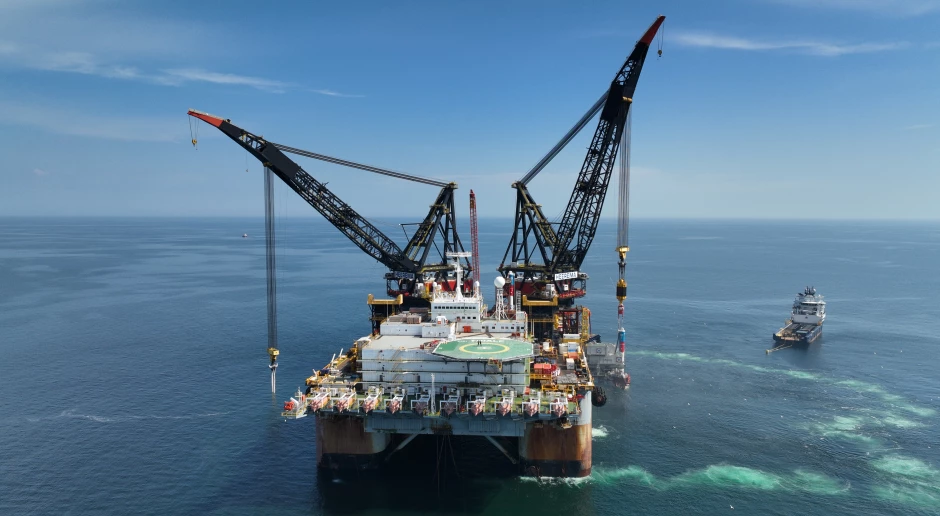
Equinor and Polenergia have announced the completion of a significant offshore phase for their Baltic 2 and 3 projects. The installation of foundations for all 100 wind turbines of both offshore farms and support structures for the offshore electrical substations has been finalised. The installation campaign for the monopiles began in May 2026 and was carried out by the specialised vessel Thialf, which belongs to the Dutch company Heerema Marine Contractors.
The dimensions of the vessel – 200 metres in length and nearly 90 metres in width – mean that only a few ports in the world are able to accommodate it. The finalisation of the foundation installation marks the end of one of the most demanding stages of the entire investment, requiring precise positioning of each monopile on the seabed and careful coordination of all offshore operations.
The installation campaign for the monopiles on the Baltic 2 and 3 offshore wind farms began in May 2026. At the beginning of July, the investors reported that they had reached the halfway point of the work. The 100 monopiles serve as the foundations for the wind turbine towers and the support structures for the future offshore substations. The next tasks related to the installation of the towers and turbines are scheduled to begin in 2027. The monopiles were installed one by one over a period of several months, with the Thialf vessel moving between locations on the Baltic Sea to carry out successive operations.
After the foundations were placed on the seabed, further work was carried out on the monopiles. Characteristic yellow transition pieces were installed on them. These serve as connectors between the foundation and the wind turbine tower. The transition pieces are a critical element of the entire structure, ensuring the stability and durability of the turbines in the harsh offshore conditions. Offshore work will not cease entirely, however, as activities related to the internal cables connecting the turbines to the substations are still ongoing.
What’s next for the project?
Work on land is also progressing in parallel. In Łeba, the service base is nearing completion, with its opening scheduled for later in 2026. The service ports are used for the ongoing maintenance of the offshore wind farm and for storing the necessary tools and components. The service base in Łeba will be the main logistical hub for the operation of both farms once they are fully operational.
The onshore electrical substation is also being built, which will receive power from Baltic 2 and 3 and then transmit it to the transmission system operator’s substation on land. Work is also underway on the onshore power cables and horizontal directional drilling for the export cables. These are key elements for connecting the offshore farms to the national power grid. The projects are being carried out simultaneously, with both offshore and onshore work progressing according to the established schedule.
The Baltic 2 and 3 offshore wind farms are scheduled to be commercially commissioned in 2028. The first power, or trial electricity generation, is planned for 2027. Each of the offshore power plants will have a capacity of approximately 720 MW. Baltic 2 and 3 will each have 50 turbines, each with a capacity of 14.4 MW. The total value of the investment exceeds 6 billion euros. Once fully operational, the farms will provide clean energy to millions of households and are a key element of Poland’s energy transformation. The developers are now moving towards the next stages of the project, which will culminate in the first power generation in 2027 and full commercial operation in 2028.
Fot. Polenergia




