
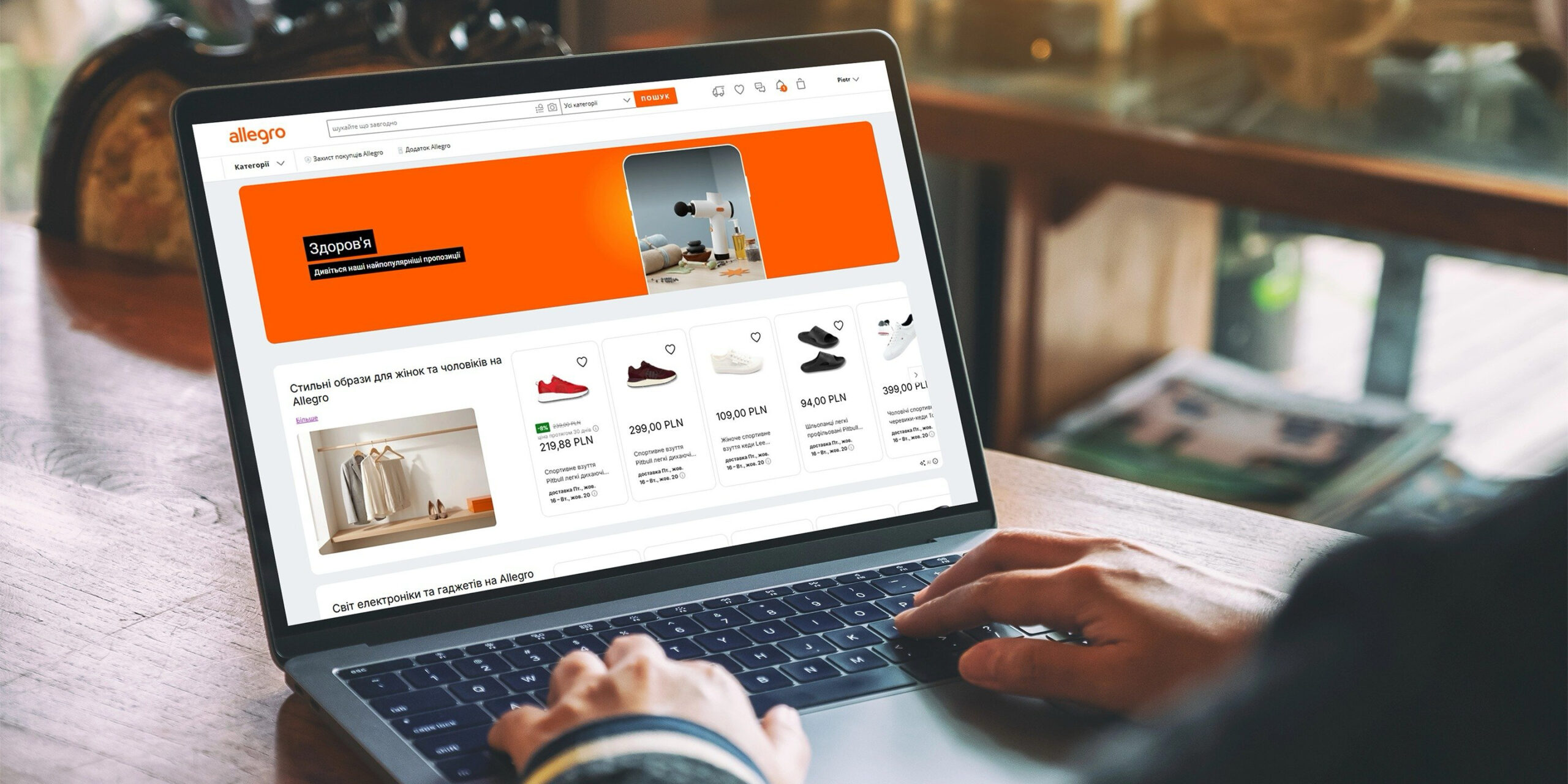
Allegro is launching a pilot programme for direct sales and shipping to Ukraine, making more than one million listings from Polish sellers available to Ukrainian consumers. The new service is intended to simplify exports beyond the European Union’s customs territory through automated documentation, settlements in Polish złoty and cooperation with logistics operator Nova Post. For Polish micro, small and medium sized enterprises (SMEs), this offers an opportunity to reach a market that, according to the company, has around 12 million active buyers, without having to organise all the procedures associated with shipping goods across the eastern border themselves.
The pilot involves a selected group of several hundred Polish sellers. Their products are available to Ukrainian customers through allegro.pl and the application’s Ukrainian language version. At the initial stage, the platform is focusing on testing sales processes, customs handling and deliveries before extending access to the service to more businesses.
The products made available include items particularly useful during winter, such as generators, power stations, tools, gas heaters and hygiene products. The range caters both to household needs and to demand for equipment and supplies required to maintain essential facilities and power supplies.
The scale of the offering matters to both sides of the transaction. Ukrainian consumers gain access to a wide selection of products from Polish companies, while sellers can reach new customers without having to build their own sales channel in a foreign market from scratch.
Allegro has announced that, once the pilot is complete, the solution will gradually be made available to all Polish sellers operating on the platform. The pace of expansion will depend on the test results and how efficiently orders can be handled.
Automation is intended to reduce export barriers
One of the most important elements of the new solution is the integration of Allegro’s systems with customs handling and logistics. Exporting to a country outside the EU customs territory involves formalities that some businesses lack the experience to manage independently. Additional obligations may require the preparation of documents, determining the correct classification of goods and coordinating delivery with a foreign operator.
Under the model proposed by Allegro, some of these tasks will be performed automatically. The platform generates export documentation, supports the verification of EORI numbers used to identify businesses in customs procedures, and helps sellers select HS codes, the international classification of goods used in foreign trade. Listings are also translated into Ukrainian.
The aim is to reduce the number of tasks that sellers would otherwise have to perform themselves. This does not mean that all legal obligations associated with exports disappear. Automation is primarily intended to simplify the handling of these requirements and integrate them into the sales process on the platform.
This could be particularly important for smaller businesses. A company without its own export department or extensive logistics resources may find it difficult to enter a market outside the European Union independently. If formalities are effectively integrated into order processing, starting to sell abroad could require less organisational effort.
Settlements in złoty and cooperation with Nova Post
Allegro says sellers will receive payments directly in Polish złoty. This is intended to limit their exposure to exchange rate risk, which can affect the final value of revenue in international trade. For a company selling in Poland, this means more predictable settlements, although it does not eliminate other costs and risks associated with exporting.
Allegro One Kurier will handle shipments on the Polish side, while Nova Post will act as the logistics partner in Ukraine. According to information provided by Allegro, the operator has a network of more than 17,700 branches and collection points, as well as nearly 40,000 parcel lockers.
The partnership is intended to connect sales on the platform with a delivery infrastructure operating in the destination market. This matters because simply making products available to foreign customers is not enough to ensure efficient trading. Predictable delivery times, the ability to collect parcels and effective handling of the entire logistics process are equally important.
In Ukraine, adapting the service to local conditions and consumer needs is also significant. Integration with an operator active in the Ukrainian market is intended to reduce the need for Polish sellers to organise the subsequent stages of delivery themselves.
Allegro aims to build on its experience in Central Europe
Expansion into Ukraine is another stage in Allegro’s international growth. The company says that nearly 6 million customers use its platform across the Czech Republic, Slovakia and Hungary, where its business is growing at around 100% year on year. Allegro hopes to apply some of the experience gained in Central Europe to the Ukrainian market as well.
Grzegorz Czapski, Chief Ventures Officer at Allegro, describes the project’s objectives as follows:
– Allegro is succeeding in foreign markets in the Czech Republic, Slovakia and Hungary, where nearly 6 million customers are already shopping with us and we are growing by around 100% year on year. We can point to a very strong offering in terms of the breadth of our product range and, above all, prices. We believe we can achieve similar success in Ukraine. We are starting with a pilot involving a small group of carefully selected sellers so that we can test the processes and assess the potential. We know that Allegro is recognised in Ukraine thanks to the Ukrainian diaspora in Poland, and that Polish platforms enjoy a high level of trust there. Until now, exporting beyond the European Union’s customs territory has been an insurmountable barrier for many Polish SMEs because of complicated procedures, exchange rate risk and logistics. We are removing these barriers. At the same time, we are working with Nova Post, a leading logistics company in the market, which provides a very high level of assurance when it comes to logistics security. We are giving Polish companies a tool that makes it easy to enter a market with 12 million active buyers – says Czapski.
The company’s statements indicate that the project is intended both to expand international sales and to test an export handling model that could eventually be made available to a larger number of businesses. The pilot should make it possible to verify how efficiently the processes operate before the service is gradually expanded.
A test for a new export model
The project’s success will depend on more than the number of listings available to Ukrainian consumers. Other important factors will include the number of completed orders, the efficiency of customs clearance, delivery punctuality and the level of interest among Polish sellers. Only the pilot results will show whether simplifying procedures translates into sustained sales growth.
For Allegro, Ukraine could become another market for international business expansion. For Polish companies, the project represents an attempt to reduce the organisational costs associated with exporting. If the announced automation works as intended, businesses will gain an additional channel for reaching customers without having to build the entire commercial and logistics infrastructure themselves.
For now, the initiative remains a pilot. Its significance will become clearer after the first stage has been evaluated and a decision has been made on whether to extend access to more sellers.




