
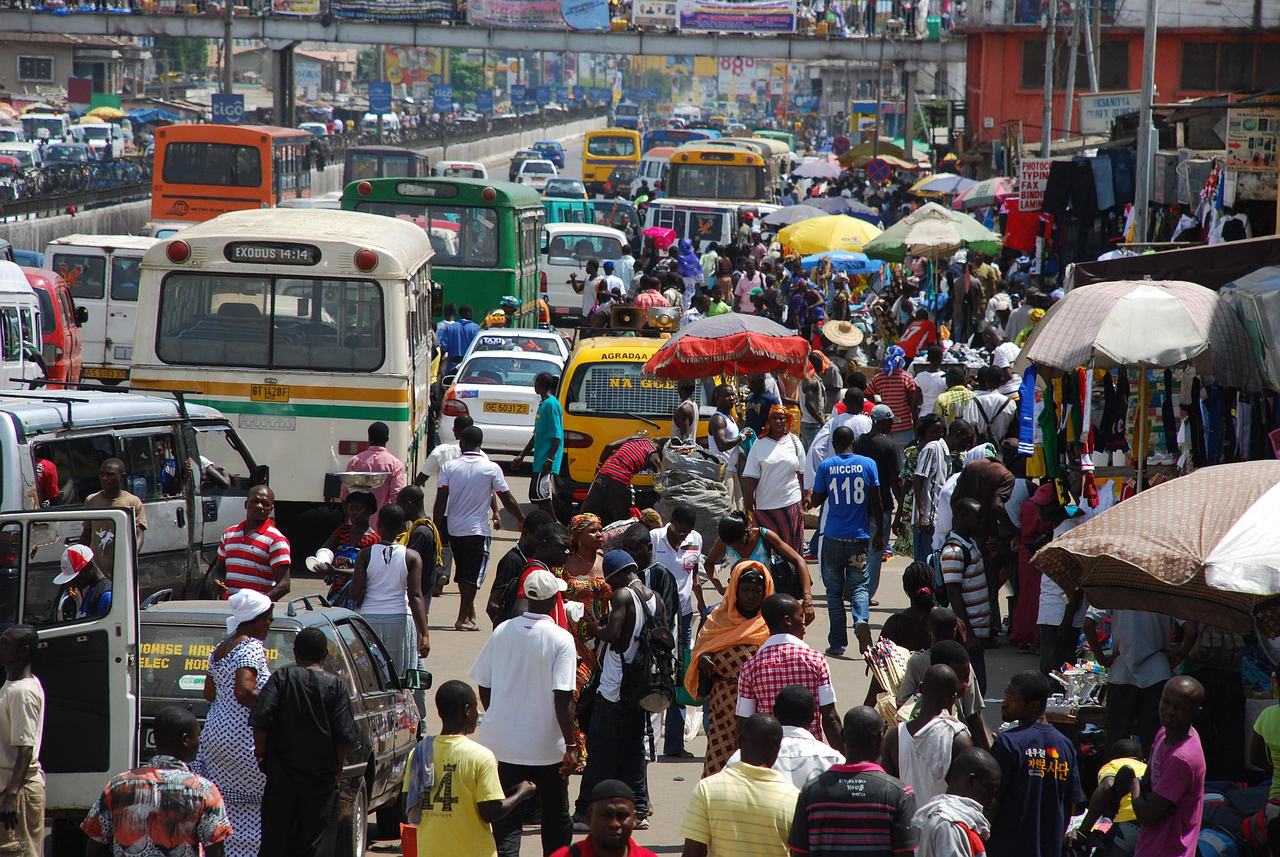
Africa is entering a period in which its importance to the global economy could grow much faster than its current share of global output would suggest. It is not just about oil, gas, copper, cobalt, or gold. An increasingly important role is being played by the continent’s young population, urbanization, a growing consumer market, energy development, infrastructure investment, and the relocation of some production closer to end markets. The International Monetary Fund estimates that the economy of Sub-Saharan Africa grew by 4.5 percent in 2025, the fastest pace in more than a decade, while several countries on the continent recorded growth of more than 6 percent.
Africa’s potential, however, is highly uneven. Nigeria has a huge market and abundant resources, Ethiopia is growing on the back of investment, energy, and industry, Morocco is building a position as Europe’s manufacturing base, while Tanzania and Kenya are benefiting from their location, infrastructure, and growing middle class.
Alongside them are countries such as the Democratic Republic of the Congo, whose importance could rise sharply as demand increases for metals needed to electrify the economy, as well as Côte d’Ivoire and Rwanda, which show that rapid growth can also be built without giant oil reserves.
Nigeria has everything it needs to become a major economy
Nigeria remains one of the most important countries in Africa when it comes to the continent’s future economic landscape. Its potential is determined above all by the size of its market.
A huge population means enormous demand for food, housing, transportation, energy, financial services, telecommunications, and consumer goods.
If rising incomes are accompanied by a growing share of this demand being met by domestic producers, Nigeria could move from an economy heavily dependent on commodity exports toward a much more diversified model.
The first signs of such a transformation are already visible. According to the IMF, Nigeria’s economic growth reached 4 percent in 2025, while the fund forecasts growth of 4.1 percent for 2026.
At the same time, growth in the non-oil sector is expected to reach around 4 percent, while growth outside both oil and agriculture is projected at 4.6 percent. Oil production is expected to rise from approximately 1.64 million barrels per day in 2025 to 1.71 million barrels in 2026.
Nigeria’s importance, however, extends beyond oil. The IMF points out that in recent years growth has been driven by agriculture, real estate, information and communications technology, as well as the oil and gas sector. Reforms introduced since 2023, including changes to the exchange-rate system, monetary policy, and the reduction of fuel subsidies, have improved some macroeconomic indicators, although the costs of these changes remain very high for households.
The biggest question surrounding Nigeria, therefore, is not whether the country has potential, but whether it will be able to use its domestic market to build an industrial base. This requires reliable energy supplies, efficient transportation, access to financing, and fewer barriers for businesses. If these conditions improve even partially, the scale of the market gives Nigeria the opportunity to create one of the largest manufacturing bases on the continent.
Ethiopia is growing faster than most of Africa
If the criterion is growth rate, Ethiopia is one of the most important cases on the continent. The IMF forecasts real GDP growth of 9.2 percent in fiscal year 2025/2026. Earlier IMF data indicated growth of 9.2 percent in fiscal year 2024/2025, driven in part by mining, construction, manufacturing, and agriculture.
Ethiopia also has a feature that many African commodity exporters lack. It has a huge domestic market, and its population is very young. The IMF notes that the median age of the country’s population is below 20. If the growing population shifts from agriculture into industry and services, the economy could benefit from rising non-agricultural employment for many years.
Energy is also crucial. The start-up of the Grand Ethiopian Renaissance Dam is increasing the availability of electricity, while output in mining and industry is also growing. The IMF specifically points to higher electricity generation, mining output, and investment as among the factors behind the economy’s current acceleration.
Public finances, the exchange rate, inflation, and political risk remain challenges, however. Ethiopia therefore illustrates two sides of Africa’s transformation. On the one hand, it has the potential for very rapid industrial growth and a huge labor pool. On the other, it needs capital, stable institutions, and infrastructure to ensure that demographic growth translates into higher productivity rather than simply an increase in population.
Morocco is already part of Europe’s industrial base
Morocco occupies a very different position from Nigeria or Ethiopia. It does not have their demographic scale, but it possesses something equally important for industry: proximity to Europe, developed transport infrastructure, and experience in attracting foreign investment.
The country has become an important production hub for automobiles, automotive components, aircraft parts, and chemical products. Exports of vehicles, phosphates, and phosphate-based products are among its most important sources of export revenue. The IMF forecasts economic growth of 4.4 percent for Morocco in 2026, following growth of around 4.9 percent in 2025.
Even more important than the growth rate itself is the structure of investment. Morocco is rapidly expanding its infrastructure, partly in connection with preparations for the 2030 FIFA World Cup. The World Bank assesses that public investment could become the basis for further productivity gains, provided that private capital plays a greater role and labor-market reforms are implemented. According to World Bank analyses, appropriate reforms could raise Morocco’s real GDP by almost 20 percent relative to the baseline scenario by 2035 and create 1.7 million additional jobs.
Morocco also has an energy advantage that could become increasingly important as European industry decarbonizes. The development of renewable energy, port infrastructure, and connections with Europe creates opportunities to attract companies for which access to low-emission energy is becoming increasingly important.
Tanzania can leverage resources, Tourism, and its location
Tanzania is among the countries capable of building growth on several different pillars. It has a large agricultural sector, natural resources, growing energy production, tourism, and access to the Indian Ocean. Tanzanian ports can serve not only the domestic economy but also landlocked countries in East Africa.
The IMF estimates that Tanzania grew by 5.9 percent in 2025, while medium-term growth could reach around 6.2 percent. The fund identifies mining, agriculture, and tourism as the main sectors supporting the country’s economic outlook.
Tanzania is also interesting because it is located in a region where transport infrastructure is becoming increasingly important. The expansion of ports, roads, and railways could change the country’s position in trade between the Indian Ocean coast and countries further inland. If Tanzania can combine its own resources with a role as a regional logistics hub, its economic importance could grow faster than its current GDP level would suggest.
Kenya wants to become East Africa’s services and financial hub
Kenya has a different advantage. Its future is not based primarily on huge commodity deposits, but on services, finance, technology, agriculture, and geography. Nairobi already serves as a regional business hub, while the development of digital services has made Kenya one of Africa’s most recognizable technology centers.
The country’s potential also comes from combining its domestic market with access to the wider East African region. Improvements in transport infrastructure can increase the importance of Kenyan ports and trade corridors, while the digitization of services allows companies to serve customers far beyond the country’s borders.
Kenya is not growing as quickly as Ethiopia, but its advantage lies in greater diversification. The country does not have to wait for one major commodity project to raise productivity. It can simultaneously develop financial services, technology, logistics, food processing, and manufacturing aimed at the regional market.
The Democratic Republic of the Congo has the resources the world needs
The Democratic Republic of the Congo is one of the clearest examples of enormous potential that can come with equally enormous challenges. The country possesses some of the world’s most important reserves of cobalt, copper, and other resources needed to produce batteries, power grids, electronics, and industrial infrastructure.
The importance of these resources will grow alongside the electrification of the economy. Electric vehicles, energy-storage systems, transmission networks, and data centers require huge quantities of metals. The DRC therefore has the potential to become one of the key suppliers of raw materials for the energy transition.
The problem is that simply possessing mineral deposits does not create an economic powerhouse. Roads, railways, electricity, ports, refineries, and processing plants are needed. If the DRC primarily exports unprocessed ore, most of the economic value will remain outside the country. If, however, it succeeds in developing domestic processing, the economic importance of the resource sector will be considerably greater.
Côte d’Ivoire shows that growth is possible without oil
Côte d’Ivoire is among the countries the IMF lists as having some of the fastest-growing economies in Africa. In 2025, Benin, Côte d’Ivoire, Ethiopia, Rwanda, and Uganda were among the countries whose growth exceeded 6 percent.
Côte d’Ivoire’s strength comes from the combination of agriculture, food processing, infrastructure, and a growing regional market. The country is one of the world’s largest cocoa producers, but processing raw materials domestically is becoming increasingly important. Moving from exporting raw commodities to exporting processed products is precisely what allows more value added to remain within the domestic economy.
Abidjan also serves as one of the most important economic centers in West Africa. The development of its port, road network, and energy infrastructure is increasing the country’s ability to serve neighboring states. In this model, the advantage is not one enormous sector, but the ability to serve a large region.
Algeria has energy, resources, and a huge domestic market
Algeria has a completely different advantage. It is one of Africa’s most important gas producers and one of the key energy suppliers to Europe. Its location means it can benefit from existing gas pipelines to Southern Europe as well as LNG infrastructure.
Gas gives Algeria the ability to finance investment, but the real challenge is using commodity revenues to create a more diversified economy. The country has a large population, a significant domestic market, and access to the Mediterranean. It can therefore develop chemical, petrochemical, fertilizer, metallurgical, and food-processing industries.
For Europe, Algeria’s importance in the coming years could extend beyond gas itself. Geographic proximity creates opportunities to develop trade in electricity, hydrogen, chemical products, and other industrial goods, provided that the necessary connections and investment projects are developed.
Egypt has the advantages of scale and location
Egypt is one of the continent’s most strategically important countries. It controls the Suez Canal and has a huge domestic market, major cities, industry, an energy sector, tourism, and access to both the Mediterranean and Red Seas. Thanks to the Suez Canal, the country is one of the most important nodes in global trade.
Its potential therefore does not derive solely from its current GDP level. Egypt can generate revenue from logistics, transportation, industrial production, and services connected to international trade. If industrial and logistics zones around the Suez Canal continue to develop, the country could attract companies seeking to manufacture closer to European, Middle Eastern, and African markets.
At the same time, Egypt remains highly vulnerable to problems related to debt, inflation, energy-import costs, and foreign-exchange constraints. Its potential is therefore enormous, but realizing it will depend on macroeconomic stability and the ability to attract private capital.
South Africa remains the continent’s industrial giant
South Africa is different from the rapidly growing economies of East Africa. It no longer has an advantage based simply on its growth rate, but it still possesses the continent’s most developed industrial base, an advanced financial sector, a large capital market, and automotive, mining, chemical, and energy industries.
If South Africa resolves problems related to electricity, rail transportation, and ports, it could once again strengthen its role as the industrial center of the southern part of the continent. The country has infrastructure that many of Africa’s rapidly growing economies are only beginning to develop. The problem, however, is low productivity growth and weak private investment dynamics.
South Africa therefore demonstrates that economic potential does not always mean the highest growth rate. A country can have developed industry, banks, a stock exchange, infrastructure, and technical expertise while still growing much more slowly than younger economies for years.
Africa’s greatest advantage will be demographics
In the long term, Africa’s greatest asset may prove to be neither oil nor metals, but the number of people living on the continent. Africa currently has a population of around 1.3 billion, and according to World Bank projections, this number could rise to approximately 2.5 billion by 2050. At the same time, Africa remains a very young continent, while urbanization will increase demand for housing, transportation, energy, food, digital services, and consumer goods.
This creates a market that cannot be assessed solely on the basis of current income levels. If productivity begins to rise, even relatively modest increases in per-capita income could translate into a huge increase in demand across the continent as a whole. For companies, this means an opportunity to build production not only for export to Europe or Asia, but also for sales within Africa.
The African Continental Free Trade Area will be crucial here. The easier it becomes for a company to manufacture in one country and sell its goods in others, the stronger the incentive to invest in factories on the continent. Individual countries would then cease to be merely small domestic markets for investors and instead become parts of a much larger regional market.
Africa will not become a single power. Several economic centers will emerge
Current data indicate that there is no single African development model. Ethiopia can build an advantage based on low-cost labor, energy, and industry. Nigeria has enormous potential arising from the scale of its market and its resources. Morocco can become increasingly integrated into European supply chains. Tanzania can develop mining, agriculture, tourism, and logistics. Kenya has a strong position in services and technology. The DRC possesses resources critical to industrial transformation, while South Africa still has the continent’s most developed industrial base across many sectors.
Not all of these countries have to succeed at the same time. The IMF points out that average per-capita income growth in Sub-Saharan Africa remains too low for the region to rapidly close the gap with wealthier economies. According to the fund’s analysis, properly implemented structural reforms, including improvements to the business environment, competition, and economic openness, could increase the region’s level of output by around 20 percent over a decade.
Africa’s future will therefore be determined neither by demographics alone nor by natural resources alone. The greatest opportunities lie with countries that can connect people with energy, capital, infrastructure, and industry. If Nigeria makes use of the scale of its market, Ethiopia maintains its high investment momentum, Morocco continues increasing its participation in European supply chains, and Tanzania, Kenya, and Côte d’Ivoire expand their roles as regional hubs, several new economic centers could emerge on the continent with significance extending far beyond Africa.
That is precisely why Africa is becoming an increasingly important destination for global capital. Not because the entire continent is growing rapidly, but because several countries are simultaneously beginning to exhibit factors that have rarely appeared together in the past: a large market, a young population, access to natural resources, growing energy demand, infrastructure investment, and the possibility of capturing part of the production currently embedded in global supply chains. If this is accompanied by higher productivity and stronger intra-African trade, some of today’s developing economies could move into a completely different league over the next several years.
Photo: pixabay




