
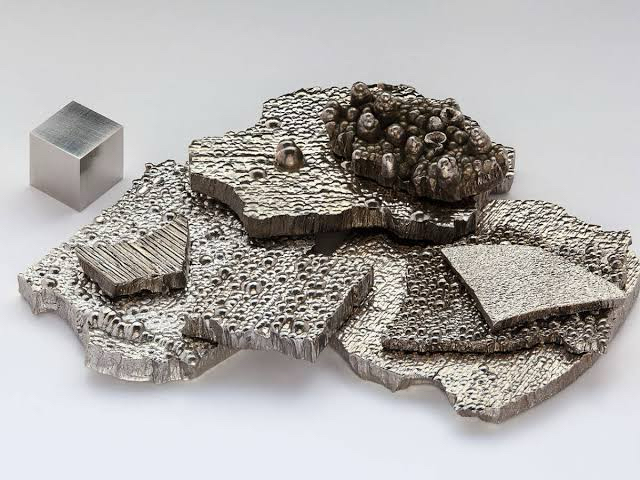
Cobalt can be removed from a nickel rich cathode, but the challenge so far has been maintaining high power, fast lithium transport and structural stability at the same time. The team described in Nature Synthesis has proposed a different approach: instead of selecting dopants through trial and error, it used two physical parameters to design a multicomponent cathode. The result is 130.9 mAh/g at a very high rate of 25 C and 112.2 mAh/g at 1 C at a temperature of minus 20°C.
Nickel rich layered materials are attractive because the high nickel content makes it possible to obtain high energy per unit mass of cathode. The problem begins when researchers try to reduce or completely eliminate cobalt at the same time. In conventional NMC materials, this element serves more than just a chemical function. It also helps stabilise the structure during cell operation. At high nickel content, however, problems arise with the kinetics of lithium ion transport, phase transformations and gradual structural degradation.
The authors of the latest study decided to approach this problem from the perspective of its mechanism. Instead of treating the selection of dopants as an experimental search for the best combination of elements, they defined the properties that an atom introduced into the structure should have. They then used these criteria to design a multicomponent cobalt free cathode.
The entire concept is based on separating two functions. The first concerns the movement of lithium ions. If electrostatic barriers make Li⁺ migration through the material structure more difficult, increasing the charging and discharging rate becomes harder. The authors therefore point to dopants with low charge density, which are intended to lower the barriers to lithium migration.
The second function concerns the stability of the material framework. Here, the important factor is dopants that form strong metal oxygen bonds. They are intended to strengthen the oxygen substructure and stabilise the system during successive charging and discharging cycles.
This distinction is important because improving one parameter can worsen another. A material can be structurally stable but transport lithium slowly. It can also have good ion transport while rapidly losing its structure during deep charging. In the new approach, both functions were designed simultaneously.
Instead of cobalt: designing according to properties
Cobalt free nickel rich cathodes are of particular interest to industry because of the possibility of reducing the use of a raw material that is a costly and problematic element of the battery supply chain. This does not mean, however, that simply removing cobalt solves the problem.
On the contrary, as the nickel content increases, the importance of material stability also increases. During operation, the cathode changes its chemical state and crystal structure, while deep charging can lead to transformations that accelerate degradation. For this reason, developing a cobalt free material requires finding another way to stabilise the structure.
This is where the most interesting element of the publication appears. The authors are not simply proposing another specific chemical composition. They are building a rule for selecting dopants based on their properties. If this design approach proves to be universal, it could also be applied when searching for other variants of cathode materials.
25 C shows whether the material can operate quickly
The most striking result concerns operation at a high charging and discharging rate. The developed cathode achieved 130.9 mAh/g at 25 C and a temperature of 25°C. Such a high C rate means that the material is being subjected to a very rapid load relative to its nominal capacity.
This figure should not, however, be directly translated into the charging time of an entire electric vehicle. A parameter obtained for the cathode material is not equivalent to the parameters of a complete cell or a finished battery pack. In a practical battery, the anode, electrolyte, current collectors, temperature and battery management system can also be limiting factors.
The result is nevertheless important from the perspective of the material itself. It shows that improving Li⁺ transport was not achieved at the cost of completely destroying structural stability at a high operating rate. It was precisely the combination of these two properties that was one of the main objectives of the study.
82.4% capacity retention after 350 cycles at 10 C
The second important parameter concerns durability. After 350 cycles performed at 10 C, the material retained 82.4% of its initial capacity.
This result needs to be interpreted in the context of the test conditions. A rate of 10 C means a very high operating rate, so this is not a direct prediction of the service life of a car battery used for several years. The test is primarily intended to determine whether the cathode structure can withstand intensive operation without rapidly breaking down.
In this case, the answer is positive. The authors associate the improved stability with limiting phase transformations occurring during cycling and reducing chemomechanical degradation. In other words, the material is intended to transport lithium faster while also undergoing less severe structural changes during operation.
Minus 20°C is just as important as high power
An even more interesting result from an application perspective may be the one obtained at low temperature. At minus 20°C, the cathode achieved 112.2 mAh/g at 1 C.
Low temperature is one of the practical problems in electric mobility. Falling temperatures worsen the kinetics of electrochemical reactions and ion transport, increase the internal resistance of the cell and limit the available power. Therefore, a material that retains useful capacity at temperatures below zero could be relevant not only in the laboratory, but also in applications requiring operation under changing climatic conditions.
Here again, however, caution is necessary. The result concerns the cathode, not a complete cell. The material itself may perform well at minus 20°C, while the entire system may require heating or have other limitations. The publication therefore demonstrates potential material resistance to low temperatures rather than a ready solution to the problem of winter operation of an electric vehicle.
The most interesting aspect of this study is not even a single capacity value. Much more important is the attempt to move away from the traditional model of cathode design, in which researchers test successive combinations of dopants and select the best one based on the results.
The authors use physical descriptors, meaning measurable or calculable properties that make it possible to predict the function of a given element within the structure. Low charge density is intended to favour lithium migration, while high bond energy with oxygen is intended to strengthen the structure. As a result, the selection of dopants becomes a design task.
If this principle also works for other materials, it could reduce the number of experiments required to find useful compositions. This could be an important change for the development of battery materials because the space of possible combinations of elements is enormous, while each synthesis and electrochemical testing experiment requires time.
Cobalt disappears from the cathode, but the problems do not disappear
The result does not yet mean that cobalt free nickel rich cathodes are ready to replace the materials currently used in automotive batteries. Before deployment, questions remain concerning synthesis scale up, parameter reproducibility, stability during long term cycling, safety and material performance in full cells.
It will be particularly important to test the parameters under a greater material loading. Results obtained at the level of a laboratory electrode can change when its thickness, packing density and surface area are increased. Industry also needs a synthesis process capable of producing large quantities of cathode material with an identical microstructure.
There is also the question of cost. Eliminating cobalt may reduce dependence on this raw material, but multicomponent doping by itself does not guarantee inexpensive production. If the new process requires expensive precursors, additional synthesis stages or very precise temperature control, part of the potential benefit may be lost.
This may be more important than another cathode with higher capacity
The most interesting element of this work is therefore the combination of three development directions: reducing cobalt, increasing the rate of lithium transport and stabilising the structure of a nickel rich cathode. The authors show that these objectives do not necessarily have to be treated as completely contradictory if the material is designed from the outset using specific physical parameters.




