
The construction of Poland’s first nuclear power plant is intended to be more than a series of contracts for domestic companies carrying out construction work. Polskie Elektrownie Jądrowe wants Polish companies eventually to become part of the supply chain for the nuclear part of the project, while the certificates and experience gained in the process could allow them to compete for contracts in other nuclear projects across Europe.
The fact that Polish companies can take part in construction does not automatically mean that they will be able to carry out the most demanding work connected with nuclear technology. This part of the project is subject to much stricter requirements concerning quality, documentation, procedures and control. That is why six Polish companies have been undergoing certification for two years in accordance with the American NQA 1 standard. PEJ expects all six to complete the process at the turn of 2026 and 2027, allowing them to bid for selected works in the nuclear part of the Choczewo plant.
At the current stage, Polish industry can relatively easily find a role in those elements of the project that do not require specialist expertise specific to nuclear power. The construction of auxiliary infrastructure, earthworks, structures, part of the installations and a broad range of construction supplies are areas in which Polish companies already have experience gained from large energy and infrastructure projects.
Grzegorz Maj, Director of Corporate Affairs and Administration at PEJ, points out that the conventional part does not require the creation of entirely new competencies, because the Polish construction and energy sectors have for years carried out projects on a large scale.
– The non nuclear part, the conventional part, is not something that Polish companies that have built conventional power plants would be unable to handle. This is the type of construction and supply work that is already very well known on the Polish market. And here the appetite of Polish companies is very large – Grzegorz Maj said during a debate on local content at the Economic Forum in Karpacz.
The first contracts show that this participation is not merely an assumption. Bechtel, the American company responsible for the general execution of the project, awarded Budimex a PLN 200 million contract for earthworks. This is one of the areas where a domestic company can use experience gained from other major investments. Unibep, meanwhile, won a tender to prepare accommodation facilities for around 1,000 people who will work on the construction of the plant.
The scale of the project means that there will be many more such orders. A nuclear power plant is not a single facility that can be built solely with the participation of the reactor technology supplier. An entire infrastructure surrounding the plant is required, including roads and construction facilities, auxiliary buildings, installations and networks, as well as services, logistics, accommodation and the support needed for a large workforce. This is where domestic companies can build the first part of their participation in the project.
The most difficult step is entering the nuclear part
A significantly higher entry threshold appears when a company wants to carry out work directly connected with the nuclear part of the plant. Experience from building a gas fired power plant, coal fired power plant or large industrial facility is not enough. In nuclear infrastructure, a contractor must demonstrate that its organization, production processes, quality control system and documentation procedures meet the requirements applicable to the nuclear industry.
One of the key requirements is the American NQA 1 standard. Its importance stems from the fact that the technology used at the first Polish nuclear power plant will be supplied by Westinghouse, while Bechtel is responsible for the execution of the project. For a Polish company, obtaining the relevant certification is therefore not a formality that can be completed before signing a contract. It is a process requiring the company to adapt its operations to the standards used in nuclear projects.
– For two years, six Polish companies have been certifying themselves to this standard and at the turn of this year and next year all six companies will complete the process. This will allow them to participate in certain elements of the construction of the nuclear power plant in the nuclear part – Grzegorz Maj said.
For these companies, the importance of certification goes beyond the first Polish reactor. A company that completes the process and gains experience at the Choczewo project will have a much stronger position when discussing future contracts. In practice, the goal is therefore to build capabilities that can later be sold beyond Poland. This is a fundamental difference between one time participation in a major investment and entering a specialist industrial sector.
73 Polish companies already have nuclear experience
Poland is not starting entirely from scratch. According to data presented by PEJ, 73 Polish companies have already participated in various nuclear projects carried out in Europe and other parts of the world. This does not mean that all of them have the capabilities required to enter directly into the most demanding part of the Choczewo project, but it shows that Polish industry already has initial experience in operating on the nuclear market.
Finland is one example. Around 3,000 Poles worked during the construction of a nuclear power plant there. Some of those who gained experience on that project are now working on preparations for the Polish investment in Choczewo. In the nuclear sector, such experience is particularly important because expertise is not limited to carrying out technical work. It is equally important to understand how the project is organized, how quality control systems operate, what documentation is required and how responsibilities are distributed among contractors.
– Around 3,000 Polish workers passed through the construction of the nuclear power plant in Finland. Some of them are now working in Choczewo. We may not have extensive experience because nuclear energy is actually experiencing a renaissance at the moment. However, we have the potential, and this certification process is evidence of that – Grzegorz Maj said.
It is precisely the combination of people, companies and procedures that could become one of the most important effects of the construction of the first plant. If Polish companies gain experience working on a project carried out according to Westinghouse and Bechtel standards, entering other investments will become easier. Companies will not have to prove every time that they are only beginning to build their capabilities in the nuclear sector.
A contract in Poland could open the foreign market
PEJ views local content more broadly than simply asking what share of the contract value will be spent in Poland. What may prove more important is whether Polish companies are accepted as suppliers by international technology partners and whether they can later participate in their subsequent projects.
– But this is not only about participating in the first unit or subsequent units in Poland. It is also about entering the Westinghouse Bechtel supply chain, which has ambitions to build nuclear power plants not only in Poland, but in other parts of Europe, whether in Bulgaria or the Netherlands. So there are opportunities to enter the supply chain – Grzegorz Maj added.
For Polish industry, this could be one of the most valuable effects of the entire investment. The Polish market will need contractors not only for the first unit. If further plants are built in the following years, demand for certified suppliers will increase even further. At the same time, Westinghouse and Bechtel operate outside Poland, meaning that a company that goes through the demanding qualification process and demonstrates its capabilities at the first Polish nuclear power plant could gain access to a much larger market.
Under this model, the value of the project does not end when construction of the first reactor is completed. For some companies, what happens to their capabilities after 2036 could be more important. Certification, employee experience, project references and familiarity with the requirements of an international contractor could allow them to compete in subsequent tenders outside Poland as well.
PEJ wants to measure more than the money staying in Poland
Grzegorz Maj stresses that PEJ defines domestic participation in the project more broadly. Under this approach, local content consists of three elements. The first is Polish companies and domestic industry, the second is Polish personnel and the involvement of Polish engineering expertise, and the third is Polish science.
This approach changes the way the economic effects of the nuclear power plant are viewed. It is possible to calculate the value of contracts going to Polish companies, but the total value of those orders does not show how much the project can permanently change the economy. A much more important question is whether companies capable of carrying out specialist nuclear work will emerge, whether Polish engineers will gain experience in nuclear projects and whether universities and research institutes will participate in developing the skills needed for future investments.
– What we want to demonstrate through the project is not only local content, but local value. Building local value is something more than simply measuring how much money remains in the Polish economy. Projects such as the construction of a nuclear power plant are also about the labour market, building housing around such an investment, developing local resources. It is definitely a much larger ecosystem – Grzegorz Maj said.
In the case of Choczewo, this effect will be particularly visible because the investment is being built in an area that has to be prepared for the presence of thousands of people involved in construction and the future operation of the plant. This is why the contract for accommodation facilities for around 1,000 workers is not simply another construction order. It shows that the nuclear power plant is creating demand for housing, services, transport, municipal infrastructure and facilities for employees.
Nuclear power could transform the regional economy
The construction of the nuclear power plant will continue for many years, meaning its impact on the surrounding area will not be limited to the period of construction work on the investment site itself. A large project creates demand for companies providing services to contractors, employees and suppliers. Accommodation, transport, technical support, catering, maintenance services and infrastructure capable of handling a larger population are all required.
This is why PEJ uses the term local value. Local value is intended to cover not only the flow of money from the investor to the contractor, but also a lasting increase in the economic potential of the area where the nuclear power plant is being built. If some of the people employed during construction remain in the region, if local companies expand their operations and if infrastructure created for the plant also serves residents, the economic impact will be greater than the value of the contracts themselves.
The same mechanism applies to domestic industry. The Polish nuclear power plant could be the first major project through which companies from Poland obtain certifications and references allowing them to compete for subsequent nuclear contracts. In that case, the money spent on certification and capability building would not be a cost associated with a single project. It would become an investment in the ability to participate in an entire market that is once again beginning to expand in Europe.
The first reactor is scheduled to start operating in 2036
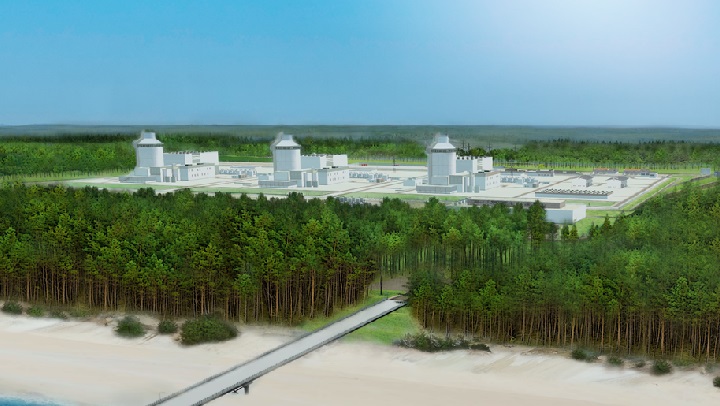
Poland’s first nuclear power plant is being built in the Choczewo municipality on the Baltic coast. The investor is Polskie Elektrownie Jądrowe, while the project is being carried out by the American companies Westinghouse and Bechtel. The schedule calls for the first reactor to begin operating in 2036, followed by two additional reactors in 2037 and 2038.
The long implementation period means that the current preparation of Polish companies has significance extending far beyond the next contracts. Companies undergoing certification today could enter some of the orders connected with the first unit in the coming years and then use the experience gained to participate in subsequent units and other nuclear projects. The same applies to personnel, as engineers, technicians and managers working on the Choczewo project will form the first generation in Poland to gain large scale experience in the construction of a nuclear power plant.
For that reason, the participation of Polish companies in nuclear power is not simply a question of whether a domestic contractor receives a specific contract from Bechtel. The much more important question is whether, over the next few years, a group of companies capable of meeting nuclear industry requirements will emerge, whether Polish personnel will acquire specialist capabilities and whether science will be incorporated into the development of the sector. If these three elements begin to work together, the first nuclear power plant could become not only a source of electricity after 2036, but also the starting point for a Polish nuclear industry capable of seeking contracts beyond Poland.




