
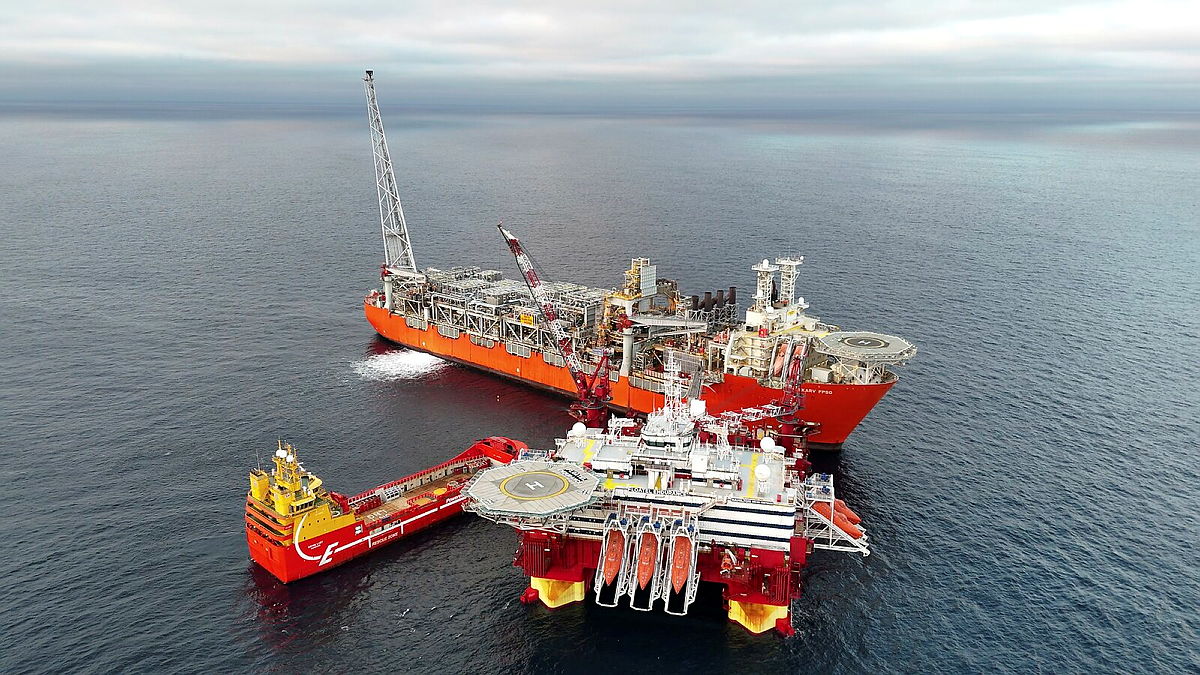
Orlen is gradually bringing production online from three Norwegian fields – Idun Nord, Alve Nord and Ørn – all tied back to the Skarv FPSO vessel. The decision to phase the start-ups sequentially rather than simultaneously was driven by technical and safety considerations. Thanks to an accelerated schedule cutting 12 months off the original timeline, total gas output from the Skarv area will reach around 3 million cubic metres per day in the first half of 2027, marking a 70 percent increase over pre-start-up levels.
Orlen opted against a simultaneous start-up of the three new fields on the Norwegian Continental Shelf. Idun Nord, Alve Nord and Ørn are being tied back to the existing Skarv FPSO, but activation is proceeding in stages – a deliberate operational decision.
Bringing a new well online requires time for a series of operational steps, including opening individual valves and verifying their correct functioning while maintaining the integrity of all safety barriers. Tying a new field into existing, producing infrastructure is a critical phase requiring full crew engagement and close monitoring of both the new operations and ongoing production.
– Starting a new well requires time to complete a series of operational steps, such as opening individual valves and verifying their correct operation, while maintaining the integrity of all safety barriers. Sequential start-ups allow us to focus resources on one asset at a time, ensuring a safe and efficient ramp-up while maintaining production from other assets – Orlen explains.
This approach allows resources to be concentrated on a single asset, ensuring a safe and efficient start-up process while maintaining output from other installations.
Twelve months ahead of schedule. Flotel and extra crew accelerated work
Production from the new fields is coming online a year earlier than originally planned. This is the result of two key factors: strong cooperation between the partners and the contractor collaboration model used by project operator Aker BP. The model is built on long-term relationships based on trust, transparency and shared incentives and risk.
A decisive factor in accelerating the work programme for Idun Nord, Alve Nord and Ørn was the decision to increase the number of personnel working on the Skarv FPSO project. This was achieved by using a floating accommodation unit (flotel) moored alongside the FPSO. At the same time, work was accelerated across engineering, production, drilling and subsea installation.
– This is down to very good cooperation between the various partners, which sped up decision-making. It is also the result of the contractor collaboration model used by project operator Aker BP, which is based on building long-term relationships founded on trust, transparency and shared incentives and risk – Orlen said.
4.5 kg CO₂ per barrel, but not a record. Some fields are even cleaner
The new fields are tied into the existing Skarv FPSO infrastructure, which helped lower the carbon footprint to 4.5 kg CO₂ per barrel of oil equivalent. However, this is not the lowest intensity in Orlen’s production portfolio. For example, the Eirin field has an emission intensity of around 3 kg CO₂ per barrel of oil equivalent, while the Goliat field – whose stake acquisition is still awaiting customary approval from the Norwegian authorities – stands at 2 kg CO₂ per barrel.
The scope for reducing emission intensity at a given asset depends on a range of circumstances. Where technically and financially feasible, production infrastructure is electrified by connecting it to the onshore power grid – over 90 percent of Norway’s electricity comes from renewable sources. Another approach is to use existing infrastructure to bring new fields online, which not only lowers capital expenditure but also reduces emissions associated with building new installations. Production is increasingly supported by digital solutions and remote operation, which cuts the number of personnel required on platforms, further lowering the carbon footprint by reducing emissions from crew transport and supply runs.
Skarv FPSO life extended to 2040. More fields under review
The start-up of Idun Nord, Alve Nord and Ørn will extend the operating life of the Skarv FPSO to at least 2040. But that is not the end of the story. Orlen stresses that activities aimed at extending the field’s life are ongoing. Several options for developing additional resources that could be tied back to the Skarv FPSO are currently being analysed.
Bringing the three new fields online extends the economic life of the Skarv area, creating opportunities to develop further discoveries that can use the existing processing infrastructure and share operating costs. In addition, the subsea infrastructure installed for Idun Nord, Alve Nord and Ørn expands the FPSO’s operational reach and could be used to tie in further fields while reducing capital expenditure.
3 million cubic metres of gas per day in H1 2027
The new fields add around 4 billion cubic metres of gas reserves to Orlen’s portfolio. Full production capacity will be reached in the first half of 2027, when total gas output from the Skarv area will hit approximately 3 million cubic metres per day – a 70 percent increase on pre-start-up levels.
Gas from Orlen’s Norwegian fields is transported to Poland via the Baltic Pipe pipeline. Last year, it met more than 40 percent of Poland’s gas demand. Once Idun Nord, Alve Nord and Ørn are fully operational, its contribution to meeting domestic demand will rise significantly.
– The new fields will supply ORLEN with around 4 billion cubic metres of additional gas reserves, which will be transported to Poland via the Baltic Pipe. The start-up of Idun Nord, Alve Nord and Ørn is another step in implementing ORLEN’s strategy to strengthen its own resource base and increase stable gas supplies for Poland and the region – the company said.
North and Sub-Saharan Africa under review. Orlen eyes opportunities
Orlen constantly analyses opportunities for upstream expansion across various markets, driven primarily by commercial criteria, operational safety and potential for creating shareholder value. North Africa remains a region of interest, and emerging opportunities are continuously monitored and assessed for alignment with Orlen’s strategy.
– In the current market environment, diversifying supply sources and strengthening energy security are particularly important. All potential investments are individually analysed for long-term profitability, risk levels and their ability to support ORLEN’s strategic goals – the company explains.
Sub-Saharan Africa is a region with significant development potential, especially in exploration-stage projects where several major hydrocarbon discoveries have been made in recent years. Orlen is also analysing opportunities in this region, assessing emerging investment prospects for resource potential, operating conditions and strategic fit.
– Any capital commitment decision is preceded by a detailed business and risk analysis. Our priority remains developing our asset portfolio in a way that ensures long-term value growth and strengthens Poland’s energy security – Orlen adds.
Photo: Aker BP




