
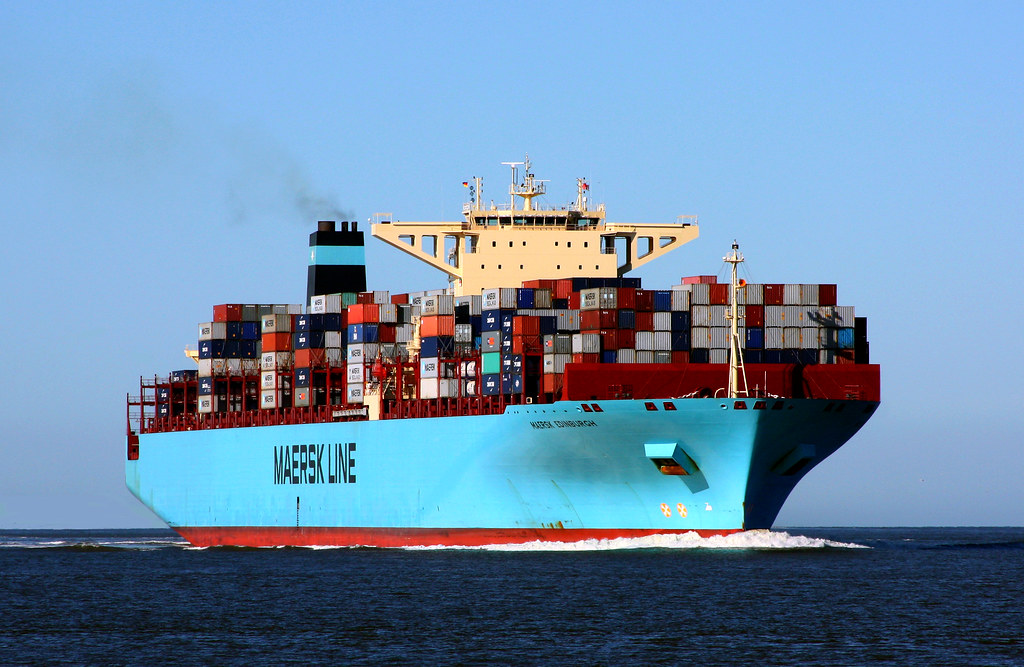
In 1904, in the small Danish town of Svendborg, Captain Peter Mærsk-Møller, together with his son Arnold Peter Møller, founded a shipping company called Dampskibsselskabet Svendborg. The company started with a modest three ships, and its founder, facing resistance from part of the management, soon decided to strike out on his own, establishing the Steamship Company of 1912 in 1912, which gave him operational independence and opened the way for rapid expansion. Today, over 120 years later, A.P. Moller-Maersk is synonymous with global logistics and is the largest integrated logistics operator in the world, operating in 130 countries. This is the story of how a shipping company from a small Danish town transformed into a logistics empire that controls approximately 13.8 percent of global container capacity and transports goods on an unprecedented scale.
A breakthrough moment for the young company came during the First World War. Although A.P. Møller felt uneasy about the excessive profits from speculation that the war brought, it was precisely this period that helped cement Maersk’s position as a leading Danish shipowner. In 1918, the Odense Steel Shipyard was established, which for nearly a hundred years built innovative ships, including the world’s largest container vessels. The 1920s and 1930s brought expansion into new markets – in 1928, the first shipping line connecting the USA with Japan and the Philippines was launched, and it was later extended to China, Thailand, Sri Lanka and India. The Second World War was a huge blow to Maersk – of the 46 ships, 25 were destroyed, and 150 sailors lost their lives. However, thanks to rapid rebuilding and the acquisition of larger vessels, within just three years the fleet had returned to its pre-war level. After the war, for the next three decades, Maersk remained a relatively small player on the global shipping scene, focusing on oil transport. Everything changed with the introduction of the standardised container.
The symbolic date for the birth of the modern Maersk is considered to be 5 September 1975, when the ship Adrian Maersk sailed from Port Elizabeth on the east coast of the USA, carrying 385 containers. This was the beginning of Maersk’s first fully containerised service, connecting the United States with the Asian market. This event initiated the company’s transformation from a traditional shipowner into a modern container operator. In 1975, Maersk Line operated a single route connecting three countries – by 2026, the company connects all parts of the world, and its fleet numbers approximately 707 vessels with a total capacity exceeding 4.7 million TEU, giving it a 13.8 percent share of the global container market. According to Alphaliner data from mid-2026, Maersk has a fleet of 707 vessels, of which 345 are owned ships with a capacity of 2.5 million TEU, and 362 are chartered vessels with a capacity of 1.7 million TEU.
The 1990s brought the first wave of acquisitions that forever changed the scale of Maersk’s operations. In 1999, the company acquired the American operator Sea-Land Service, which was one of the key steps towards strengthening its position in the transatlantic market. This acquisition was part of a broader consolidation strategy, which also included the acquisitions of Safmarine and CMB-T. However, the true breakthrough came with the acquisition in 2005 of the Dutch Royal P&O Nedlloyd for 2.3 billion euros (approximately 3 billion dollars). This was then the largest transaction in the history of the shipping industry, making Maersk the largest container operator in the world. This transaction not only doubled Maersk’s fleet but also significantly expanded its geographic reach and customer portfolio.
The container revolution. From a single route to a global network
Maersk consistently pursued a strategy of growth through acquisitions, which allowed it not only to increase its fleet but also to enter new markets and expand its range of services. In 2017, Maersk Line acquired the German carrier Hamburg Süd for 3.7 billion euros (approximately 4 billion dollars), which strengthened its position on north-south routes, especially in trade with South America. This acquisition was finalised on 30 November 2017 after obtaining all necessary regulatory approvals. In 2021, another major acquisition took place – for 3.6 billion dollars, LF Logistics, a subsidiary of Li & Fung, was acquired, significantly expanding capabilities in supply chain management, especially in the Asia-Pacific region. In August 2022, Maersk acquired the Danish freight forwarder Martin Bencher for 61 million dollars, strengthening its presence in the project and oversized cargo segment.
In April 2025, Maersk reached another important milestone by acquiring the Panama Canal Railway Company. This strategic move strengthened end-to-end logistics capabilities, connecting trade flows between the Atlantic and the Pacific. Thus, Maersk gained control over a key transit corridor, enabling it to offer more comprehensive logistics solutions. In total, the company has carried out 15 acquisitions in its history, of which 7 in the last five years. The acquisition activity covers 9 countries, with a particular focus on the United States, Denmark and the Netherlands. Each of these acquisitions was carefully chosen to complement gaps in the offering and strengthen Maersk’s position as a global logistics integrator, not just a maritime carrier.
Strategic acquisitions. How Maersk built its dominance through takeovers?
The year 2016 was a turning point in Maersk’s history. The company announced a strategic decision to spin off its oil and gas operations, which were sold to the French Total in 2017, and to focus on container logistics. This was not, however, merely a reorganisation – Maersk decided to transform itself from a shipping company into an integrated logistics company offering customers comprehensive end-to-end supply chain solutions. The new value proposition, delivered under the slogan ALL THE WAY, later changed to ALL THE WAY TO ZERO, involved handling the entire container-related supply chain – from maritime transport, through land and air transport, to warehousing, customs clearance and formalities.
This strategy required huge investments in land and air infrastructure as a complement to the existing maritime business. Maersk began expanding its warehouse network, strengthening its capabilities in air transport and inland logistics, and investing in digital platforms to increase supply chain visibility. The aim was to offer customers seamless, integrated solutions that went beyond traditional ocean shipping.
CEO Vincent Clerc emphasised that the company aims to provide customers with a single partner, a single view of their goods, eliminating the need to combine separate service providers. In 2026, Maersk continues its transformation, grouping its logistics services into three sub-segments: Landside, Forwarding and Solutions.
The company consistently pursues a strategy of revenue diversification beyond the ocean segment, investing in warehousing, e-commerce and supply chain management. The effects of this strategy are already visible. In 2025, the Logistics and Services segment, including warehousing, distribution, customs clearance and e-commerce logistics, generated 15.1 billion dollars in revenue, representing an increasingly large share of the company’s total revenue.
Business model transformation. From maritime carrier to global logistics integrator
An inseparable element of Maersk’s transformation is digitalisation. The company has been investing for years in technologies that are meant to make it a global logistics integrator. A key tool is the TradeLens platform, developed together with IBM, based on blockchain technology, which aims to digitalise global trade and increase supply chain transparency. TradeLens enables all supply chain participants, from forwarders, through carriers, to customs authorities, to exchange information in real time on a single, secure platform. In 2026, Maersk announced the first significant expansion of TradeLens into China as part of a partnership with China Unicom Digital Tech, opening up new opportunities for the world’s largest export market.
In 2025, Maersk launched Maersk Trade & Tariff Studio, an artificial intelligence-based platform that enables customs and tariff management in a changing trade environment, especially in the face of growing geopolitical instability and changing trade relations between the great powers. In July 2026, the company presented MAPS 3.0, an intelligent planning engine using mathematical models, digital modelling and artificial intelligence to generate logistics solutions. This tool allows for route optimisation, delay prediction and the proposal of alternative scenarios in real time, which is crucial in the face of growing unpredictability in global supply chains. Maersk is also implementing state-of-the-art IoT technologies to monitor its fleet of refrigerated containers, enabling customers to track shipments in real time, monitor temperature and humidity, and receive alerts about potential problems.
Since 2019, customers have had access to the Captain Peter product, which enables cargo monitoring from the moment the container is closed until delivery to the destination. This is a virtual assistant that provides personalised notifications and recommendations, helping customers better manage their supply chains. As CFO Patrick Jany emphasises, the real transformation comes from mastering processes, data and change management, as well as using powerful AI solutions to automate repetitive tasks. Technology at Maersk is not just about building tools but about building capabilities that can be scaled globally. The company is also investing in machine learning solutions for demand forecasting, price optimisation and risk management, enabling it to make more informed business decisions in the face of changing market conditions.
The digital revolution. Technology as the foundation of a new empire
According to Alphaliner data from mid-2026, Maersk ranks second in the world in terms of container fleet capacity, with a market share of 13.8 percent and a fleet exceeding 4.7 million TEU. By comparison, market leader MSC currently controls approximately 21.5 percent of the global market and has a lead of over 2.6 million TEU over Maersk. Maersk’s fleet consists of approximately 707 vessels, of which 345 are owned by the company (2.5 million TEU) and 362 are chartered vessels (1.7 million TEU). Maersk currently has 33 ships on order, including eight large units with a capacity of 18,600 TEU with dual-fuel engines, which are to be delivered in 2029-2030. Four of these ships are scheduled for delivery by the end of 2026.
As part of a broader fleet renewal plan, Maersk plans to order between 50 and 60 dual-fuel vessels with a total capacity of 800,000 TEU, of which approximately 300,000 TEU will be owned by the company, and the remaining 500,000 TEU will be obtained through long-term charters. This shows that Maersk, despite losing its leadership position in terms of capacity, remains the most integrated logistics operator in the world, offering services that go far beyond maritime transport. The company’s revenue in 2025 amounted to 54 billion dollars, a decrease of 2.7 percent compared to 2024, when revenue reached 55.5 billion dollars. Operating profit (EBIT) reached 3.5 billion dollars, compared to 6.5 billion dollars in 2024. The Logistics and Services segment, including warehousing, distribution, customs clearance and e-commerce logistics, generated 15.1 billion dollars in revenue in 2025.
The world’s second largest carrier in the shadow of MSC
Today, Maersk faces two main challenges: decarbonisation and further digitalisation. The company has committed to achieving carbon neutrality by 2040 and is investing in ships powered by alternative fuels such as methanol and LNG. In 2026, it ordered eight large, flexible vessels with dual-fuel engines, and as part of a broader fleet renewal plan, it plans to acquire a total of 50 to 60 units powered by alternative fuels with a total capacity of 800,000 TEU. At the same time, in the face of geopolitical uncertainty, the company forecasts that global container demand growth in 2026 will be only 2-4 percent, which is a significant slowdown compared to previous years. Despite these challenges, Maersk remains profitable and consistently pursues its strategy of transforming into an integrated logistics operator.
In response to changing market conditions, Maersk has also announced plans for corporate cost reductions, aiming to increase operational efficiency. The company continues to sell non-core assets and focus on its core logistics business, while investing in the development of new services such as e-commerce logistics and data-driven supply chain management. In 2026, Maersk also announced the expansion of its refrigerated fleet, responding to growing demand for the transport of food and pharmaceutical products, which require precise temperature control and real-time monitoring.
Photo: Flickr




