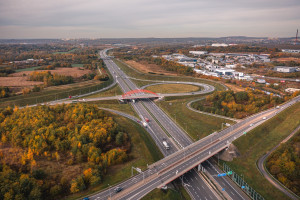
A consortium of Colas Polska and Antex II is close to signing a contract for the repair of a more than 3-kilometre section of the A1 motorway near Piekary Śląskie. This is the first of 13 independent tasks into which the work on removing the infamous 'Danube waves’ has been divided. The General Directorate for National Roads and Motorways (GDDKiA) announces that the renovation is to restore full load-bearing capacity and evenness of the road, and ensure its operational durability for at least the next 30 years.
The notorious section of the A1 between Pyrzowice and Piekary Śląskie, opened to traffic in 2012, has long been a nightmare for drivers. Deformations, colloquially called 'Danube waves’, appeared already during the warranty period due to swelling of one of the materials used in construction. Despite ongoing reports to the contractor, the condition of the road only deteriorated, forcing speed limits of 80 to 110 km/h. A permanent repair became inevitable.
A long-awaited breakthrough
– It is unbearable to look at – said Minister of Infrastructure Dariusz Klimczak about the 16-kilometer stretch during the European Economic Congress. The tender for the first repair stage was announced in October 2025. Eight contractors applied, all within the budget set by GDDKiA. The cheapest offer, worth PLN 36.37 million gross, came from the Colas Polska and Antex II consortium. If no appeals are filed by June 22, the contract is expected to be signed at the turn of the second and third quarters of 2026. The contractor will then have 11 months (excluding the winter period from December 16 to March 15) to complete the work.
The first repaired section will cover the carriageway towards Piekary Śląskie, starting in Siemonia (Będzin district) and ending near the Dobieszowice Zachód rest area. During construction, traffic must be maintained at all times.
Scope and technology of the renovation
The existing road structure, including the frost protection layer and the upper part of the embankment, will be dismantled. The new pavement will be built using bituminous technology with an anti-skid layer of uniform sand, a sealing geomembrane, and a geotextile-reinforced aggregate mat. This is intended to prevent rainwater and meltwater from penetrating the road body. The drainage system, rainwater sewers, curbs, and gullies will also be replaced or repaired. Acoustic screens and two engineering structures – a viaduct along the motorway and an overpass above the route – are also to be renovated. The repair is designed to ensure full load-bearing capacity and evenness, guaranteeing operational durability for at least 30 years.
The entire project to restore the technical efficiency of the damaged section has been divided into 13 independent tasks. Their order and timing depend on the degree of damage, technical and logistical possibilities, as well as the ability to introduce optimal traffic management changes and secure funding. Work on subsequent sections will be announced in separate tenders.
Źródło: WNP.PL, Fot. GDDKiA / Paweł Klarecki