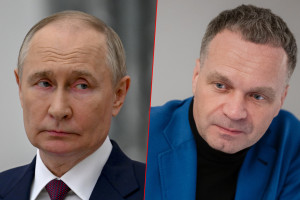
Russian economist Vyacheslav Shiraev, currently living in exile in Vilnius, delivers a devastating verdict on Vladimir Putin’s economic policies. In an interview with WNP, he argues the Russian economy is heading for a collapse driven by sanctions, massive money printing, and a catastrophic loss of European markets.
Shiraev estimates that the Russian money supply has grown by 100 percent since the start of the full-scale invasion, reaching a staggering 800 billion dollars in printed money. This, he says, is a direct result of Russia’s isolation from the global financial system. The economist dismisses official claims of import substitution success as a failure, blaming the country’s small domestic market and lack of competition.
– Monopolies are not economically effective – said Shiraev. – They just burn state money. Russia, historically speaking, was only a symbol of military strength. To change that, you must first abandon the illusion of military power and imperial dreams and start working on your own products and the quality of life of your own citizens.
A looming collapse hidden by propaganda
Despite official data showing relatively stable inflation, Shiraev points to a dangerous discrepancy between the central bank’s key rate and official inflation figures. The bank rate stands at 15 percent while official inflation is reported at 5 percent. This three-to-one ratio, he argues, proves that real inflation is much higher than admitted.
– Basic goods like pasta have risen by at least 100 percent since before the war, while cars have gone up by around 200 percent – said Shiraev. – People have become poorer. At first, they did not feel it because of increased transfers funded by money printing, but last year prices rose while wages and pensions stagnated.
The economist notes that sanctions have not yet triggered a full economic crash because Russia has been living off its reserves, including the National Welfare Fund built from oil and gas revenues. A further 200 billion dollars in unexpected oil price gains in 2022-2023 provided a temporary buffer. But this is now being rapidly depleted.
The war’s final act and the end of the russian export model
Shiraev predicts that 2026 could be the last year of the war. He believes that prolonging the conflict into 2027 would lead to a total catastrophe for the Russian economy across all sectors. A critical factor is the loss of the European energy market, which he calls the main pillar of the Soviet and Russian economic model.
– Putin basically killed the Russian economy – said Shiraev. – He gambled on blackmailing Europe into buying gas on his terms, but he did not foresee the political determination of Europeans. Russia has five main export goods: gas, oil, metals, timber, and coal. The last three are already practically bankrupt because China, the main remaining customer, is not interested in them.
He adds that European sanctions are now complemented by the full embargo on Russian energy imports set to take effect in 2027. Moscow’s attempts to pivot trade to Asia have largely failed, with gas exports to China reaching no more than 30 billion cubic meters per year compared to the 200 billion that used to go to Europe.
– Even if the war ends tomorrow, Russia will still face a deep economic crisis – said Shiraev. – It can only prosper through cooperation with Europe, and that will take years to rebuild, if ever, and only after the West no longer sees Russia as a threat.
Źródło: WNP.PL, Fot. Shutterstock/photoibo / arch. Wiaczesława Szirajewa