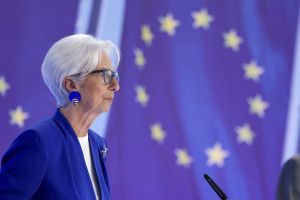
The European Central Bank raised its key interest rate by 25 basis points to 2.25 percent on Thursday, a move unanimously approved by the Governing Council. Christine Lagarde, the ECB president, said no alternative was considered and that inflation is expected to return to the 2 percent target only by mid-2027.
The decision, which takes effect on Friday, lifts the deposit rate to 2.25 percent, the main refinancing rate to 2.40 percent and the marginal lending rate to 2.65 percent. Lagarde explained that the inflation outlook has been revised due to an expected easing of tensions in the Middle East, which should lower energy prices and slow the rise in food costs.
According to new Eurosystem projections, average headline inflation will be 3.0 percent in 2026, 2.3 percent in 2027 and 2.0 percent in 2028. Core inflation excluding energy and food is seen at 2.5 percent in both 2026 and 2027, falling to 2.2 percent in 2028.
Economic growth forecasts cut
The ECB also revised down its GDP growth forecasts for the eurozone, now expecting 0.8 percent in 2026, 1.2 percent in 2027 and 1.5 percent in 2028. These projections are based on a baseline scenario that assumes a rapid resolution of the conflict in the Middle East.
Lagarde stated: – Inflation should return to its 2 percent target in mid-2027, thanks to lower energy prices and a slowdown in other price increases. – She added that the Governing Council was unanimous in its decision and considered no other options.
Market reaction
Financial markets reacted immediately after the announcement. Gold prices dropped to $4,094.60 per ounce, while Brent crude oil for July delivery fell to $92.41 per barrel. The euro remained relatively stable against the dollar.
The ECB’s move signals that borrowing costs will remain elevated for longer than previously anticipated, as the central bank prioritizes bringing inflation back to target despite weaker growth prospects. Lagarde emphasized that the timing of any future rate cuts would depend entirely on incoming data.
Źródło: WNP.PL, Fot. PAP/EPA