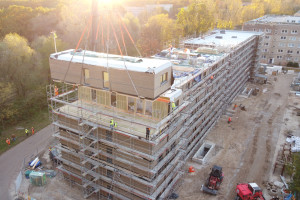
A contract for a modular housing estate for workers building a nuclear power plant has been signed by Unihouse, a subsidiary of Unibep, with Bechtel. The deal, worth nearly PLN 260 million net, is a major breakthrough for Polish modular construction, which has long struggled for recognition at home.
The housing estate will be built using low-emission timber modules and will accommodate around 1,000 workers at the site of Poland’s first nuclear power plant. According to Marcin Gołębiewski, president of Unihouse, the project’s key impact will not be on employment numbers but on process automation. – The most important thing is process automation – that is how we will increase efficiency – he stressed.
Andrzej Sterczyński, president of Unibep, noted that the contract provides welcome stability. – The contract with Bechtel allows us on one hand to work steadily on a large project, and on the other hand we are not under pressure to take part in a price war and compete for smaller contracts at any cost – he said.
Twenty years of experience finally rewarded
Unihouse has been building modular structures for over two decades, mainly for foreign markets such as Germany and Scandinavia. The company’s portfolio includes a project for Germany’s federal real estate authority BImA worth about EUR 35.7 million and a housing development in Będzin, southern Poland. Bechtel chose Unihouse after a multi-month due diligence process focused on quality and compliance. – In our international certification, our 20 years of experience and the audit of our company, they found that quality and responsibility, and I believe that is why they made this decision – said Marcin Gołębiewski.
The project will not disrupt the factory’s current operations. Detailed design and permitting will last until mid-2027, with module production starting in mid-2027. This allows Unihouse to prepare for a smooth production ramp-up and to further automate its processes. The company plans to increase capacity, but as Gołębiewski points out, automation is more critical than adding workers.
Local content and the chance to change perception of prefabrication
Bechtel has highlighted the contract as an example of local content – involving Polish companies and supply chains in the nuclear project. – We are very pleased that this aspect has been noticed and that our capital group Unibep, which owns Unihouse, is Polish, with Polish capital – said Andrzej Sterczyński. The project will also engage subcontractors and suppliers from Pomerania, where the power plant is being built.
Marcin Gołębiewski sees a broader opportunity. – This project is a huge chance to demystify prefabrication in Poland. Poles have not been convinced of this technology so far. When we talk about prefabrication in Poland, almost everyone thinks of the old large-panel concrete systems. Their quality failed. Now a major American contractor has chosen a technology that is used all over the world but could not break through on the Polish market – he explained. The housing estate, covering tens of thousands of square metres, could convince other investors of the benefits of modular construction – speed, cost efficiency, and even the possibility of relocation after the building’s initial use.
Źródło: WNP.PL, Fot. Unibep